To learn how to become an AI Product Manager, work in seven steps: map the role and 20 real job descriptions, learn product management fundamentals, build practical AI literacy, learn to measure products with data, build five portfolio projects, package them into a portfolio and resume, then run a targeted job search. For someone putting in 15 to 20 focused hours a week, the plan takes about 12 months. You do not need a computer science degree or a coding background. You need evidence of product judgment that a hiring manager can inspect.
Key takeaways
- Understand the job before you buy courses. An AI PM decides which problems deserve AI, how the product should behave, and what happens when the model is wrong.
- Every week of learning should produce something visible: a teardown, a PRD, a metric tree, an eval table, a prototype, or an application.
- Most first offers come through bridge roles such as APM, product analyst, product operations, or AI internships. Treat them as entry points, not as a detour.
- Five finished projects with honest case studies beat a wall of certificates in every interview loop.
Five stages of your career.
Number of chapters in each stage · First edition
What does an AI Product Manager actually do?
An AI Product Manager decides which AI products or features should be built, why they matter, who they serve, how they should behave, how success is measured, and what happens when the AI gives a weak or wrong answer. That is the working definition the book uses, and it is the one hiring managers test against.
The job is product management applied to systems that learn from data. Regular software is deterministic: select "Mumbai" in a filter and you get jobs in Mumbai, every time. AI systems are probabilistic: a job recommender weighs a candidate's skills and projects against location and goals, then estimates which roles fit. It will be right often and wrong sometimes. The AI PM owns that "sometimes."
So the daily questions change. Not only "can we build it?" but: how often is the result useful, what does a bad result look like, who gets hurt by it, what should the product do when the model is unsure, and how will the team find repeated failures after launch? If you want the side-by-side version of this, read AI Product Manager vs Product Manager.
What the job is not
It is not machine learning engineering. You will not train models. It is not prompt writing as a job title, and it is not project coordination with an AI label on it. Engineers, data scientists, and researchers do most of the technical build. You bring the user problem, the decision, the quality bar, and the business case, then you connect them.
Weak candidates ask "where can we add AI?" Strong candidates ask "what problem is the user facing, and can AI solve it better than a simpler fix?" If a user cannot find a button, the answer is design, not a model. Interviewers listen for this instinct in the first five minutes.
Can you become an AI Product Manager with no experience or degree?
Yes. Degrees and prior PM titles are screening signals. They open some doors early, especially at large or regulated employers, but they are not proof that you can do the work. Without them you replace the signal with evidence: product documents, working prototypes, evaluation results, and case studies that show your decisions.
That is the honest answer to how to become an AI Product Manager from outside tech, and the book spends three full chapters on it. The short version: psychology backgrounds translate into user research, finance into risk and fintech products, healthcare into domain judgment that generalists lack, operations into workflow design, and teaching into learning products. Do not hide your background. Translate it. The full route is in how to become an AI Product Manager without a degree.
What you cannot skip is the proof. "Passionate about AI" on a resume gets filtered out. "Designed a permission-aware knowledge assistant, defined the retrieval flow, scoped the first version, and ran a groundedness evaluation on 40 test questions" gets read.
The AI Product Manager roadmap at a glance
Here is the full sequence. Each step produces a specific piece of proof, and each step feeds the next one. Skip ahead and you end up with demos you cannot explain.
| Step | What you do | Proof you walk away with | When |
|---|---|---|---|
| 1. Map the role | Read 20 job descriptions, pick a direction | Your own role definition and a market map | Month 1 |
| 2. Product fundamentals | Teardowns, user interviews, PRDs | One teardown, two one-page PRDs | Month 2 |
| 3. AI literacy | ML basics, LLMs, RAG, agents, evals | "Does this need AI?" memo on 10 problems | Months 3 and 5 |
| 4. Data and metrics | SQL, funnels, cohorts, AI quality metrics | A metric tree for one AI product | Months 4 and 6 |
| 5. Build proof | Five scoped AI projects with evaluations | Five prototypes, three polished case studies | Months 7 to 9 |
| 6. Package it | Portfolio site, resume, LinkedIn | A portfolio a reviewer understands in 90 seconds | Months 8 and 9 |
| 7. Get hired | Targeted applications, referrals, mock interviews | A tracked pipeline and offers to compare | Months 10 to 12 |
If you prefer a calendar view, the 12-month AI Product Manager roadmap breaks the same plan into monthly deliverables. The rest of this guide explains what each step really involves and how to know you are done.
Step 1: Map the role and the market before you study anything
Your first month is orientation. No random building, no mass applications. Open 20 current job postings across company career pages, LinkedIn, startup boards, and remote boards. Search adjacent titles too: Product Manager (AI), Associate Product Manager, Product Analyst, Product Operations, AI Solutions, and Technical Product Manager.
Put them in a spreadsheet with five columns: responsibilities, required experience, domain, tools named, and the evidence the employer asks for. After 20 rows the patterns jump out. You will see which skills repeat, which levels are realistic, and which domains are hiring near you. This spreadsheet decides what you build later.
Pick a direction: which type of AI PM are you aiming at?
| Direction | What the work looks like | Good first target if you are |
|---|---|---|
| AI-enabled PM | Adds AI capabilities to a broader product, such as smart search inside a banking app | Coming from business, operations, or a non-technical field |
| Applied AI PM | Builds copilots, recommendations, automation, or generative workflows as the core experience | Comfortable with prototypes and evaluating model output |
| Core or platform AI PM | Works close to models, APIs, infrastructure, data platforms, and developer tools | An engineer, data scientist, or technical PM already |
Most beginners enter through the first two. Your existing domain can change that. A nurse targeting healthcare AI or an analyst targeting fintech has a sharper story than a generalist. The book describes five types in detail, and our guide to the types of AI Product Managers helps you choose.
You can write a one-paragraph definition of the role in your own words, you have a 20-row market map, and you have picked one direction plus one or two domains to explore.
Step 2: Learn product management fundamentals first
AI does not replace the operating system of product work. It sits on top of it. Before you touch models, learn to identify users, understand the job they are trying to finish, compare alternatives, prioritise, write requirements, and measure outcomes. Interviewers can smell a candidate who learned LLM vocabulary before learning what a product decision is.
Three exercises that teach more than a course
- Tear down one product you use weekly. Name its main user, the job it finishes, the core loop, the business model, the likely metrics, the biggest friction point, and one improvement you would ship.
- Run two or three short user interviews. Ask what they do today, how they work around the problem, and what it costs them. Never ask "would you use a feature that...?" People are terrible at predicting their own behaviour.
- Write two one-page PRDs. Problem, target user, evidence, proposed experience, minimum scope, non-goals, success measures, risks, open questions. Later you add AI requirements: data, evaluation, latency, cost, privacy.
A job platform has thousands of listings, yet many graduates leave without applying. The surface problem looks like "not enough jobs." Interviews suggest the real one: users cannot tell which roles fit them. A good PM tests cheap fixes first, such as clearer descriptions and a comparison view. Only if those fail does an AI recommender that explains why a role fits earn its cost. That reasoning chain is what a hiring manager wants to see on paper.
For reading, Marty Cagan's Inspired gives you the four-risk lens (value, usability, feasibility, viability) that most product teams still use. The nine books to read after it, in order, are in our guide to the best books for AI product managers. The complete skill list, all 22 of them, is in the AI Product Manager skills guide.
Step 3: Build practical AI literacy without becoming an engineer
You need enough understanding to sit with engineers, ask the right question, and spot when a simpler solution wins. That means concepts, not code. Start with AI for Everyone from DeepLearning.AI for vocabulary and project workflow, then the introductory modules of Google's Machine Learning Crash Course for classification and embeddings, plus overfitting and fairness.
The concepts you must be able to explain in plain English
- Training versus inference: learning patterns from data versus using them to produce an output for a new request.
- Classification, prediction, generation: the three broad things models do for products.
- Large language models: tokens, context windows, temperature, and why the same prompt can give different answers.
- Prompt and context engineering: what the model is told, what information it receives, and in what form.
- Retrieval-augmented generation: grounding answers in your own documents. Read RAG for Product Managers.
- Agents: systems that plan and take actions with tools, which need permissions, step limits, and human approval. See AI agents for Product Managers.
- Evaluations: how you define and measure "good." This is the most tested AI PM skill right now. Start with AI evals for Product Managers.
- Fine-tuning: changing model behaviour with extra training, which is expensive and often unnecessary.
The "does this need AI?" test
Here is the exercise that separates AI PMs from AI enthusiasts. Write down ten product problems and decide, for each one, whether it needs AI. Use rules or filters when the logic is stable and must be transparent. Use AI when the product has to understand messy language, predict, generate, classify, recommend, or summarise in ways rules handle poorly. Write your reasoning in two sentences per problem. That memo is interview gold.
If you keep hitting unfamiliar terms, the AI PM glossary defines 25 of them in one page.
Step 4: Learn to measure products with data
Product decisions need evidence, and AI products need more of it because usage alone can hide a failing feature. Learn enough SQL to answer your own product questions. Filtering and grouping come first. Joins come next. Then learn the product metrics you will use every week: activation, engagement, retention, conversion, churn, funnels, cohorts, and a North Star metric.
Add the AI-specific layer
| Product | Metrics a strong AI PM tracks |
|---|---|
| Writing assistant | Suggestions accepted, suggestions edited, time saved, repeat use, harmful output reports |
| Support copilot | Handle time, agent approval rate, policy errors, escalation rate, satisfaction, latency, cost per ticket |
| Knowledge assistant | Groundedness, retrieval relevance, citation support, unanswered questions, trust, repeat use |
Then build a metric tree for one AI product with five branches. Business outcome and user value on one side. Output quality, safety risk, and cost per task on the other. Finish it with one uncomfortable sentence: which metric could go up while the product gets worse? For a support copilot, "tickets closed per hour" rises nicely if the model starts closing tickets with confident wrong answers. Knowing that is why companies pay AI PMs more than they pay dashboard readers.
Step 5: Build five portfolio projects and finish each loop
This is where most career switchers stall, and where you pull ahead. A project is not a demo. It is a small product with a defined user, a scoped first version, an evaluation, and an honest write-up of what worked and what broke. The book gives you five briefs, each chosen to prove a different kind of judgment.
| Project | What it proves to a hiring manager |
|---|---|
| AI interview coach | You can define "good feedback" and evaluate it against a rubric |
| Voice-of-customer copilot | You can turn messy feedback into traceable, prioritised themes |
| A real product feature rebuilt with AI | You can improve an existing workflow, not invent a disconnected toy |
| Meeting-to-execution copilot | You understand review steps and ownership, and when a human must confirm |
| RAG knowledge-base assistant | You can handle sources, permissions, citations, and "I don't know" |
Before building anything, write the brief: user, job, current workflow, evidence, the AI's role, minimum scope, non-goals, metrics, failure modes, and safeguards. Keep an evidence log of screenshots, prompts, failed examples, and revisions. Include hard test cases on purpose, like unanswerable questions and ambiguous inputs. Each brief is written out in the five AI PM portfolio projects.
Say what kind of test you ran and how big it was. "Tested on 30 synthetic support tickets, 24 routed correctly, the 6 misses were all refund edge cases" is more credible than "improved routing accuracy by 80%." Precision reads as competence.
Step 6: Package the proof into a portfolio, a resume, and a LinkedIn profile
Proof nobody can find does not get you interviews. Build a simple portfolio site on a platform you can update in minutes. The home page says who you are, which roles and domains you target, and where your strongest case study lives. Each case study opens with the user, the problem, your role, and the decision, then shows evidence, the evaluation table, trade-offs, and what you would test next. The structure is laid out in how to build an AI PM portfolio.
Your resume should read like a list of product decisions, not a list of tools. Use job-description language only where it truthfully matches your work. Applicant tracking systems parse keywords, and humans punish keywords you cannot defend. The format rules are in the AI PM resume guide, and the terms to include are in AI PM resume keywords for 2026.
Then fix LinkedIn: a headline that names the role you want, a short transition story, and your best case study pinned in Featured. Recruiters search LinkedIn before they read resumes. Our LinkedIn guide for AI Product Managers covers the profile and a weekly posting rhythm.
Step 7: Run a measured job search, not a spray of applications
Treat the search as a campaign with data. The book's three-bucket strategy splits targets into dream companies, strong-fit companies, and a broad pipeline of relevant roles. Give the strongest matches deeper research and tailoring. Track every application with company, role, source, resume version, referral, interview stage, and final outcome. The full method is in the three-bucket job search, and the sites worth using are listed in the AI PM job boards guide.
Realistic entry points from zero
- AI product internships, covered country by country in AI PM internships
- Associate Product Manager and junior PM roles
- Product analyst and product operations roles
- Implementation, solutions, or customer success roles at AI companies
- Founder's office roles at early-stage AI startups
- An internal move inside your current company toward its AI initiatives
A bridge role is not a failure to get the title. It gives you users, data, technical teams, and real constraints, which become the stories that win the next move.
Diagnose the stage that is breaking
| Symptom | Likely cause | What to fix |
|---|---|---|
| No replies to applications | Targeting or visibility | Role seniority, resume clarity, portfolio link placement, referrals |
| First calls, no second round | Communication or fundamentals | Answer structure, metrics reasoning, how you tell project stories |
| Final rounds, no offers | Depth of judgment | Trade-off reasoning, business impact, executive presence |
Start mock interviews early, around month six, not the week before your first loop. Rehearse every project in 3, 5, and 10 minute versions. The question bank and answer structures are in AI Product Manager interview questions. When the offer lands, read how to negotiate your first AI PM offer before you reply.
How long does it take to become an AI Product Manager?
About 12 months for a consistent learner working 15 to 20 focused hours a week. That is a planning model, not a deadline. Your background, local market, and time available change the pace. People already in product roles often move in three to six months because steps 1, 2, and 4 are done. Complete beginners with eight to ten hours a week should plan for around 18 months.
| Starting point | Hours per week | Realistic range |
|---|---|---|
| Current PM moving into AI | 8 to 10 | 3 to 6 months |
| Engineer, analyst, or designer | 10 to 15 | 6 to 9 months |
| Non-tech professional | 15 to 20 | About 12 months |
| Student or fresher | 8 to 10 | 12 to 18 months, often through an internship |
More hours do not help if they produce burnout or shallow work. Protect regular sessions and make sure every week ends with something someone else could look at.
Seven mistakes to avoid when you learn how to become an AI Product Manager
- Collecting certificates as proof. Courses give you structure and vocabulary. They do not prove judgment. Use one as a syllabus, then build. Our guide to AI PM courses shows how to pick.
- Starting with tools instead of problems. Tool names change every quarter. The decision about whether AI belongs in a workflow does not.
- Building demos that only show the happy path. Hiring managers look for the failure cases you tested.
- Applying before the proof exists. Early mass applications burn referrals and teach you nothing.
- Targeting only senior AI PM titles. Bridge roles are where most people actually get in.
- Restarting the plan after rejections. Diagnose the weakest stage and repair it. Do not go back to month one.
- Inflating results. One precise small win is more believable than a big invented number, and interviewers will probe it.
What you get paid once you make it
The money is real, and it grows with responsibility. Public 2026 data puts average US AI PM pay near $197,500, with a typical range of $164,000 to $243,000 and senior total compensation of $250,000 to $550,000. In India the average is about ₹28 lakh, with leadership packages crossing ₹1 crore. Entry roles pay less than those averages, which is exactly why the ladder matters. The full breakdown by level and country is in AI Product Manager salary in 2026, with dedicated pages for the USA and India.
Your first 30 days: start today
Reading about how to become an AI Product Manager is easy. Here is exactly what to do in the next month so this guide turns into progress.
- Days 1 to 3: Collect 20 job descriptions and build the market map spreadsheet.
- Days 4 to 7: Write your one-paragraph role definition and pick a direction and a domain.
- Days 8 to 14: Tear down one AI product you use and publish it as a short LinkedIn post.
- Days 15 to 21: Interview two or three people about a recurring task in your chosen domain.
- Days 22 to 28: Write your first one-page PRD from those interviews.
- Days 29 and 30: Write the "does this need AI?" memo for ten problems and set your weekly schedule for month two.
That is one month, four artefacts, and a clearer picture of the market than most applicants ever get. The book takes the same sequence through all 88 chapters, with templates and worked examples for every step, and the free resources pack gives you the trackers and briefs to run it.
Questions & answers
9 questions readers ask most, answered straight.
How long does it take to become an AI Product Manager?
About 12 months at 15 to 20 focused hours a week, starting from zero. Existing product managers often make the move in 3 to 6 months. Students and people with fewer hours available should plan for 12 to 18 months, often entering through an internship or associate role first.
Can I become an AI Product Manager with no experience?
Yes, but you replace experience with evidence. Build five scoped AI projects with evaluations and case studies, then target bridge roles such as Associate Product Manager, product analyst, product operations, or AI internships. Those roles give you the real-world stories that win the next promotion.
Do I need to know how to code to become an AI Product Manager?
No. You need technical literacy, not programming skill. Learn how models and retrieval work at a product level, and how agents and evaluations change a feature, and use no-code tools to prototype. Basic SQL is very useful for answering product questions yourself, and it takes weeks to learn, not years.
Can a fresher or a commerce student become an AI Product Manager?
Yes. Freshers and commerce graduates usually enter through APM programmes, product analyst roles, or AI product internships. A commerce background is a real advantage for pricing, business models, and fintech products. Pair it with AI literacy and two or three strong projects.
Is an AI product manager certification worth it?
A certification is useful as a structured syllabus and for vocabulary, but it does not get you hired on its own. Hiring managers look for product decisions and evaluation work they can inspect. Take one well-regarded programme if you need structure, then spend most of your time building projects.
How do I become an AI Product Manager in India?
Follow the same seven steps, then target Bengaluru, Hyderabad, Pune, Mumbai, and the Delhi NCR region, where product companies, funded startups, and global capability centres hire. Associate PM, product analyst, and AI internship roles are the most common entry points. Average AI PM pay in India is about ₹28 lakh per year.
What is the difference between an AI Product Manager and a Product Manager?
Both own user problems and priorities, and both answer for outcomes. An AI PM also owns probabilistic behaviour: defining acceptable quality, running evaluations, planning for wrong answers, and balancing accuracy against cost and latency. Read our full comparison of AI Product Manager vs Product Manager for the details.
Will AI replace product managers?
AI is automating parts of the job, such as drafting documents, summarising feedback, and analysing data. It is not replacing the judgment about which problem matters, what good looks like, and which trade-off to accept. Product managers who understand AI systems are becoming more valuable, not less.
What should I learn first to become an AI Product Manager?
Start with product fundamentals: users and their problems, prioritisation, clear requirements, and success metrics. Then add AI literacy. Learning AI tools before product thinking is the most common mistake, because interviewers test decisions first and tools second.
Where this comes from
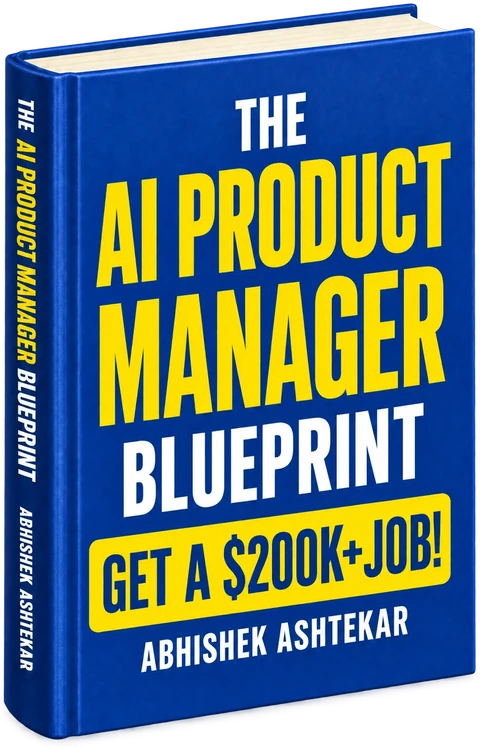
This guide is condensed from chapters 1 to 19, 43 to 46, 59 to 88 of The AI Product Manager Blueprint by Abhishek Ashtekar (first edition, 2026). The book goes several levels deeper, with the full walkthroughs, templates, and examples.
External sources cited
- Inspired: How to Create Tech Products Customers Love, Marty CaganValue, usability, feasibility, viability: the product risk lens used in Step 2.
- AI for Everyone, DeepLearning.AINon-technical introduction to AI vocabulary and project workflow.
- Machine Learning Crash Course, Google for DevelopersClassification, embeddings, generalisation, LLMs, and fairness modules.
- People + AI Guidebook, Google PAIRDesign patterns for trust, feedback, and errors in AI products.
- AI Risk Management Framework, NISTThe reference framework for responsible AI decisions.
Last reviewed September 16, 2026. Tools, platforms, and salary data change; the book’s free resources page is updated as they move.
Browse all 88 chapters
This guide is the trailer.
The book is the whole system.
Everything this guide compresses, in full. The chapters, the skills, the portfolio projects, and the week by week roadmap that takes you from zero to hired.
- 88Chapters
- 22Skills
- 5Projects
- 1Roadmap