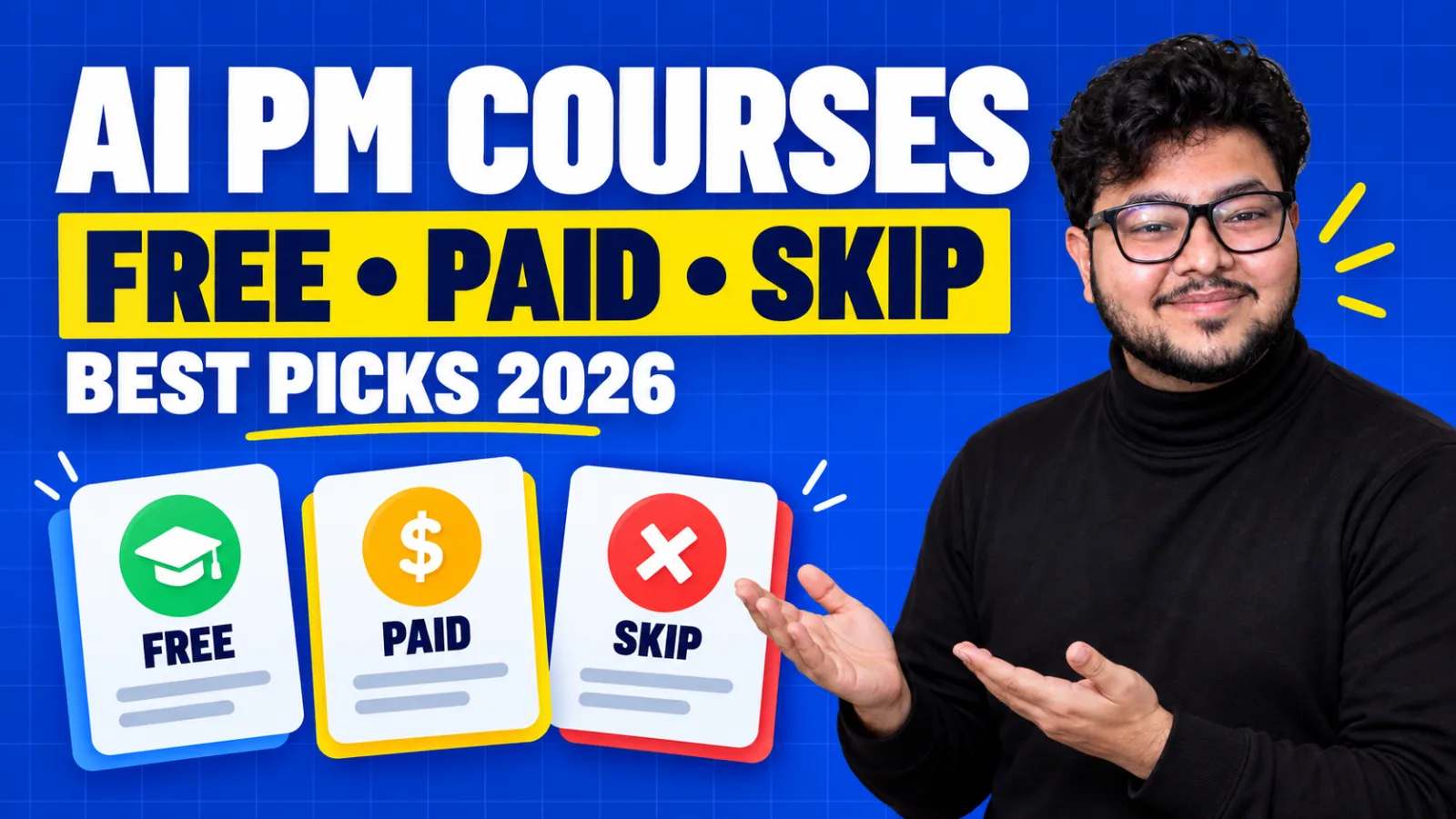
The best AI product manager courses depend on your gap, not the brand. Start free: AI for Everyone (DeepLearning.AI), Elements of AI, Google's Machine Learning Crash Course, SQLBolt, and the People + AI Guidebook from Google. Add one structured programme only if you need discipline, such as the IBM AI Product Manager Professional Certificate or Duke's AI Product Management specialization on Coursera. Consider a live cohort from Product Faculty, Maven, or Product School only after you have foundations and a project to bring. No certificate gets you hired on its own. Projects and case studies do.
Key takeaways
- A certificate is learning proof. Hiring managers look for thinking proof and building proof, which only your own work creates.
- The free stack covers AI foundations, SQL, and responsible AI well enough to start building within two months.
- Pick one structured programme at most. Five beginner courses repeat the same definitions.
- Every course should end in an artifact: a PRD, a metric tree, an eval set, a risk review, or a case study.
Do you need AI product manager courses or a certification?
You need structured learning. You do not need a stack of certificates. A course gives you vocabulary, examples, and a sequence. It cannot give you product judgment simply because you watched the lessons.
Think of proof in three layers. Learning proof shows you studied. Thinking proof shows how you frame problems and make decisions. Building proof shows you can turn a decision into a working prototype, evaluation, or experiment. Courses contribute mostly to the first layer. Your projects, PRDs, and the case studies you write create the other two, and those are what interviews test.
So the useful question is never "which course will get me hired?" It is "which skill do I need next, and what will I make after learning it?" The full skill map is in the 22 AI PM skills.
The six-check course filter
Buying a course can feel like progress when you are anxious. Run these checks before enrolling in anything.
- Need. Which gap does it close? Product thinking, AI literacy, data, LLM workflows, evaluation, or interviewing each need different material.
- Level. Read the prerequisites and a sample lesson. Advanced material too early turns into vocabulary without understanding.
- Practice. Are assignments real product work, such as a brief, a PRD, a metric tree, or an evaluation plan? A quiz checks recall, not judgment.
- Feedback. Will a person review your work, or do you only get videos?
- Proof. Can you name the artifact you will publish afterwards? If not, the course is too broad or badly timed.
- Price. Compare it with free material. Pay only when structure, feedback, or community closes a gap you cannot close alone.
Course pages change constantly. Before paying, confirm the current instructor, syllabus, schedule, prerequisites, project work, feedback model, access period, total cost, and refund terms.
Best free AI product manager courses
This free stack can fill your first one or two months. Take notes, connect each idea to a real product, and create one small artifact per resource.
| Course | Best for | Build this afterwards |
|---|---|---|
| AI for Everyone (DeepLearning.AI) | Complete beginners who need AI vocabulary and how AI projects run in companies | A one-page memo on one workflow: where AI helps, where it fails, and whether something simpler wins |
| Elements of AI (University of Helsinki) | A broader view of what AI can and cannot do, and its effect on people | A short list of good AI use cases and cases where AI should not be used |
| Machine Learning Crash Course (Google) | The concepts engineers use: training, classification, overfitting, embeddings, evaluation | A plain-English explanation of those concepts in your own words |
| DeepLearning.AI short courses | Specific generative AI topics: prompting, RAG, agents, evals | One small workflow matching the course topic |
| SQLBolt | Learning SQL interactively from zero | Five product questions answered from a sample dataset |
| People + AI Guidebook (Google PAIR) | Designing for trust, feedback, uncertainty, and the right level of control | A trust and error-handling section for one of your projects |
| AI Risk Management Framework (NIST) | A formal vocabulary for AI risk: govern, map, measure, manage | A risk review for a feature you designed |
Take courses when they match the work in front of you. Study prompting while you design prompt behaviour. Study RAG when you build a grounded assistant. Randomly finishing every new short course creates breadth without retention.
Product management foundation courses
AI product management is still product management. If you cannot identify a user problem, prioritise scope, choose metrics, or explain a trade-off, more AI knowledge will not fix it. Choose one of these paths and study it properly.
| Programme | Format | Good fit if |
|---|---|---|
| Product Ideation, Design & Management (University of Maryland, Coursera) | Self-paced specialization | You want a deeper, university-structured foundation |
| IBM Product Manager Professional Certificate (Coursera) | Self-paced certificate | You want the product lifecycle, strategy, and the basics of Agile in one sequence |
| LinkedIn Learning product management courses | Short video courses | You already have access through Premium, college, or work and need orientation |
Do not confuse product management with project management. Product management decides which problem and outcome deserve investment. Project management plans timelines and coordinates delivery. A project management certificate is useful, but it does not replace learning discovery and product decisions.
Structured AI product manager certifications compared
Once you have basic AI and product knowledge, a structured AI PM programme can connect the two. These are self-paced and usually cheaper than live cohorts.
| Certificate | What it covers | Best for | Watch out for |
|---|---|---|---|
| IBM AI Product Manager Professional Certificate | Product management, AI and generative AI concepts, prompting, responsible AI, practical activities | Beginners who want one connected path at subscription cost | Finishing videos without pushing the projects beyond the minimum |
| AI Product Management (Duke University, Coursera) | Machine learning fundamentals, managing ML projects, human-centred AI design | Building machine learning judgment and project lifecycle understanding | Less emphasis on the newest LLM and agent patterns |
| AI Product Manager Nanodegree (Udacity) | Supervised learning, data annotation, stakeholders, roadmaps, LLMs, metrics, bias, projects | Learners who want project-based work with a published curriculum | It assumes some product and statistics knowledge, so check prerequisites |
Coursera programmes are subscription-based, and Coursera offers financial aid on many courses, which matters for learners in India and other price-sensitive markets. Check local pricing on the course page before assuming the headline price applies to you.
Live AI product management cohorts: are they worth it?
Live programmes add instruction, deadlines, feedback, and a peer group. That can justify a higher price if you will attend, finish the work, and use the cohort to improve a real project.
| Programme | Style |
|---|---|
| AI Product Management Certification (Product Faculty, on Maven) | Live cohort focused on moving from opportunity to shipped AI product, with strategy and evaluation |
| AI PM Bootcamp (Marily Nika, on Maven) | Live lessons and worked examples, with assignments and a learner community |
| AI Product Management Certification (Product School) | Live online modules on AI product frameworks, agents, PRDs, and the case studies behind them |
Live cohorts help most when you already understand PM basics and AI basics. If you are still confused about both, you will get far less from the discussions. Before paying, ask these questions:
- Who teaches the live sessions this cohort, and what have they shipped?
- What are the assignments, and who gives feedback on them?
- Can I see work produced by previous learners?
- What is the weekly time commitment, and are sessions recorded?
- What is the refund policy and access period?
Never buy three premium programmes. One serious programme followed by strong practice beats a shelf of expensive certificates. For a side-by-side review of ten programmes matched to your background, see the best AI product management certification for your background.
Data and analytics courses for AI PMs
You do not need to become a data scientist, but you must be comfortable with evidence. Learn activation, retention, funnels, cohorts, and the basics of experiments early.
- SQLBolt: interactive lessons from simple queries to joins and grouping.
- SQL Tutorial for Data Analysis (originally Mode, now hosted by ThoughtSpot): realistic analytical practice once SQLBolt feels easy.
- Amplitude Academy: product analytics concepts such as activation, engagement, retention, and the adoption of features.
- Paid guided platforms such as DataCamp are optional. Start free and pay only if you need more structure.
For every portfolio project, define what you would measure if it were live: one main success metric, a few supporting metrics, and guardrails for harm, cost, and any poor results.
AI evaluation courses: take them later
Evaluation is one of the strongest signals that you understand AI beyond a demo, and it is also the easiest topic to learn too early. Start with your model provider's official evaluation guidance and a small test set of your own. Once you have built one or two prototypes with real failure cases, a practitioner course such as AI Evals for Engineers and PMs by Hamel Husain and Shreya Shankar becomes very valuable, because you can bring actual failures to it.
Taking an advanced eval course before you have a system to evaluate turns practical methods into abstract vocabulary. Our free walkthrough, AI evals for Product Managers, covers enough to build your first 50-case evaluation.
Cloud AI certifications: optional
Cloud credentials help when your target employers run on that cloud. They are not a universal requirement for AI PM roles. If you work in a Microsoft environment, Azure AI Fundamentals can support your understanding of Microsoft's AI services. Microsoft retired exam AI-900 on June 30, 2026 and moved the certification to exam AI-901, which now covers generative AI and agents. That change is a good reminder to check the official credential page before you study for any exam.
Is an AI product manager certification worth it?
It depends on who you are and what you lack.
| Your situation | Verdict |
|---|---|
| Complete beginner who struggles to self-direct | Worth it: one self-paced certificate gives structure. Build projects alongside it. |
| Beginner with strong self-discipline | Usually skip: the free stack plus projects gets you further for less. |
| Existing PM moving into AI | Maybe: a focused live cohort can speed up AI depth if you bring a real problem. |
| Engineer or data scientist | Skip AI basics: study product discovery, strategy, and the work of managing stakeholders instead. |
| Anyone hoping the certificate alone gets interviews | Not worth it for that reason. Employers weigh shipped work far more heavily. |
AI product manager courses by budget and background
Free path for a complete beginner
AI for Everyone, then Elements of AI if you need more, the core parts of Google's ML Crash Course, SQLBolt and the SQL tutorial for data analysis, the People + AI Guidebook, the structure of the NIST framework, and one product management foundation course. Then build. That is a serious starting point with no spending.
Medium budget
The free AI stack, plus the IBM AI Product Manager certificate or Duke's specialization as your single structured path. Do not add more certificates. Put the time into projects.
Larger budget, learns best live
Free foundations first, then one live cohort chosen with the questions above, entered with a prototype or case study you want to improve.
By background
- Existing PM: skip beginner PM material. Focus on AI literacy, LLM workflows, RAG, agents, evaluation, cost, and the practice of responsible AI.
- Engineer: focus on user research, strategy, prioritisation, and the business side.
- Designer: add technical understanding of models and retrieval, plus metrics.
- Data analyst: add product discovery, stakeholder management, and AI product patterns.
- No degree: keep it practical. Courses teach the language, projects prove you can use it. See the no-degree path.
A 12-month learning sequence
| Months | Learning focus | Output |
|---|---|---|
| 1 and 2 | AI foundations, responsible AI, PM foundation, SQL | Explainers, one PRD, SQL answers |
| 3 to 6 | One structured certificate if needed, analytics, LLMs, RAG, agents | Metric trees, small prototypes, evaluation plans |
| 6 to 9 | A live or advanced programme only if it strengthens work in progress | Portfolio projects and case studies |
| 9 to 12 | Learning supports the job search, not the other way round | Published portfolio, applications, mock interviews |
Do not use another certificate to postpone publishing, networking, or interviewing. The same timeline with weekly deliverables is in the 12-month AI PM roadmap.
Turn every course into evidence
| After you finish | Create |
|---|---|
| A general AI course | An explanation of how an AI project moves from opportunity to monitoring |
| ML foundations | Training, inference, evaluation, and the idea of overfitting, in plain language |
| A PM foundation course | A PRD for one focused AI feature |
| SQL practice | Five product questions answered from a dataset |
| Product analytics | Activation, adoption, retention, and the outcome metrics for a project |
| A generative AI short course | One small working workflow |
| Responsible AI reading | A risk section: who could be harmed, what data is accessed, where humans review |
| Evaluation learning | A small test set, a definition of good, and a failure summary |
| An AI PM certificate | A published case study showing your decisions |
Keep a simple learning tracker with the course, the skill, why you chose it, what you learned, and what you created. It stops passive consumption, and it gives you better resume lines. "Completed several AI courses" says little. "Studied AI foundations, PM, SQL, responsible AI, and evaluation, then applied them across three documented AI case studies" says a lot. Those case studies belong in your AI PM portfolio.
Mistakes people make choosing AI product manager courses
- Taking five beginner courses that repeat the same definitions.
- Learning AI tools before learning what a product decision is.
- Buying a live cohort before understanding basic AI and PM concepts.
- Taking advanced evaluation courses with nothing to evaluate.
- Choosing by brand name or price instead of syllabus and feedback.
- Trusting old course reviews for programmes that have since changed.
- Treating the certificate as the finish line instead of the start of a project.
The course is not the career. Use courses to move forward, not to avoid practising. Pair each course with one of the best books for AI product managers, read in order. The book's Chapters 20 and 45 go deeper into each option and sequence, and the free resources pack keeps an updated course list alongside the templates you will use to turn lessons into proof.
Questions & answers
8 questions readers ask most, answered straight.
What is the best AI product manager course for beginners?
Start with AI for Everyone from DeepLearning.AI for vocabulary, add Google's Machine Learning Crash Course for core concepts, and take one product management foundation course. If you want a single structured path, the IBM AI Product Manager Professional Certificate on Coursera is a common beginner choice.
Is there a free AI product manager course with a certificate?
Several strong AI foundation courses are free to study, including Elements of AI and Google's Machine Learning Crash Course. Coursera certificates usually require a subscription, but many programmes offer financial aid. Remember that hiring managers value your projects far more than a free certificate.
Is the IBM AI Product Manager certificate worth it?
It is worth it for beginners who want one structured path at subscription cost and who will push the assignments into real portfolio work. It is less useful for experienced PMs or engineers who already know much of the content, and it will not get you hired without projects and case studies.
Do employers care about AI product manager certifications?
Employers care much more about evidence of product judgment: shipped features, scoped projects, evaluation work, and clear case studies. A relevant certificate can support a career change on a resume, but it rarely decides an interview on its own.
Should I choose a Coursera certificate or a Maven cohort?
Choose a self-paced Coursera certificate if you need an affordable, structured sequence and can stay disciplined. Choose a live Maven cohort if you already understand the basics, have a project to improve, and want live feedback and accountability. Many people benefit from free foundations first, then one of the two.
How long does it take to learn AI product management through courses?
The free foundations take about one to two months at a steady pace. A structured certificate typically takes a few months part time. Plan roughly nine months of learning and building before a job search, and keep producing artifacts throughout rather than learning first and building later.
Which AI PM course is best for experienced product managers?
Skip beginner product material. Focus on generative AI patterns, RAG, agents, evaluation, and the cost trade-offs, through DeepLearning.AI short courses and provider documentation, then consider a live AI PM cohort or an advanced evaluation course where you can apply the ideas to a real product.
Can I become an AI product manager with only online courses?
Courses alone are rarely enough. Use them to learn the language and frameworks, then prove the skills with portfolio projects, PRDs, evaluations, and the case studies you publish. That combination, plus a targeted job search, is what turns learning into offers.
Where this comes from
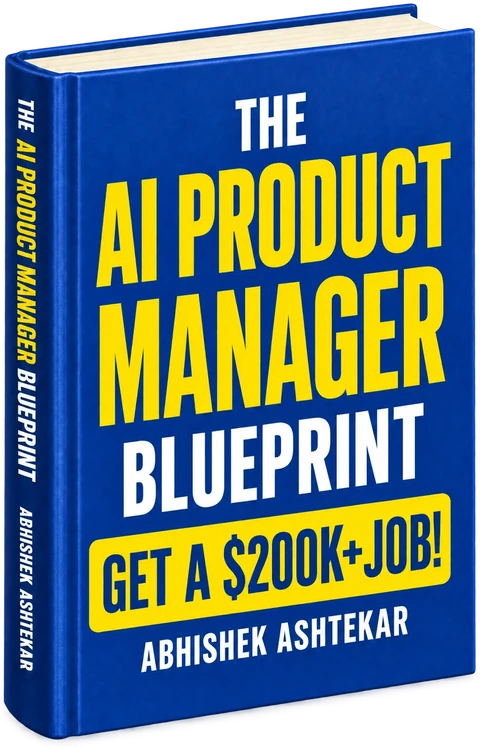
This guide is condensed from chapters 19, 20, 44, and 45 of The AI Product Manager Blueprint by Abhishek Ashtekar (first edition, 2026). The book goes several levels deeper, with the full walkthroughs, templates, and examples.
External sources cited
- AI for Everyone, DeepLearning.AINon-technical AI foundation course.
- IBM AI Product Manager Professional Certificate, CourseraStructured self-paced AI PM curriculum.
- Evolving the Azure AI Fundamentals certification, Microsoft Tech CommunityMicrosoft's announcement of AI-901 replacing AI-900.
- AI Risk Management Framework, NISTFree reference for responsible AI practice.
- People + AI Guidebook, Google PAIRFree guide to designing trustworthy AI experiences.
Last reviewed September 16, 2026. Tools, platforms, and salary data change; the book’s free resources page is updated as they move.
Browse all 88 chapters
This guide is the trailer.
The book is the whole system.
Everything this guide compresses, in full. The chapters, the skills, the portfolio projects, and the week by week roadmap that takes you from zero to hired.
- 88Chapters
- 22Skills
- 5Projects
- 1Roadmap