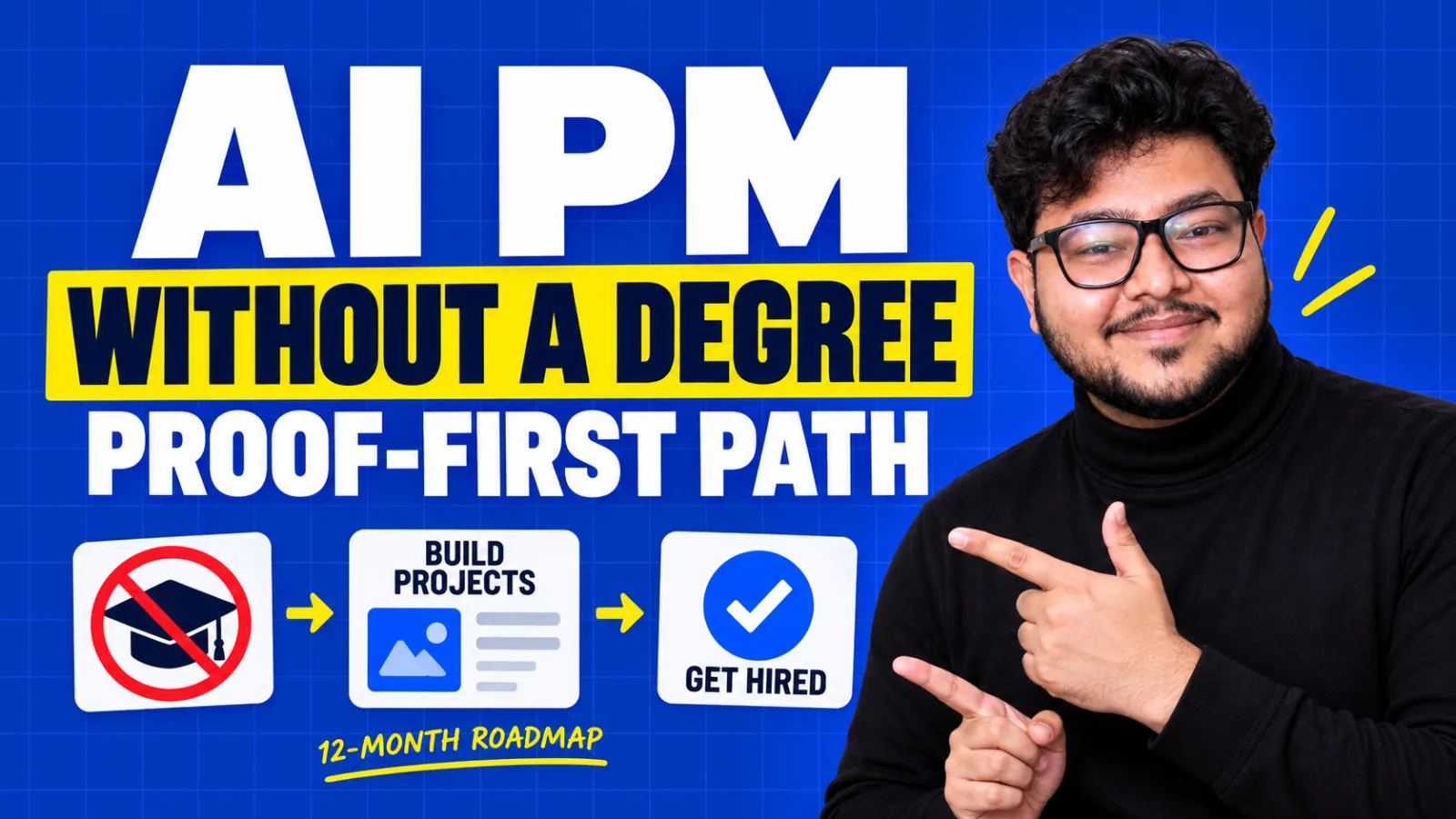
You can become an AI product manager without a degree, but you have to replace the degree's signal with stronger evidence. A degree tells employers you completed a structured programme. Without one, you show the same readiness through three foundations: product management and AI fundamentals, visible proof such as scoped AI projects with honest case studies, and visibility through LinkedIn, a portfolio, and relationships that get the work seen. Most people enter through bridge roles such as associate PM, product analyst, or product operations. At 15 to 20 focused hours a week, plan for about 12 months.
Key takeaways
- A degree is a screening signal, not proof of ability. Evidence you can inspect works at every level.
- Some employers still filter by degree, especially for competitive entry roles. Target the ones that do not, and use referrals where they do.
- Translate your background instead of hiding it. Psychology, finance, teaching, and ops work all map to real product strengths.
- The hidden challenge of the no-degree path is consistency, not access to information.
Do you need a degree to become an AI product manager?
No, not always. But degrees are not irrelevant either, and pretending otherwise sets you up for frustration. Some companies use education as an early filter. Others care more about experience, product judgment, technical understanding, and evidence you can do the work. A startup may judge your projects directly, while a large or regulated employer may prefer a degree in computer science, engineering, data, or business.
Research backs up that split. A 2024 study by Harvard Business School and the Burning Glass Institute, Skills-Based Hiring: The Long Road from Pronouncements to Practice, found that many large employers removed degree requirements from job postings but changed their actual hiring very little. A minority of firms did follow through and hired noticeably more people without degrees. The lesson for you: a posting that drops the degree line is a start, not a guarantee. Proof and referrals do the rest.
Read the degree line in every job description
| The posting says | What it usually means | Your move |
|---|---|---|
| "Degree required" | A stricter filter, often applied automatically | Go through a referral or skip it for now |
| "Degree preferred" | Flexibility for strong candidates | Apply with your strongest case study linked at the top |
| "Or equivalent practical experience" | Explicit room for proof instead of credentials | A priority target. Lead with shipped work. |
| No education line at all | Judged on skills and experience | Apply normally with proof front and centre |
Degree requirements also weaken as you progress. At entry level, education carries more weight because there is little work history to judge. At senior levels, employers care about products launched, outcomes achieved, and decisions made.
What a degree actually signals (and what it does not)
A degree tells an employer you studied a subject through a structured programme, which helps when recruiters compare many applications quickly. But a signal is not ability. A technical graduate can struggle to find meaningful user problems. A business graduate can know strategy and little about how AI systems behave. Someone with an impressive degree can still write unclear documents and make weak product calls.
| Degree | What it signals | Gap graduates still have to fill |
|---|---|---|
| Computer science or engineering | How software is built, technical constraints | User research, strategy, business value |
| Data science or statistics | Data, probability, experiments, model evaluation | Product strategy, communication, user needs |
| Business, economics, or MBA | Markets, pricing, operations, strategy | Software, data, model behaviour, AI evaluation |
| HCI, psychology, or design | How people understand and trust systems | Technical depth and business metrics |
Notice that every degree leaves a gap. No programme covers users, business, software, data, AI behaviour, and communication all at once. Graduates fill their gaps with practical work, and so will you. You just start from a different place. If you want to see the complete skill map you are working toward, read the 22 AI PM skills.
The no-degree path: three foundations
The no-degree path is not a shortcut around competence. It is a self-directed route to competence. A university hands you a curriculum, deadlines, feedback, and a credential. On this path you build that structure yourself, and the freedom only helps if you use it with discipline.
- Fundamentals. Product management and practical AI literacy, learned in the right order.
- Visible proof. Projects and case studies that show product decisions, not just interfaces.
- Discoverability. A profile, a portfolio, and relationships that make sure the proof is actually seen.
Each foundation feeds the next. Fundamentals make your projects credible. Projects give you something worth showing. Visibility turns that proof into conversations.
Foundation 1: learn the fundamentals in order
Start with product management, because AI tools cannot replace it. Learn how PMs find problems, study users, research markets, prioritise, write requirements, work across teams, choose metrics, build roadmaps, and connect decisions to business outcomes. These skills make you a product thinker.
Then add practical AI literacy. You should be able to explain what AI and machine learning systems do, why data quality matters, why outputs go wrong, how large language models behave, what hallucinations are, how retrieval works, what agents can and cannot do, how evaluation works, and why latency, cost, privacy, and a human in the loop shape a product. You do not need engineering depth. You need enough to ask informed questions and make responsible decisions.
Keep learning focused. Jumping between courses and tools, or chasing every new model announcement, feels productive and builds very little. Learn a concept, apply it, get feedback, improve the work, then move on. Our guide to AI PM courses lists a free stack that covers these fundamentals without spending money.
Foundation 2: build proof that shows decisions
"I built an AI tool" tells a hiring manager nothing. A case study that explains the decision tells them how you think, which is exactly what a degree could never show them anyway.
Weak: a few screenshots and "uses AI to improve your interviews."
Strong: who struggles with interview prep, what current options fail to give them, what useful feedback means (a rubric), which outputs need evaluation, where the advice could mislead someone, and what you tested with real users.
Every case study should answer these questions
- Who is the user, and what are they trying to do?
- What is wrong with the current process, and why does it matter?
- Why is AI suitable here, and what would a simpler fix look like?
- How should the experience work?
- What does success mean, and how did you measure it?
- What can fail, and what safeguards did you add?
- What would you test next?
Reasoning matters more than polish. A simple prototype with thoughtful decisions beats an advanced app with no clear user. The book builds this proof through five projects, each briefed in 5 AI PM portfolio projects. Your quality should visibly improve from the first case study to the fifth, and that improvement is itself a signal of fast learning.
"AI is the future, so this product needs an assistant" sounds like trend-chasing. "Agents spend too long reviewing long support conversations, summarisation fits because the task is extracting context and actions, and the product must preserve critical details, let agents verify the source, and never invent information" sounds like a product manager. Hiring managers stop worrying about your degree when you talk like the second example.
Foundation 3: make the proof discoverable
Strong work has little career value if nobody finds it. When you apply only through crowded job boards, your resume gets compared quickly against candidates with traditional credentials, which is exactly where a missing degree hurts most. Visibility changes where you enter the process.
- LinkedIn: a headline naming the role you want, a short transition story, and your best case study in Featured. The full setup is in LinkedIn for AI Product Managers.
- A simple portfolio site: each project shows the problem, user, AI's role, decisions and metrics, the risks, and the lessons you took away. See how to build an AI PM portfolio.
- Public learning: product teardowns, project lessons, and honest observations about AI products. Document progress. Do not pose as an expert.
- Relationships: ask practitioners about their problems, request specific feedback, and share useful work. Networking is not asking strangers for jobs.
- Domain relationships: if you want healthcare AI, learn from clinicians. For education products, talk to teachers and students.
A referral can move your application past an automated degree filter. The work still has to hold up once someone reads it. The strongest combination is useful proof plus someone willing to make sure it is seen.
Translate your background instead of hiding it
Whatever you studied or worked in, it taught you something about users, industries, research, or complex workflows. Name that value and combine it with PM fundamentals and AI literacy. Domain knowledge matters a lot in AI products, because they must fit the reality of the industry they serve.
| Your background | Product strength it gives you | Natural AI product areas |
|---|---|---|
| Psychology | User research, behaviour, motivation | Consumer apps, wellbeing, learning products |
| Teaching or education | Explanation, learning design, feedback loops | Edtech, tutoring, training tools |
| Finance or commerce | Risk, compliance, unit economics, pricing | Fintech, fraud, lending, accounting automation |
| Healthcare | Clinical workflows and safety instincts generalists lack | Healthtech documentation, triage support, admin automation |
| Design or arts | User experience, communication, taste | Creative tools, consumer AI, content products |
| Operations or logistics | Spotting inefficient workflows | Enterprise automation, supply chain, agents |
| Customer support or sales | Direct knowledge of repeated user pain | Support copilots, sales assistants, voice-of-customer tools |
| Writing, journalism, or research | Discovery, synthesis, clear communication | Knowledge tools, research assistants, content systems |
One caution. Your background should never become an excuse to skip technical learning. Domain knowledge plus AI literacy is a powerful combination. Domain knowledge alone is not enough for an AI PM role.
Bridge roles: realistic first jobs without a degree
Applying only to competitive AI PM roles at major global companies is rarely the best entry strategy without a degree or product experience. Bridge roles put you next to users, data, technical teams, and product decisions, and they are how most people get the title later.
| Bridge role | What it teaches you |
|---|---|
| AI product internship | Real product work with a structured path to conversion |
| Associate Product Manager | Direct feature ownership at a smaller scope |
| Product Analyst | How usage data drives decisions |
| Product Operations | How releases and feedback loops run across teams |
| Business Analyst | Turning messy workflows into structured requirements |
| Customer success at an AI company | Repeated user problems with a real AI product |
| Founder's office at a startup | Broad exposure to users and strategy, plus fast, scrappy execution |
These are not failed versions of the career. The right question is not whether your first title is perfect, but whether the role moves you closer to product ownership. Where to find them is covered in AI PM internships and the three-bucket job search.
How long does the no-degree path take?
The book plans the path as roughly 12 months for someone who can work consistently. These numbers show the scale of effort, not a promise.
| Weekly time | Realistic timeline |
|---|---|
| 15 to 20 focused hours | About 12 months, with heavier weeks during projects and interviews |
| 8 to 10 hours | 18 months to two years |
The sequence stays the same at any pace: foundations, projects, case studies, visibility, relationships, applications, and the interview prep. Pick a schedule that fits your real responsibilities rather than one that collapses after two weeks. The month-by-month version is in the 12-month AI PM roadmap.
The real risk is inconsistency, not your background
The most common failure on this path looks like this: a burst of motivation, dozens of saved resources, a few videos watched, a month off, then starting over from the beginning. Lots of activity, no accumulated evidence.
Small, connected efforts beat bursts. One finished analysis per week beats twenty saved videos. One case study improved every week beats five unfinished project ideas. An imperfect project that ships beats an ambitious one that never becomes visible.
Self-directed does not mean alone. Use courses, books, templates, communities, mentors, and a peer group. You are simply the one responsible for organising and finishing the work.
Check your progress with these questions
- Can you explain what an AI Product Manager does without vague language?
- Can you find the user problem behind a feature?
- Can you explain why AI helps in one case and is unnecessary in another?
- Can you write a basic PRD?
- Can you define product metrics and system quality metrics?
- Can you name failure cases and propose sensible safeguards?
If your answers get sharper month over month, you are progressing, whatever your transcript says. Be honest about weaknesses too. Weak writing, shaky AI concepts, or thin business thinking all become manageable once you name them.
Should you get an MBA or a master's degree instead?
A relevant degree can make the first stretch easier through structure, internships, recruiting pipelines, and a network, especially if you are aiming at large companies with campus hiring programmes. It is also expensive and slow, and it still leaves the same gaps every graduate has to fill with practical work.
If you can afford it and want a structured, network-heavy route into big-company APM programmes, a degree is a legitimate choice. If you cannot, or you want to move sooner, the proof-first path works, and it produces portfolio evidence that degree holders also need. Either way, interviews test product sense, metrics, AI understanding, and communication, which no credential can answer for you.
Mistakes that stall no-degree candidates
- Believing degree filters do not exist, then taking every rejection personally.
- Collecting certificates as a substitute for a degree.
- Putting "AI Product Manager" in a LinkedIn headline with no proof behind it.
- Hiding a non-technical background instead of translating it.
- Using domain knowledge as an excuse to skip AI literacy.
- Applying only through job boards where degree filters are strictest.
- Targeting only senior AI PM roles at the most competitive companies.
- Restarting from scratch after every break.
Your first 90 days without a degree
- Days 1 to 15: Read 20 job postings, sort them by degree line, and note which companies and titles show flexibility. Pick a domain that fits your background.
- Days 16 to 45: Learn PM fundamentals and write one product teardown plus one PRD in your domain. Start the free AI foundation courses.
- Days 46 to 75: Build your first scoped AI project and write its case study with the seven questions above.
- Days 76 to 90: Publish the case study, update LinkedIn to tell one clear story, and start three conversations with people working in your target domain.
That is one piece of real proof and three relationships in three months, more than most applicants with degrees have. Then keep compounding. The full route is in how to become an AI Product Manager, and the book's Part II covers the degree question in three chapters. Your background is the starting point, not the verdict.
Questions & answers
8 questions readers ask most, answered straight.
Can you become an AI product manager without a degree?
Yes. Degrees act as screening signals, and some employers still use them as filters, but many companies hire based on demonstrated skill. Replace the signal with proof: scoped AI projects, honest case studies, a clear portfolio, and referrals that help your work get read.
What degree do you need to be a product manager?
There is no single required degree. Computer science, engineering, data, business, economics, psychology, or design degrees can all lead into product management, and each leaves gaps graduates fill with practical work. Many product managers come from unrelated fields and built product skills on the job.
Do product managers need a degree to get hired?
Not always. Entry-level roles at large or regulated companies are most likely to filter by degree. Startups, smaller product companies, and roles that say "or equivalent experience" are more flexible. Referrals and strong portfolio proof help you get past filters that do exist.
Is an MBA necessary to become an AI product manager?
No. An MBA can help with structure, campus recruiting, and networks, especially for large-company APM programmes, but it is expensive and not required. You still need practical AI and product proof, which you can build without an MBA.
How long does it take to become an AI product manager without a degree?
About 12 months at 15 to 20 focused hours a week, and 18 months or more at 8 to 10 hours a week. The order stays the same: fundamentals first, then projects and case studies, visibility, relationships, applications, and the interview practice.
What jobs can I get without a degree that lead to AI product management?
Common bridge roles include AI product internships, associate product manager, product analyst, product operations, business analyst, customer success at an AI company, and founder's office roles at startups. Each puts you close to users, data, and the product decisions.
Can a commerce or arts graduate become an AI product manager?
Yes. Commerce backgrounds translate well into fintech, pricing, and a range of risk products, and arts backgrounds bring communication and user experience strengths. Pair that background with product fundamentals, AI literacy, and a few strong projects in a domain that fits it.
Do companies really hire without degrees now?
Some do and many say they do. Research from Harvard Business School and the Burning Glass Institute found that removing degree requirements from postings often changed actual hiring very little, although a minority of employers made real progress. That is why proof and referrals matter so much on this path.
Where this comes from
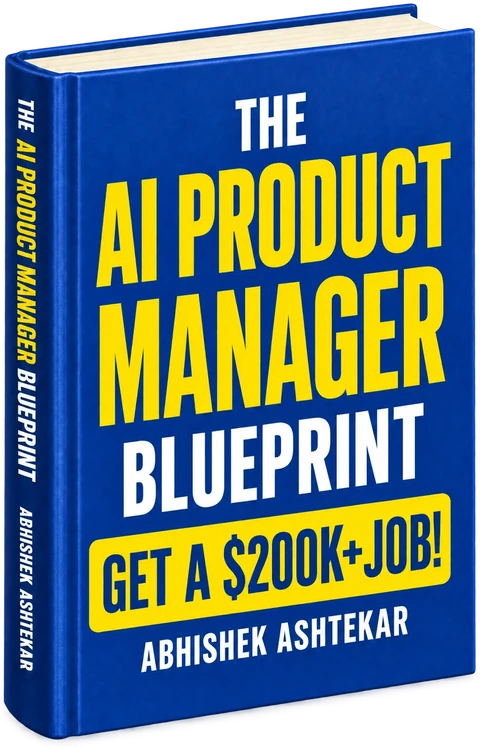
This guide is condensed from chapters 9 to 11 of The AI Product Manager Blueprint by Abhishek Ashtekar (first edition, 2026). The book goes several levels deeper, with the full walkthroughs, templates, and examples.
External sources cited
- Skills-Based Hiring: The Long Road from Pronouncements to Practice, Burning Glass Institute and Harvard Business SchoolEvidence on how often dropped degree requirements change real hiring.
- STARs: Skilled Through Alternative Routes, Opportunity@WorkResearch on workers who built skills outside a bachelor's degree.
- AI for Everyone, DeepLearning.AIA free, non-technical AI foundation course.
- People + AI Guidebook, Google PAIRFree guidance for designing trustworthy AI products.
Last reviewed September 16, 2026. Tools, platforms, and salary data change; the book’s free resources page is updated as they move.
Browse all 88 chapters
This guide is the trailer.
The book is the whole system.
Everything this guide compresses, in full. The chapters, the skills, the portfolio projects, and the week by week roadmap that takes you from zero to hired.
- 88Chapters
- 22Skills
- 5Projects
- 1Roadmap