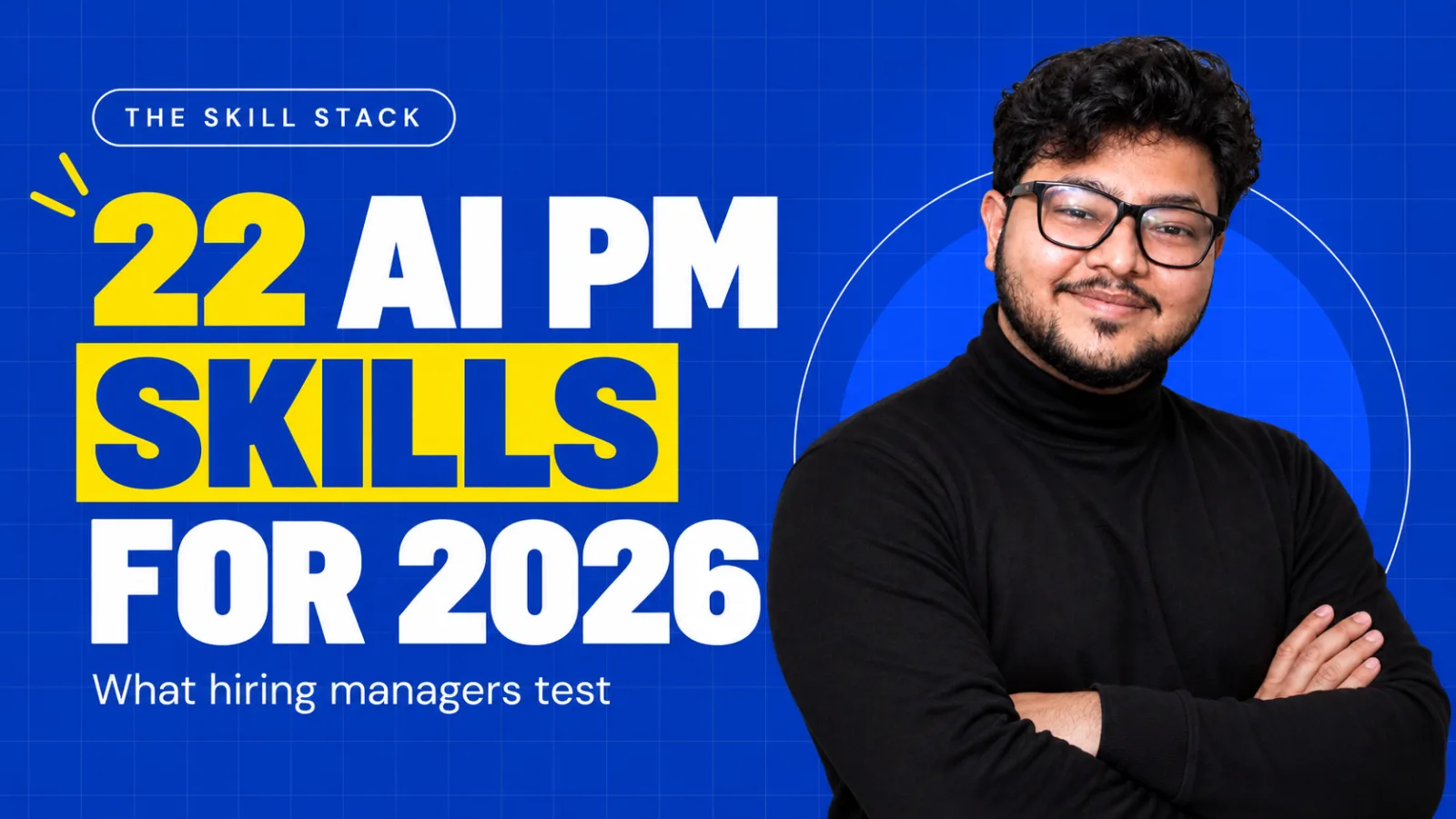
The core AI product manager skills fall into four areas. Product judgment, which covers product thinking, user research, market research, PRDs, prioritisation, go-to-market, metrics, and the work of delivering with cross-functional teams. Data fluency (SQL and product analytics). AI literacy, from ML fundamentals and LLMs to prompt and context engineering, RAG, agents, and no-code building. Production and leadership (evals, experimentation, responsible AI, cost and latency, stakeholder communication, and AI trade-off thinking). That makes 22 skills. Product thinking is the foundation, and evaluation is the skill most in demand right now.
Key takeaways
- You do not need all 22 skills at expert level to get hired. You need working depth in each area and real proof in three or four of them.
- Product thinking comes first. AI literacy without it produces impressive features nobody uses.
- Every skill in this guide has a matching portfolio artifact. Build the artifact and the skill comes with it.
- AI evals, context engineering, and cost-versus-quality trade-offs are the skills that separate AI PMs from PMs who have read about AI.
One product mindset.
08Product & delivery
- Product thinking
- User research
- Market research
- PRD writing
- Prioritization
- Go-to-market
- Product metrics
- Agile & collaboration
04Data & measurement
- SQL & data analysis
- Product analytics
- AI evaluations
- Experimentation
06AI foundations & building
- AI & ML fundamentals
- Large language models
- Prompt & context engineering
- RAG
- AI agents
- No-code AI building
04Judgment & communication
- Responsible AI
- Cost & latency
- Stakeholder communication
- AI product trade-offs
A practical grouping of the book’s 22 core skills.
What skills does an AI Product Manager need?
An AI Product Manager needs enough skill across users, business, data, AI systems, and communication to make sound product decisions with specialists. You are not replacing the engineer, the data scientist, the designer, or the lawyer. You are the person who understands enough of each view to ask the useful question and choose the trade-off.
That is why job descriptions look chaotic. One posting wants SQL. Another wants prompt engineering, model evaluation, and stakeholder management. They are all describing the same role from different angles. The book organises those demands into 22 skills across four areas, one chapter per skill.
| Area | Skills | The question it answers |
|---|---|---|
| Product judgment | 1 Product thinking, 2 User research, 3 Market research, 4 PRDs, 5 Roadmapping and prioritisation, 6 Go-to-market, 7 Metrics and North Star, 8 Agile and collaboration | What deserves to be built, and how will we know it worked? |
| Data fluency | 9 SQL and data analysis, 10 Product analytics tools | What are users actually doing? |
| AI literacy | 11 AI and ML fundamentals, 12 Large language models, 13 Prompt and context engineering, 14 RAG, 15 AI agents, 16 No-code AI building | How will the AI behave, and where can it fail? |
| Production and leadership | 17 AI evals, 18 Experimentation, 19 Responsible AI, 20 Cost and latency, 21 Stakeholder communication, 22 AI product sense and trade-offs | Is it good enough, safe enough, cheap enough, and can we agree to ship it? |
The rest of this guide takes each skill in turn: what it means, what good looks like in AI work specifically, one exercise to practise it, and the artifact that proves it. If you want the order to learn them in, the 12-month AI PM roadmap sequences all 22.
Why product thinking comes before every AI skill
A weak team asks "where can we add AI?" A strong team asks "what is the user trying to do, and what makes it hard?" The first question produces demos. The second produces products.
Here is a real pattern. Leadership wants a chatbot that answers questions from company documents. A PM who starts from the technology connects a model to a chat window. A PM who starts from the problem asks which questions employees actually ask, which documents are current, who is allowed to see what, and what should happen when the answer does not exist. Same request. Completely different product, and only one of them survives real users.
Sometimes the strong answer is not AI at all. Better search, a clearer page, or a simple rule can beat a model on reliability and cost. Hiring managers test for exactly this willingness to pick the simpler answer. It is the first skill on the list for a reason.
Area 1: Product judgment skills (skills 1 to 8)
These eight skills decide what deserves to be built. They transfer from general product management, which is good news for career switchers: you can practise all of them on products you already use, with no technical setup.
1. Product thinking and product sense
Starting from the user problem, forming a testable hypothesis, and judging outcomes instead of outputs.
What good looks like in AI work: You treat "users will resolve tickets faster with an AI summary" as a belief to test. Do agents need it, is it accurate, do they trust it, does it change the final answer?
Practise it: Diagnose one confusing AI product per week. Was the user unclear, did it demand effort before showing value, or did it automate more than people trust?
Proof to show: A short teardown series published on LinkedIn or your portfolio.
2. User research and customer discovery
Learning how people really work. Interviews and observation come first, then support tickets and behaviour data.
What good looks like in AI work: You ask "how did you finish this task last time?" instead of "would you use an AI assistant?" Research often shows users need an editable draft, not a fully autonomous agent.
Practise it: Pick one problem, find five users, run five 30-minute interviews, and talk less than they do.
Proof to show: A one-page discovery summary with the patterns you found, direct quotes, and what the problem costs.
3. Market research and competitive analysis
Understanding the alternatives a user already has, including manual work and ordinary software.
What good looks like in AI work: You compare a direct AI competitor, a traditional software option, and the manual workflow, then name the gap in one sentence.
Practise it: Write a one-page competitive analysis of one AI category using the product, its docs, and its reviews.
Proof to show: An opportunity statement such as "tools summarise feedback fast but keep too little source evidence for teams to trust the themes."
4. Writing product requirement documents (PRDs)
Turning a decision into a document a team can build from.
What good looks like in AI work: An AI PRD adds sections a normal PRD skips: model capability, data, evaluation, failure modes, guardrails, cost, latency, privacy, human review, and monitoring.
Practise it: Write two PRDs for narrow AI workflows, such as a meeting-decision extractor or a job-posting fit explainer. Never "add a chatbot."
Proof to show: Two portfolio PRDs with explicit non-goals and an evaluation plan.
5. Roadmapping and feature prioritisation
Choosing what to do now, next, and later when every option looks reasonable.
What good looks like in AI work: You rank AI work by user pain, technical feasibility, evidence strength, and risk, and you can say what you are not doing and why.
Practise it: Build a Now, Next, Later roadmap for one AI product from public information, with the reasoning for each placement.
Proof to show: A roadmap artifact that shows trade-offs, not a spreadsheet of invented scores.
6. Go-to-market strategy and positioning
Deciding who the product is for, how to describe the difference, and how it reaches users.
What good looks like in AI work: You choose a pricing logic (seat, usage, credits, hybrid, or outcome) that fits both customer value and your inference costs.
Practise it: Add a go-to-market plan to one of your PRDs: segment, positioning statement, pricing model, launch channels, and warning signals.
Proof to show: A GTM section with launch metrics for activation and repeat value, plus quality, trust, and a cost you can sustain.
7. Product metrics and North Star frameworks
Picking the one outcome that represents value and the inputs that move it.
What good looks like in AI work: You pair every AI North Star with a guardrail. "Accepted code changes" needs a guardrail for changes that later break the build.
Practise it: For three AI products, propose a North Star, three input metrics, and one guardrail. Label them as your analysis.
Proof to show: A metrics page that explains why each metric reflects real value.
8. Agile, Scrum & cross-functional collaboration
Working in short cycles with engineering, design, data, legal, and go-to-market teams.
What good looks like in AI work: You plan for AI-specific uncertainty: evaluation sprints, model swaps, and decisions that need a data scientist and a legal reviewer in the same week.
Practise it: Write a one-page "how this feature would be built" plan with a responsibility map for one AI feature.
Proof to show: A delivery plan showing who decides, who advises, and when.
For the underlying delivery framework, the official Scrum Guide is short and worth reading once.
Area 2: Data fluency skills (skills 9 and 10)
Product decisions cannot rest on opinions, demos, or stakeholder excitement. Data fluency lets you answer your own questions and challenge a chart that looks too good.
9. SQL and data analysis
Writing simple queries that filter and group product data, then join tables to answer real questions.
What good looks like in AI work: You define the metric before you query it, and you know that high engagement can mean value, confusion, or users retrying a failed answer.
Practise it: Design a small schema for an AI knowledge assistant (users, queries, answers, sources, feedback), write ten product questions, then write at least five queries.
Proof to show: A query notebook answering questions like "cost per accepted answer" or "negative feedback by query category."
10. Product analytics tools
Using Amplitude, Mixpanel, PostHog, or Google Analytics to study funnels, retention curves, and user cohorts.
What good looks like in AI work: You instrument AI events properly: answer shown, answer accepted, answer edited, source opened, feedback given. The platform matters less than the event design.
Practise it: Set up a practice project, build one funnel, compare retention for two cohorts, and write down one decision the data supports.
Proof to show: A short product analytics plan for an AI feature.
Lower support volume can mean the AI solved the problem. It can also mean users gave up. Always pair a quantitative signal with qualitative evidence before you call a result a win.
Area 3: AI literacy skills (skills 11 to 16)
AI literacy is how you predict the way a proposed solution will behave. You do not train models. You understand them well enough that engineers do not need to translate every conversation for you.
11. AI and machine learning fundamentals
The three learning types (supervised, unsupervised, reinforcement), classification and regression, training versus test data, overfitting, and why data quality decides outcomes.
What good looks like in AI work: You can explain why a model that aced the demo fails on messy real inputs, and you know evaluation data must stay separate from training data.
Practise it: Write a roughly 1,000-word explanation of machine learning for a curious 12-year-old. The gaps in your understanding will show up immediately.
Proof to show: A plain-English explainer you can publish and reuse in interviews.
12. Large language models
Tokens, context windows, sampling, hallucination, model tiers, and why the same prompt can give different answers.
What good looks like in AI work: You test a fake company or a made-up book and watch whether the model admits uncertainty or invents detail, then fix it by supplying a source and requiring citations.
Practise it: Run one prompt many times in a model playground, vary the settings the interface exposes, and log what changes.
Proof to show: An LLM behaviour log with observations and product implications.
13. Prompt engineering and context engineering
Prompting defines the task and the output format, plus limits and examples. Context engineering decides everything else the model receives: user input, retrieved documents, history, tool results, and permissions.
What good looks like in AI work: You know prompts cannot fix wrong source data, missing permissions, or poor retrieval. A sales-prep assistant needs account notes and open support issues, not a cleverer instruction.
Practise it: Design ten prompts for real workflows, test each on ten varied inputs including messy and ambiguous ones, and record pass criteria first.
Proof to show: A prompt and context library with test results.
14. Retrieval-augmented generation (RAG)
Retrieving relevant information before generating an answer, so the product uses approved, current sources.
What good looks like in AI work: You decide which sources are allowed, who can access them, how citations appear, and what happens when retrieval finds nothing.
Practise it: Build a small assistant over a coherent set of public documents and include questions it cannot answer.
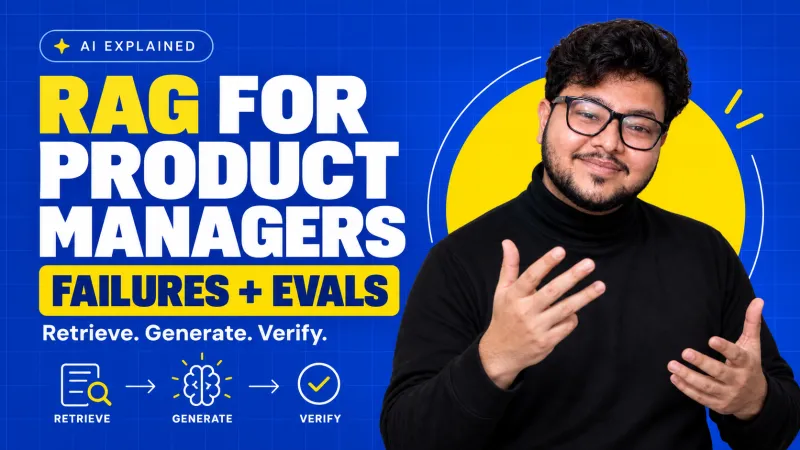
Proof to show: A RAG project with a separate retrieval evaluation. The full walkthrough is in RAG for Product Managers.
15. AI agents and agentic workflows
Systems that plan steps, use tools, and act toward a goal.
What good looks like in AI work: You set autonomy on purpose. An agent that drafts an email is a different product from one that sends it, and permissions, approval points, and undo paths are designed in from day one.
Practise it: Design one agent for a workflow you know: define start, end, tools, what it may read, draft, or execute, and where a human approves.
Proof to show: An agent design document with a state diagram. See AI agents for Product Managers.
16. No-code and low-code AI building
Using current builders to prototype and publish small AI products without an engineering team.
What good looks like in AI work: You write the brief before you open the tool, keep scope tiny, and test with real people rather than polishing screens.
Practise it: Build and publish one focused tool, such as a resume-to-job-description reviewer. Share it with five to ten users and fix the top two failures.
Proof to show: A live prototype plus a case study that states what stayed out of scope.
Anthropic's engineering essay Building effective agents is one of the clearest explanations of when a simple workflow beats a fully autonomous agent. Read it before you design skill 15.
Area 4: Production and leadership skills (skills 17 to 22)
This is where AI PMs earn senior pay. These skills decide whether a feature is good enough to ship, safe enough to scale, cheap enough to keep, and clear enough that leadership agrees.
17. AI evals and model evaluation
Structured tests that check whether the system does its job against a defined standard.
What good looks like in AI work: You define "good" per task. A support assistant needs policy grounding and correct escalation. A coding assistant needs working, secure output. Evaluation continues after launch because AI can fail silently while sounding confident.
Practise it: Evaluate one narrow task with 50 cases: 30 common, 10 edge, and 10 adversarial. Write the pass condition for each before running anything.
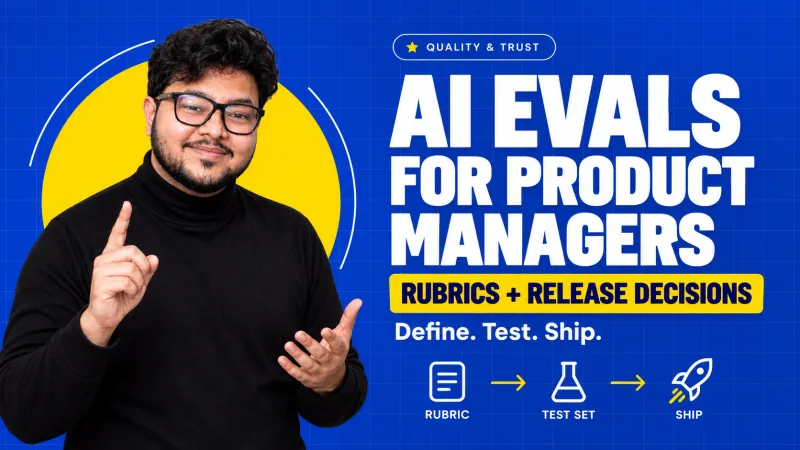
Proof to show: An eval table with failure categories and a release recommendation. Start with AI evals for Product Managers.
18. Experimentation and A/B testing
Proving that a change caused an outcome.
What good looks like in AI work: You handle AI-specific traps such as novelty effects, memory and personalisation contaminating the control group, and too little traffic for a meaningful test.
Practise it: Turn one PRD into an experiment plan: hypothesis, control, treatment, randomisation unit, one primary metric, guardrail metrics, and the inputs for sample size.
Proof to show: An experiment plan that says what you would do if traffic is too low.
19. Responsible AI: bias, fairness, safety & ethics
Designing controls in proportion to the harm a wrong output can cause.
What good looks like in AI work: You narrow launch scope, add human review, and set rollback rules for high-stakes domains such as hiring, healthcare, or any lending decision. A disclaimer never substitutes for better data or narrower access.
Practise it: Add a responsible AI section to one PRD: intended and excluded uses, affected groups, failure modes ranked by severity, the guardrails, and a set of adversarial tests.
Proof to show: A risk section your interviewer can read in two minutes. The NIST AI Risk Management Framework is the reference to cite.
20. AI cost, latency & production considerations
Understanding what each task costs and how long users will wait.
What good looks like in AI work: You calculate cost per task, per user, and per month, compare model tiers on quality and latency together, and decide whether to route requests by difficulty.
Practise it: Create an AI economics document for one idea using current official pricing, with scenarios for light users, typical users, and heavy users.
Proof to show: A cost model that ends in a recommendation, not a spreadsheet.
21. Stakeholder communication and executive presence
Getting a group of people with different incentives to a clear decision.
What good looks like in AI work: You explain technical limits to sales without being dismissive, and commercial pressure to engineering without oversimplifying. You find the realistic middle between AI hype and AI fear.
Practise it: Write a one-page memo to a fictional CEO recommending one side of a real trade-off, such as autonomous agent versus human approval. Put the recommendation in the first paragraph.
Proof to show: A decision memo, which doubles as a strong interview story.
22. AI product sense and trade-off thinking
Seeing an AI product as a set of choices and judging whether those choices fit the user.
What good looks like in AI work: You notice whether a product assists or acts, favours speed or depth, shows sources or hides complexity, and whether users can correct it.
Practise it: Complete 20 teardowns across writing, research, coding, meeting tools, customer support, and agents.
Proof to show: A teardown collection that shows your judgment improving over time.
AI product manager technical skills vs soft skills
Search results love to split the role into "technical" and "soft" skills. Hiring managers do not think that way. They look for technical understanding used to make a product decision, then communicated clearly. Here is how the two sides map.
| Technical skill | The soft skill that makes it useful | Where they meet |
|---|---|---|
| Model evaluation | Getting design, engineering, and the legal team to agree on "good enough" | A release decision everyone signs off |
| Cost and latency modelling | Explaining to leadership why the cheaper model is the right call | A pricing or model-tier decision |
| RAG and permissions | Telling sales which promise the product cannot keep yet | A scoped launch customers trust |
| SQL and analytics | Presenting evidence without overstating it | A roadmap change backed by data |
| Agent design | Negotiating autonomy with risk and security teams | Approval points that keep users in control |
So when a posting asks for "strong communication," read it as "can explain probabilistic trade-offs to people who want certainty." That is a very specific skill, and you can practise it with skill 21's memo.
Decode an AI PM job description into skills
Job descriptions use vague phrases. Translate each one into the skill being tested and the proof that answers it. Keep this table next to you when you tailor applications, and pair it with the AI PM resume keywords guide.
| When the posting says | It is testing | Show them |
|---|---|---|
| "Define success metrics for ML features" | Skills 7 and 17 | A metric tree with a quality guardrail and an eval table |
| "Work closely with ML engineers and data scientists" | Skills 8, 11, and 13 | A PRD with model and data sections plus failure modes |
| "Drive responsible AI practices" | Skill 19 | A risk section with severity levels and rollback rules |
| "Experience with LLM-powered products" | Skills 12, 14, and 16 | A shipped prototype with grounded answers |
| "Data-driven decision making" | Skills 9, 10, and 18 | Queries and an experiment plan tied to a decision |
| "Balance quality, speed, and the cost of serving" | Skills 20 and 22 | An AI economics document with a recommendation |
| "Strong product sense" | Skills 1, 2, and 22 | Discovery summary plus a teardown series |
Which AI PM skills matter most in 2026?
All 22 matter, but four are pulling the most weight in interviews and job postings right now.
- AI evals. Teams have learned that a good demo proves nothing. The PM who can build an evaluation set, define failure severity, and make a release call is the PM who gets trusted with production features.
- Context engineering. As models improve, product quality depends more on what information the model receives, in which form, and with which permissions.
- Cost and latency judgment. Usage-based costs make unit economics a product decision, not a finance afterthought.
- Agent design and autonomy control. Products are moving from answering to acting, and every action needs a permission model and an undo path.
Notice what is not on this list: any specific tool. Tools change every quarter. Candidates who list tools read as junior. Candidates who explain the decision behind a tool read as senior.
AI product manager skills by seniority
The same 22 skills show up at every level. What changes is the scope of the decision you are trusted with.
| Level | What you are expected to do with the skills |
|---|---|
| Associate or entry AI PM | Run research, write PRDs for a scoped feature, build eval sets with guidance, track metrics, and communicate progress clearly |
| AI Product Manager | Own a product area end to end, set quality bars, run experiments, make model and scope trade-offs, and align cross-functional teams |
| Senior AI PM | Set strategy for a portfolio of AI features, define evaluation and responsible AI standards, own unit economics, and influence executives |
| Director and above | Decide where AI investment goes, build teams, set governance, and answer for business results at scale |
The promotion path, and what each jump requires, is covered in the AI Product Manager career path. Pay tracks the same ladder, which you can see level by level in AI PM salary in 2026.
AI product manager skills assessment: rate yourself in 10 minutes
Score each of the four areas from 1 to 3. Be strict. A skill only counts at level 3 if someone else could inspect the proof.
| Score | What it means |
|---|---|
| 1: Aware | You can define the concepts but have not applied them |
| 2: Practised | You have done the exercise at least once and can explain what went wrong |
| 3: Proven | You have a published artifact and can defend its decisions in an interview |
Then act on the result. A 1 in product judgment means start there, before anything technical. A 1 in AI literacy with 2s elsewhere means spend the next month on skills 11 to 14. Twos everywhere with no threes means stop studying and start building portfolio projects, because what you lack is proof. The five project briefs are in AI PM portfolio projects.
How to learn all 22 skills without drowning
Do not try to master all 22 before you build something. Pick one small product and practise connected skills through it. One AI support assistant can exercise research, PRDs, metrics, RAG, evals, cost modelling, and a stakeholder memo, which covers seven skills with one coherent story.
- Learn in the order of the areas: judgment, then data, then AI literacy, then production.
- Produce the artifact for each skill before moving to the next one.
- Use one course as a syllabus, not as proof. Our AI PM courses guide explains how to choose.
- Keep a skills log with what you can explain, what you can show, and where you still need help.
- Rehearse explaining each artifact aloud, because interviews test the explanation as much as the work. Practise with AI PM interview questions.
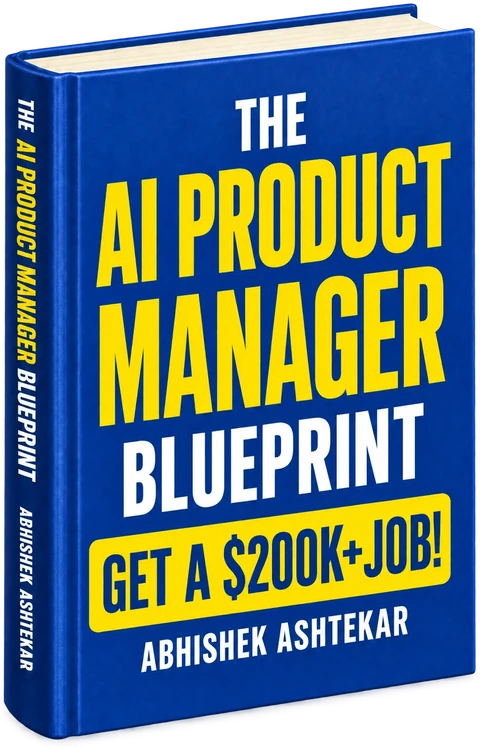
The book gives every one of the 22 skills its own chapter, with frameworks, worked examples, and the full exercise. If you only take one thing from this guide, take the artifact column. Build the proof and the skills come with it.
Questions & answers
8 questions readers ask most, answered straight.
What skills are required for an AI Product Manager?
AI Product Managers need 22 skills across four areas: product judgment, data fluency, AI literacy, and production and leadership. The most important are product thinking, user research, metrics, understanding of LLMs and RAG, AI evaluations, responsible AI, cost and latency trade-offs, and clear stakeholder communication.
Does an AI Product Manager need coding skills?
No. AI PMs need technical literacy, not programming ability. Basic SQL is very useful, and no-code tools let you build working prototypes. What matters is understanding how models and retrieval behave, and how agents act, well enough to make decisions with engineers.
What are the most important technical skills for an AI PM?
AI evaluations, context engineering, RAG, agent design, and cost and latency modelling are the most valuable technical skills in 2026. Each one maps directly to a product decision: whether to ship, what information the model gets, how answers stay grounded, how much autonomy to allow, and whether the feature is affordable.
Which AI PM skill should I learn first?
Product thinking. Start with users and their problems, define the outcome, then add metrics and user research. Learning AI tools before product fundamentals is the most common reason career switchers struggle in interviews.
How long does it take to learn AI product manager skills?
Working depth across all 22 skills takes about nine months at 15 to 20 hours a week, followed by portfolio building and applications. People with product or analytics backgrounds move faster because the first ten skills transfer directly.
How do I show AI PM skills without job experience?
Build the artifact for each skill: discovery summaries, PRDs, metric trees, SQL notebooks, eval tables, risk sections, cost models, and decision memos. Bundle them into five portfolio projects and a public portfolio so hiring managers can inspect your judgment directly.
Are AI product manager skills different from regular PM skills?
The first ten skills overlap heavily with general product management. The difference is the last twelve: understanding probabilistic model behaviour, grounding, agents, evaluation, responsible AI, and inference economics. Those skills are why AI PM roles often pay more.
Is prompt engineering still an important AI PM skill?
Yes, but as part of context engineering. Clear prompts matter, yet most product quality problems come from missing, outdated, or unauthorised context. AI PMs who understand the whole context pipeline are more valuable than those who only write prompts.
Where this comes from
This guide is condensed from chapters 19 to 42 of The AI Product Manager Blueprint by Abhishek Ashtekar (first edition, 2026). The book goes several levels deeper, with the full walkthroughs, templates, and examples.
External sources cited
- Building effective agents, AnthropicWhen workflows beat autonomous agents, and how to design agent systems.
- People + AI Guidebook, Google PAIRPatterns for user trust, feedback, and graceful failure in AI products.
- AI Risk Management Framework, NISTReference framework for responsible AI practice (skill 19).
- The Scrum GuideThe official definition of Scrum for skill 8.
- Machine Learning Crash Course, Google for DevelopersPractical modules for ML fundamentals (skill 11).
Last reviewed September 16, 2026. Tools, platforms, and salary data change; the book’s free resources page is updated as they move.
Browse all 88 chapters
This guide is the trailer.
The book is the whole system.
Everything this guide compresses, in full. The chapters, the skills, the portfolio projects, and the week by week roadmap that takes you from zero to hired.
- 88Chapters
- 22Skills
- 5Projects
- 1Roadmap