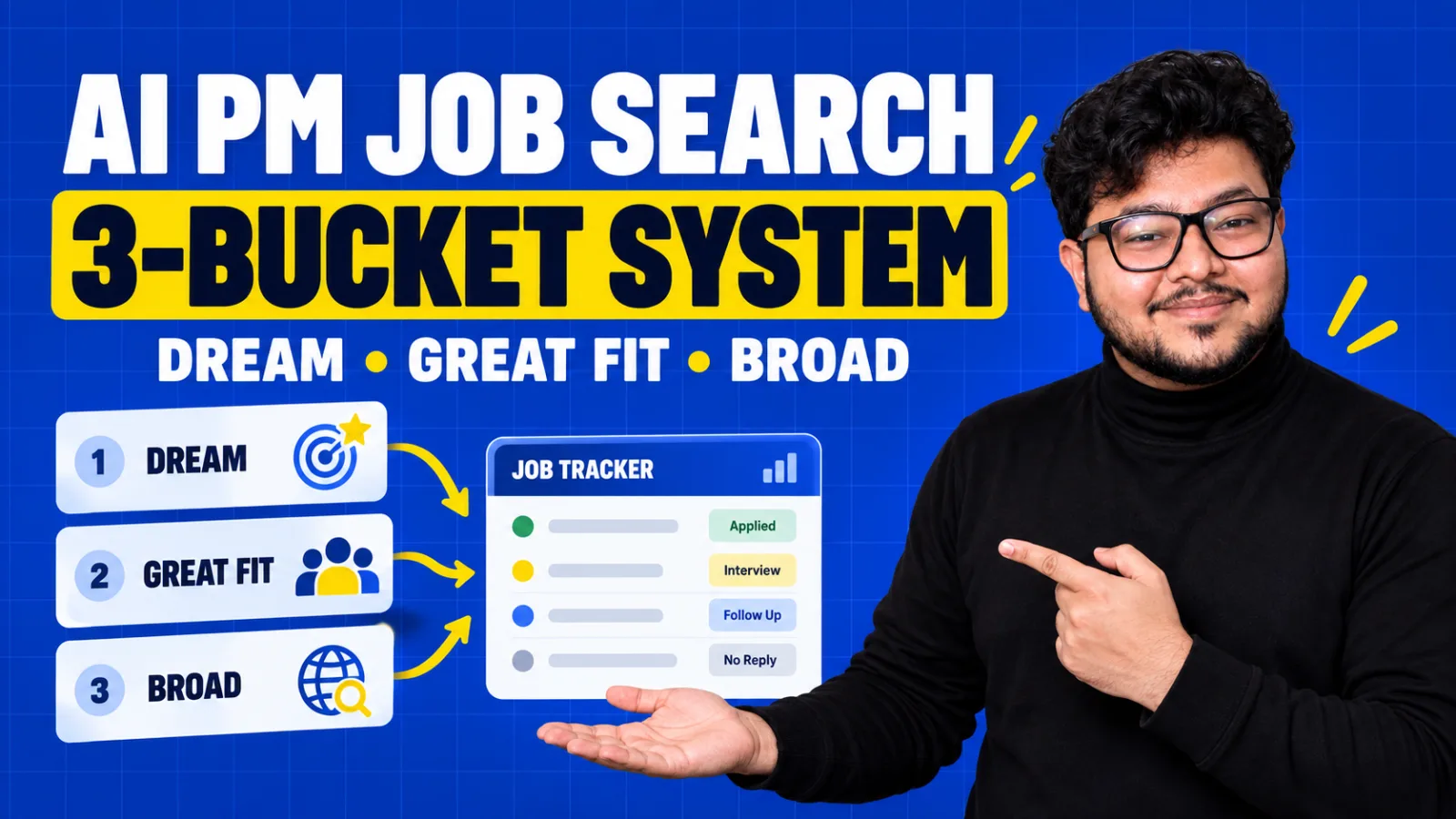
If you are asking how to get an AI product manager job, the answer is to run your search as a three-bucket campaign instead of random applications. Bucket one is 10 to 20 dream companies that get deep research, tailored applications, and relationship building. Bucket two is 30 to 50 great-fit companies that get careful but faster tailoring. Bucket three is a broad set of relevant bridge roles, such as product analyst, product operations, and associate PM, applied to efficiently. Track every application, pursue referrals where they matter most, and use the tracker to find which stage of your funnel is breaking.
Key takeaways
- Different opportunities deserve different effort. Deep work for dream companies, disciplined speed for great fits, efficient volume for broad roles.
- Bridge roles are real entry points. Product analyst, product operations, and associate PM roles put you next to AI products and users.
- A referral is earned through a useful conversation, never requested in the first message.
- Silence and rejection are data. Change one part of the system at a time and watch what moves.
How to get an AI product manager job: why random applications fail
Random applications create activity, not information. You never learn which roles deserved attention, which resume version worked, or what to fix after a rejection. Treat every role the same and you either burn out tailoring everything or disappear into the pile with generic applications.
A job search should run like a product. Prioritise deliberately, measure honestly, and improve the system each week. That is what the three-bucket strategy does. It gives each opportunity the right level of time and care, and it protects your confidence, because one rejection matters much less inside a balanced campaign.
Before you start, make sure the foundation exists: a focused resume, a working portfolio, and a LinkedIn profile that tells the same story. If those are not ready, start with the zero-to-hired roadmap, then come back.
The three-bucket strategy at a glance
| Bucket | How many | Effort per application | What you do |
|---|---|---|---|
| 1. Dream companies | 10 to 20 | Deep | Study the product, tailor everything, lead with the most relevant project, build relationships, pursue referrals |
| 2. Great-fit companies | 30 to 50 | Careful but fast | Adjust summary and skills, pick the best project, apply promptly, one polite follow-up |
| 3. Broad applications | Ongoing | Efficient | Standard resume variant, short customised note, review every submission |
These counts are guides, not quotas. Your location, experience, and the time you have change the size of the campaign. If time is tight, cut broad volume before you weaken the focused applications. And do not hide behind endless polishing. Once your foundation is credible, the market has to become part of your learning.
Bucket 1: Dream companies
Pick companies whose products, users, AI problems, and working environment match the product manager you want to become. A famous logo is not a reason. Relevance is.
Dream companies deserve deep effort. Use the product. Read product updates, documentation, customer case studies, and posts from the team. Tailor the resume and lead with the one portfolio project that matches their problem. Write a specific cover letter in your own voice. If someone on the team writes about a problem you understand, contribute something thoughtful. The aim is to become visible as a serious candidate, not to pester anyone.
Company: what it builds and for whom.
Product area that interests me: one specific area, not "their AI."
My strongest matching proof: for enterprise search, the RAG assistant; for a support platform, the voice-of-customer copilot.
People to learn from: a PM or product leader, a recruiter, and someone in an adjacent team.
Open roles and timing: current postings and when to check again.
Bucket 2: Great-fit companies
These are companies where the role, the product, and your current proof line up well, even if the company is not a personal favourite. This bucket usually produces the most realistic interviews. Smaller product companies and AI-enabled businesses often face less competition, value practical evidence, and stay more open to career switchers.
Tailor carefully but move faster. Read the posting, adjust your summary and skills, choose the best project, and make the cover letter specific. Apply promptly, because some teams review candidates while the posting is still open. Speed only helps if your resume variants, portfolio, base letter, and tracker are already prepared.
If you hear nothing after a reasonable interval, send one short follow-up that names the role, restates your interest, and points to one relevant piece of proof. Then leave it. Repeated nudges hurt more than silence.
Bucket 3: Broad applications and bridge roles
Broad applications are roles where you meet much of what is asked and where the work still moves you toward AI products, users, analytics, or product decisions. This bucket creates reach in an uncertain market where roles close, budgets change, and recruiters never reply.
Broad does not mean random. If a role has no credible connection to your target path, skip it. Use a suitable standard resume, a short cover letter base, and customise the company, role, leading project, and one sentence of relevance.
Entry-level AI product manager job titles to search
| Title | Why it is a real path into AI PM |
|---|---|
| Associate Product Manager (APM) | The classic entry product role, with direct feature ownership |
| Product Analyst | Metrics and experiments, the data that product decisions depend on |
| Product Operations | Process, feedback loops, and cross-team execution close to PMs |
| AI Solutions Associate or Implementation Specialist | Real customer workflows and AI product behaviour in the field |
| Founder's Office | Broad exposure to product, users, and the strategy of a startup |
| Product Intern | A structured trial that can convert into an offer |
| Junior Product Manager | Smaller scope, same core job |
| Customer success at an AI company | Deep user knowledge and a common internal transfer route |
Your first role does not have to be your final destination. A bridge role gives you users, data, technical teams, and real constraints, which become the stories that win the next move. Internship routes by country are covered in AI product manager internships, and the sites that list these roles are in the AI PM job boards guide.
Build a job search tracker
A tracker turns applications into a managed campaign. Use a spreadsheet, Notion, Airtable, or any tool you will actually keep updated. The habit matters more than the software.
| Column | Why it matters |
|---|---|
| Company, role, bucket | Shows where your effort is going |
| Source | Reveals which channels produce replies |
| Date applied | Sets follow-up timing |
| Resume version and lead project | Shows which positioning works |
| Referral or contact | Separates warm from cold results |
| Response and stage | Builds your funnel |
| Next action and date | Stops opportunities going stale |
| Notes | Repeated requirements, work authorisation limits, questions asked |
After a few weeks, the notes column becomes gold. You will see which skills keep appearing, which projects get attention, and where candidates like you drop out.
Diagnose your job search funnel
Treat silence and rejection as signals. Each stage that breaks points to a different fix.
| What you see | Likely cause | What to change |
|---|---|---|
| No replies from dream companies | Low visibility or undifferentiated proof | More relationship work, a sharper matching case study |
| No replies from great-fit companies | Targeting or resume problems | Role seniority, summary clarity, project order |
| No replies from broad roles | Unclear profile or roles still too distant | Tighter title list, clearer positioning |
| Recruiter screens, no manager rounds | A weak or generic story | Rework your 60-second introduction and project framing |
| Interviews, no offers | Interview skill or product judgment | Mock interviews on the round where you stall |
Change one part of the system at a time. If you rewrite the resume, switch target titles, and change outreach in the same week, you will never know what helped. Interview practice for the last row is in AI Product Manager interview questions.
Networking and referrals: the fastest path to interviews
Cold applications still belong in a serious search, but they enter a crowded queue. A referral adds a signal that someone near the company thinks your profile deserves attention. It does not guarantee an interview or replace fit, but it changes the starting point.
Networking is how you earn that signal. It is learning from people near the work, showing genuine interest, sharing credible evidence, and becoming known as someone prepared. Focus it on dream companies and, where you can, great-fit companies. You cannot build a relationship for every broad application, and you should not try.
Who to contact at a target company
Identify several people rather than one: a product manager or product leader, a recruiter, and people in adjacent functions such as customer success, solutions, engineering, design, or go-to-market. At an early startup, the founder may be the hiring manager. Read each person's public work first, and find one real reason to connect, such as a launch, an article, or a talk.
Message templates that respect people's time
Hi [Name], your post on [specific topic] was useful, especially the point about [detail]. I am moving into AI product management and building projects around [related problem]. Would be glad to follow your work.
Thanks for connecting, [Name]. I am exploring roles close to [their product area]. Would you be open to a 15-minute call sometime in the next few weeks? I would love to hear how your team decides when an AI feature is good enough to ship.
Thanks again for the conversation about [topic]. I have since applied the idea about [insight] to my [project]. I noticed the [Role] opening on your team: [link]. If you feel my profile is relevant, would you be comfortable referring me? My resume is attached, and the most relevant case study is here: [link]. Completely understand if not.
Make the referral easy
Give your contact a ready referral packet: the exact job link, the right resume version, one portfolio case study that matches the team, and two or three accurate sentences on why you fit. Do not make them search the careers site or reconstruct your story. If someone declines, thank them and keep the relationship. Pressure destroys the trust you were building.
Build visibility before you ask
Warm outreach beats cold outreach, and visibility is what warms it. Comment thoughtfully on posts from product leaders, founders, recruiters, and the people at target companies. Add an observation or a question, not "great post." On a post about AI support, ask when the system should hand off to a person. On a post about retrieval, ask how the team checks that sources actually improve answers.
Events help because they create shared context. Local AI, product, and startup meetups, online webinars, and product communities all work. Before an event, pick a few people or companies to learn about. Within two days, connect with two or three people and mention something specific from the session. The full profile and posting strategy is in LinkedIn for AI Product Managers.
Working with recruiters
A recruiter normally works for the hiring company. Their job is to fill an existing need, not to manage your career. That gives you two rules. First, you should never pay for a submission, access to a vacancy, or a promised placement. Second, recruiters are one channel, alongside direct applications, referrals, company career pages, and job boards.
| Recruiter type | Useful for |
|---|---|
| Internal recruiters | One company's process and roles. Best source of accurate information. |
| Agency recruiters | Permanent and contract roles across several client companies |
| Specialist recruiters | Focused markets such as product, AI, data, SaaS, or startups |
| Executive search firms | Director level and above |
Your first message should state the roles you target, your level, location or remote constraints, and one or two proof items, with a focused resume and portfolio link. Never say you are "open to anything." Ask what they usually place. Insist on approving each company before your resume is submitted, and record every submission in your own tracker to avoid duplicates.
Pause and verify through the company's official channels if someone asks you for money, uses a personal email while claiming a known firm, will not name the role, pressures you for sensitive information, promises a guaranteed job, or wants to send your resume around without approval.
Automation tools: where they help and where they hurt
Automation can remove repetitive work. It can also submit weak or inaccurate applications under your name. The deciding factor is where you use it and how much control you keep. Keep dream and great-fit applications human, and use automation mainly for broad applications.
| Tool type | Examples | Risk | Rule |
|---|---|---|---|
| Tracking | Teal, Simplify, Notion, Airtable, spreadsheets | Low | Use from day one |
| Resume review | Jobscan, Resume Worded, Rezi, Enhancv | Low | Scores are prompts, not targets |
| Autofill | Simplify and similar extensions | Medium | Review every field before submitting |
| Writing assistants | General AI chat tools | Medium | Edit into your own voice, add a real company detail |
| Auto-apply services | LoopCV, AIApply, JobCopilot, and the like | High | Small test on broad roles only, stop at the first false claim |
Never let a tool invent leadership, metrics, employers, or results. And be careful on LinkedIn specifically: LinkedIn states that third-party software that scrapes or automates activity on its site can violate its User Agreement and lead to restrictions, as explained in its help article on prohibited software. Do not risk your network for a few saved minutes. Keep messaging and commenting human.
A weekly routine for how to get an AI product manager job
| Day | Focus |
|---|---|
| Monday | Review the tracker and last week's funnel. Pick this week's one change. |
| Tuesday | Dream companies: product research, one tailored application or relationship step |
| Wednesday | Great-fit applications and follow-ups |
| Thursday | Broad applications in one focused block, plus recruiter messages |
| Friday | Networking: two personalised notes, two thoughtful comments, one follow-up |
| Weekend | One mock interview and one portfolio or case study improvement |
Every week should touch all three buckets. Consistent, respectful activity over months beats a panicked burst of messages when you urgently need a job.
Remote AI product manager jobs
Remote roles attract applicants from everywhere, so competition is higher and hiring bars are usually stricter. Many "remote" roles are remote within one country or time zone, and some require local work authorisation. Read the location line before you invest effort. Remote-first companies tend to value strong written communication, independent execution, and visible proof, which is another reason a clear portfolio matters. Remote job boards are listed in the AI PM job boards guide, and pay differences by market are in AI PM salary in 2026.
Mistakes that slow down AI PM job searches
- Applying before the resume, portfolio, and the LinkedIn profile tell one consistent story.
- Giving every role the same effort, or the same generic application.
- Targeting only "AI Product Manager" titles and ignoring bridge roles.
- Asking strangers for referrals in the first message.
- Not tracking applications, so nothing is learned.
- Changing everything at once after a bad week.
- Letting auto-apply tools submit applications you have not reviewed.
- Stopping the search after one promising interview. Keep going until an offer is signed.
How to get an AI product manager job: your first 30 days
- Week 1: Build the tracker. List 10 dream and 30 great-fit companies. Write a note for each dream company.
- Week 2: Send the first great-fit applications. Identify three people at each of five dream companies and send connection notes.
- Week 3: Start broad applications with two resume variants. Book one or two informational conversations.
- Week 4: Review the funnel, pick one change, and run your first mock interview.
When interviews arrive, prepare round by round, and when an offer arrives, read how to negotiate your first AI PM offer. Chapters 63 to 71 of the book cover every channel in more depth, and the free resources pack includes the job search tracker template.
Questions & answers
8 questions readers ask most, answered straight.
How do I get an AI product manager job with no experience?
Build proof first with a few scoped AI projects and case studies, then run a three-bucket search that includes bridge roles such as associate product manager, product analyst, product operations, AI implementation, founder's office, and internships. Pursue referrals at your top companies through genuine conversations rather than cold requests.
What entry-level jobs lead to AI product management?
Common entry points are Associate Product Manager, Product Analyst, Product Operations, AI Solutions or Implementation roles, Founder's Office roles at startups, product internships, junior PM roles, and customer success at AI companies. Each gives you exposure to users, data, and the product decisions.
How many jobs should I apply to for an AI PM role?
There is no fixed number. A practical structure is 10 to 20 dream companies with deep effort, 30 to 50 great-fit companies with careful tailoring, and an ongoing stream of relevant broad applications. Track results and adjust volume based on where your funnel breaks.
How do I ask for a referral for a product manager job?
Start with a relevant connection note, then have a useful conversation about the person's work before mentioning a role. Ask whether they would be comfortable referring you if they feel your profile is relevant, and send a ready packet with the job link, the right resume, one matching case study, and a short fit summary.
Should I use auto-apply tools for product manager jobs?
Only for broad, lower-priority roles, and only after testing on a small batch while reviewing every submission. Keep dream and great-fit applications manual. Never let a tool invent experience, and avoid tools that automate activity on LinkedIn, which can put your account at risk.
Are recruiters useful for AI product manager jobs?
They can be, especially for specialised or urgent searches, but they work for the hiring company. Treat them as one channel, never pay for placement, approve every submission, and keep your own pipeline running in parallel.
How long does it take to get an AI product manager job?
It varies with your background, your market, and the preparation you have done. With a solid portfolio and resume in place, many candidates plan for a focused search of three months or more. Running all three buckets and diagnosing the funnel weekly is the fastest reliable approach.
Are remote AI product manager jobs harder to get?
Usually yes, because remote roles attract applicants from many locations. Many are also limited to certain countries or time zones. Strong written communication and a visible portfolio help, and local or hybrid roles are often a more realistic first step.
Where this comes from
This guide is condensed from chapters 63 to 71 of The AI Product Manager Blueprint by Abhishek Ashtekar (first edition, 2026). The book goes several levels deeper, with the full walkthroughs, templates, and examples.
External sources cited
- Prohibited software and extensions, LinkedIn HelpLinkedIn's position on automation tools and account restrictions.
- Applicant Tracking Systems overview, JobscanHow resumes are parsed and searched after you apply.
- The STAR method for behavioral interviews, MIT CAPDPrepare stories before referral conversations turn into interviews.
- Teal job trackerOne example of a job application tracker.
Last reviewed September 16, 2026. Tools, platforms, and salary data change; the book’s free resources page is updated as they move.
Browse all 88 chapters
This guide is the trailer.
The book is the whole system.
Everything this guide compresses, in full. The chapters, the skills, the portfolio projects, and the week by week roadmap that takes you from zero to hired.
- 88Chapters
- 22Skills
- 5Projects
- 1Roadmap