
The five strongest AI product manager portfolio projects are an AI interview coach, a voice-of-customer copilot, a real product feature rebuilt with AI, a meeting-to-execution copilot, and a RAG knowledge-base assistant. Each proves a different skill: feedback design, evidence-backed synthesis, product judgment, structured extraction with human review, and grounded retrieval. A good project defines one user and one painful moment, builds the smallest useful version in 20 to 50 hours, evaluates it on hard cases, tests it with real people, and ends in an honest case study.
Key takeaways
- A chatbot is not a portfolio project. A scoped product with a user, a baseline workflow, an evaluation, and documented failures is.
- Write the evaluation criteria before you pick your best examples, or you are building a demo.
- Report small numbers honestly. "Seven of ten testers found the feedback useful" beats any inflated percentage.
- Each of the five projects doubles as a ready-made interview story about trust, quality, discovery, or trade-offs.
Then show your evidence.
- 01ProblemWho needs help, and why?
- 02DecisionWhy this solution, and why AI?
- 03PrototypeWhat did you build and test?
- 04EvaluationWhat worked? What failed?
- 05Case studyWhat did you learn or change?
Use this structure across all five portfolio projects.
What makes a strong AI product manager portfolio project?
Hiring managers open your portfolio with one question: can this person think like an AI Product Manager? Random chatbots and one-off dashboards show effort. They do not answer that question. A project answers it when a reviewer can see the problem, the workflow, how you tested it, and the decisions you made.
Compare two descriptions. "I built an AI chatbot" tells the reader nothing. "Support agents spend too long on repeated refund questions, so I designed an assistant that drafts replies from the approved policy, shows the source, requires agent approval, and tracks response time and approval rate" tells them you understand users and grounding, plus control and measurement. Same technology. Completely different signal.
The seven forms of evidence every project needs
- Problem evidence. Interviews, public reviews, forums, or observed work showing the problem is real and repeated.
- A specific user. An interview coach for final-year students is a different product from one for senior engineers.
- The current workflow. How people handle the task today. This is your baseline, and without it you cannot claim improvement.
- The AI workflow. What the user provides, what context the system uses, what the model produces, and what the user reviews.
- Evaluation criteria. Defined before you choose your best examples.
- Failure modes and recovery. What happens when it invents, misclassifies, or answers outside scope.
- Impact measures. A small set of signals covering user value, quality, risk, and the cost to run it.
Then add visible proof: a working demo or clickable prototype, screenshots of the main flow, a two to three minute walkthrough video, a simple evaluation sheet, and feedback from at least five target users who agreed to share it. Each asset proves something different. The demo shows execution, the walkthrough shows communication, and the evaluation sheet shows quality judgment.
The five AI PM portfolio projects at a glance
These five projects come from Chapters 47 to 51 of the book. Together they cover the patterns most AI product roles ask about: personalisation, synthesis, search and ranking, structured extraction, and document retrieval.
| Project | Target user | What it proves | Build time |
|---|---|---|---|
| 1. AI interview coach | Career switchers practising for product roles | Rubric design, truthful feedback, handling personal data | 20 to 40 hours |
| 2. Voice-of-customer copilot | PMs and founders drowning in feedback | Traceable synthesis, severity versus urgency | 30 to 50 hours |
| 3. Real feature rebuilt with AI | Users of a specific product workflow | Judging whether AI beats a simpler fix | 20 to 40 hours |
| 4. Meeting-to-execution copilot | Teams that lose decisions after meetings | Structured extraction, source references, human review | 30 to 50 hours |
| 5. RAG knowledge-base assistant | Employees searching internal documents | Grounding, citations, honest refusal, evaluation | 30 to 50 hours |
You do not need all five AI product manager portfolio projects to start applying. One finished project with an honest case study already puts you ahead of most applicants. Two or three that show different kinds of judgment make a coherent portfolio. The 12-month roadmap schedules all five across months seven to nine.
Project 1: AI interview coach
Candidates for product roles usually prepare alone. They collect questions, write scripts, and ask friends for vague advice, without learning whether an answer is structured, specific, or relevant to the job. An AI interview coach gives them repeated, role-aware practice. It does not replace a mentor or promise an offer. Its job is narrower: generate relevant questions, assess an answer against a clear rubric, explain what is weak, and help the candidate revise without inventing experience.
User and workflow
Target entry-level candidates and career switchers applying for product, AI product, or product analyst roles. The flow: the user pastes a background summary and a job description and picks the target role. The system extracts role requirements, generates matching questions, accepts a typed answer, scores it, and offers feedback plus a faithful revision. Voice can wait for version two.
The feedback rubric
| Criterion | The question it asks |
|---|---|
| Structure | Is the answer easy to follow? STAR for behavioural questions, user and goal first for product questions. |
| Specificity | Does it contain concrete actions and constraints, and real decisions, rather than broad claims? |
| Relevance | Does it answer the actual question and connect to the target role? |
| Impact | What changed for the user, team, or business, and what did the candidate learn? |
Failure modes to design against
The most serious failure is inventing experience the candidate might repeat in a real interview. Others include generic advice, misreading the job, rewarding polished language over sound thinking, and a tone that is either hostile or falsely encouraging. Controls: use only information the candidate supplied, label assumptions, ask a clarifying question when evidence is missing, and keep the original answer, the analysis, and the revision visibly separate. Accept a background summary instead of a full resume so you collect less personal data.
Scope, evaluation, and the proof to show
Five screens are enough: introduction, context input, question, answer entry, and a feedback view. Treat prompts as separate components (requirement extraction, question generation, scoring, revision) so failures are easy to locate. Build an evaluation sheet covering short answers, long answers, vague ones, strong ones, off-topic ones, plus a confusing job description. Then run one practice session each with ten people who resemble the user and ask what felt generic, harsh, or unexpectedly helpful.
Designed an AI interview coach for career switchers that scores answers on a four-part rubric and revises them without adding facts. Tested with [N] target users; [N] rated the feedback useful; changed [specific thing] after testing.
Project 2: Voice-of-customer copilot
Product teams never lack feedback. They lack a reliable way to turn app reviews, tickets, survey answers, and sales notes into evidence. This copilot does the first pass. It groups repeated pain, shows the source comments, separates severity from urgency, and suggests where a PM should investigate. It never writes the roadmap.
Dataset and baseline
Pick one real product and collect 200 to 500 public feedback items. Store an ID, the source, the comment, and an optional date or rating, and strip names and order numbers. Before running any model, read at least 50 comments yourself and write down the themes you see. That manual baseline is how you will know whether the AI found real patterns or produced plausible-sounding labels. State clearly that the company did not sponsor the work.
The AI workflow
Clean the input, represent each comment so similar meanings sit close together, cluster them, and let a language model name and describe each cluster. Embeddings are what connect "refund is taking too long" with "still waiting for my money back" even though the words differ. For every cluster show a specific theme name, the pain point, the item count, exact quotes, severity, urgency, and a few investigation prompts. Never let the model write a quote a customer did not write.
Why severity and urgency stay separate
Severity is how badly a problem hurts. Urgency is how fast the team should act. A login failure in a finance app is severe. A payment error that suddenly appears across recent reviews is urgent. A popular cosmetic request may only deserve monitoring. Collapsing both into "most mentioned" is the classic mistake, and showing you avoided it is a strong signal.
Evaluation and testing
Compare the system's clusters with a manually labelled sample. Check that unrelated issues stay apart, related complaints stay together, and rare high-severity problems survive even at low volume. Common failures: grouping by shared words instead of meaning, vague labels, missed sarcasm, and duplicates inflating counts. Then give five PMs or founders the raw data and the organised output, and time how long each takes to find the top themes.
Built a voice-of-customer copilot that clusters [N] public reviews into evidence-linked themes with separate severity and urgency ratings. Reviewed by [N] PMs; first-pass synthesis time fell from [X] to [Y] minutes in a timed comparison on [N] items.
Project 3: Rebuild a real product feature with AI
This project tests product judgment more directly than any other. Choose one painful workflow in a real product, document how it works today, and redesign it so AI creates a clear improvement. A strong case study is allowed to conclude that better filters or clearer copy would have been enough. AI earns a place only when it handles complexity that fixed rules cannot.
Worked example: food-delivery search
Someone who knows the dish can search by keyword. Someone who wants "something light, vegetarian, under ₹250, arriving before my 1pm meeting" has to combine a keyword with several filters, open restaurant pages, and compare menus by hand. Their intent mixes price and timing with diet and mood. That gap between how people think and how the interface asks is the opportunity.
The AI flow
The user types their situation. The system extracts structured constraints (budget, delivery time, diet, meal weight), shows them so the user can correct them, ranks matching items from the catalogue, and explains each match in one line. Quick refinements such as "cheaper" or "less spicy" update the results without starting over. Vague requests like "something good" trigger a clarifying question instead of guessed intent.
Keep it honest and testable
Label the work as an independent concept, not affiliated with the company. Use a mock catalogue with prices, delivery times, ratings, diet tags, and descriptions. Build two lanes on the same data: the current keyword and filter flow, and the natural-language flow. Then run ten target users through the same task in both lanes, alternating the order, and record time, steps, final choice, and confidence. Never make nutrition or allergy claims the data cannot support.
Failure modes
Misread intent, ignored budget, a heavy meal labelled light, unavailable items, and explanations the data does not back. Controls: editable extracted constraints, classic filters kept as a fallback, ranking based on structured data, and clear labels for partial matches.
Designed an independent concept for intent-based food search with constraint extraction, explainable ranking, and one-tap refinement. In a [N]-user comparison on a mock catalogue, [N] users reached a suitable choice faster than with keyword and filter search.
Project 4: Meeting-to-execution copilot
A meeting ends and its decisions, owners, and due dates scatter across a transcript and several memories. A summariser tidies up the conversation. A meeting-to-execution copilot turns it into structured work: confirmed decisions, action items with owners and dates, flags for what is missing, open questions, risks, a follow-up draft, and records ready for a task tool.
Scope the first version tightly
Start with pasted transcripts plus meeting title, meeting type, and optional participant roles. Do not join live calls, record audio, or integrate with every tool yet. Those add permissions and privacy work before you have proven that extraction is reliable. Copy-ready records or a clean data object are enough until quality is proven.
Traceability is the product
If the output says "Priya will revise the onboarding wireframes," the user must be able to click to the transcript line that supports it. Number lines or chunks so every extracted item carries a source reference. Use a fixed schema: task, owner, deadline, priority, source reference, and any missing fields. When an owner or date is absent, say "owner missing." Never fill the gap with a guess.
Evaluation
Build about ten varied transcripts with human-reviewed expected outputs. Include clear commitments, loose proposals, missing deadlines, ambiguous speakers, and off-topic tangents. Score each component separately, because a good summary proves nothing about owners. Count invented tasks, wrong owners, fabricated deadlines, and proposals recorded as decisions. A typical first fix is requiring explicit commitment language before an item counts as an action. Rerun the same set and report what improved and what still fails. Then test with five teams, not five individuals, because teams can tell you whether everyone agrees with the extracted decisions.
Generation is not the outcome. The outcome is a team that can verify what happened and move the right work forward. Keep follow-up messages as editable drafts and require review before anything enters a shared system.
Built a meeting-to-execution copilot that extracts cited decisions and action items with missing-owner and deadline flags. Evaluated on [N] transcripts; invented action items dropped from [X] to [Y] after tightening commitment rules; tested with [N] teams.
Project 5: RAG knowledge-base assistant
Retrieval-augmented generation is the most common enterprise AI pattern, and this project puts document handling, search, citations, uncertainty, access permissions, and the evaluation into one workflow. The assistant answers questions from an approved document set and cites its sources. When the documents do not contain the answer, it says so. The underlying technique was introduced in the 2020 paper Retrieval-Augmented Generation for Knowledge-Intensive NLP Tasks, and our RAG for Product Managers guide explains it at product level.
Start small
Use 10 to 20 clean documents in one domain, such as onboarding notes, support procedures, or a club's event guide. Use public, mock, or consented material only. Check a sample of the extracted text, because a policy that was parsed badly can never be answered correctly, whichever model you choose.
The decisions that shape quality
- Chunking: small chunks lose context, large ones add noise, slow responses, and extra cost. Document your strategy and test changes against the same questions.
- Metadata: keep the source name, section, page, date, and who may access it with every chunk.
- Grounded generation: the model must cite claims, keep conditions and exceptions, and never invent policies, numbers, or steps.
- Safe non-answers: "I could not find this in the available documents" is a feature. It protects users and exposes gaps in the knowledge base.
- Feedback: let users mark answers helpful, wrong, incomplete, or not found.
The 50-question evaluation
Write 50 questions with known source answers before running anything: easy lookups, specific conditions, paraphrased questions, questions needing two passages, and questions with no answer in the documents. Score retrieval and generation separately. Retrieval asks whether the right evidence appeared in the top results. Generation asks whether the answer was correct and complete, stayed grounded, and was supported by its citation. A system can retrieve the right policy and still drop an exception, which is why one overall "good answer" score hides the real problem.
Production thinking you should mention
Your prototype can use one non-sensitive collection, but the case study should describe what production needs: document-level permission checks so employees never see content they cannot open, audit logs, freshness warnings for outdated documents, and a human escalation path. If you can, test with three small organisations, such as a student club, a nonprofit, and a startup, and let their members write the questions.
Built a RAG knowledge assistant over [N] documents with cited answers and a safe fallback for unsupported questions. Evaluated retrieval and generation separately on a 50-question set; improved [metric] from [X] to [Y] by [change]; tested with [N] organisations.
Which AI product manager portfolio projects should you build first?
Match the project to the roles you want. Your job-description spreadsheet from the zero-to-hired roadmap tells you which patterns employers in your target area use most.
| If you are targeting | Build first | Then add |
|---|---|---|
| Applied generative AI or copilot roles | RAG knowledge assistant | Meeting-to-execution copilot |
| Consumer product roles | Real feature rebuilt with AI | AI interview coach |
| B2B SaaS and enterprise roles | Voice-of-customer copilot | RAG knowledge assistant |
| Data or analytics product roles | Voice-of-customer copilot | Real feature rebuilt with AI |
| Productivity and collaboration tools | Meeting-to-execution copilot | AI interview coach |
| Complete beginner, unsure of direction | AI interview coach | Any one of the others |
The interview coach is the easiest first build for most people because you already understand the user: yourself and people like you.
Where to find your own AI project ideas
The five briefs are proven starting points, but a project rooted in your own domain tells an even sharper story. Look for manual thinking work: repeated copying, searching, comparing, summarising, classifying, drafting, or chasing follow-ups.
- Your current job. Which task makes smart colleagues sigh every week?
- App store and extension reviews. Study a category, not one company, and look for complaints that repeat across products.
- Community forums and support threads. Recurring "how do I" questions point at retrieval and guidance problems.
- Your target domain. Education suggests practice and feedback. Support suggests triage and policy lookup. Sales suggests call notes and follow-ups.
- Moments where people need an expert and cannot reach one. Those are natural fits for guided feedback products.
Then narrow it. "AI for education" is not a project. "A retrieval assistant that answers questions from one exam-prep document and shows the source" is. Pick one user, one painful moment, one AI capability, and one measurable improvement. Validate with five potential users before building, asking about what they did last time rather than pitching your idea. In health or finance, choose an administrative or educational workflow unless you have the expertise and controls for higher-stakes work.
A two-week build plan for any project
- Days 1 and 2: Write a one to two page brief covering user, evidence, current workflow, AI role, minimum scope, success measures, evaluation plan, and failure modes.
- Days 3 to 6: Build the smallest useful version. One input, one core output, one review step.
- Days 7 and 8: Run your evaluation sheet with ordinary, messy, edge-case, out-of-scope, and contradictory inputs.
- Days 9 and 10: Test with at least five target users. Watch them, and do not defend the design.
- Days 11 and 12: Make one deliberate improvement and rerun the same tests.
- Days 13 and 14: Record a two to three minute walkthrough and write the case study as a decision story.
One improvement cycle is enough. Endless polishing is how portfolios never ship. Publish serious work before it feels perfect, but fix obvious failures and say clearly what is incomplete. Five users is a sensible minimum for spotting major usability problems, a rule of thumb popularised by Nielsen Norman Group.
Turn each project into interview stories
Finished AI product manager portfolio projects become a bank of interview answers. Interviewers ask about trust, quality, discovery, and the trade-offs you made, and your projects give you specific, verifiable stories for each one.
| When they ask about | Tell the story from |
|---|---|
| Hallucination and trust | The RAG assistant's safe fallback, or the coach refusing to invent experience |
| Evaluation and quality bars | The 50-question RAG set or the meeting copilot's per-component scoring |
| Discovery and research | The 50-comment manual baseline in the voice-of-customer copilot |
| Prioritisation | Severity versus urgency in the voice-of-customer copilot |
| When not to use AI | The rebuild project's comparison against simpler fixes |
| Human in the loop | The meeting copilot's review step before export |
| Privacy | Background summaries instead of full resumes in the interview coach |
Rehearse each project in three, five, and ten minute versions. The question bank to practise against is in AI Product Manager interview questions.
Mistakes that make AI product manager portfolio projects look like demos
- Leading with the tool stack instead of the user problem.
- Showing only the best outputs and hiding the failures.
- Claiming production impact from a prototype test with ten people.
- Using a famous brand's workflow without saying the work is independent.
- Building every version-two feature before the core loop works.
- Calling a project user-centred when no users touched it.
- Implying you wrote production code when you used no-code builders. Say what you used. Honest scope builds trust.
Package the projects so they get seen
A finished project still needs a home. Put your strongest case study first on a simple portfolio site, link it from your resume, and pin it on LinkedIn. The case study structure and hosting options are in how to build an AI PM portfolio. The resume wording is in the AI PM resume guide, and the LinkedIn guide shows how to share each project without turning it into empty self-promotion.
The book gives each project a full chapter with the workflow diagrams, rubric details, evaluation sheet columns, and case study outline. The free resources pack includes the project brief templates so you can start day one of the build plan today.
Questions & answers
8 questions readers ask most, answered straight.
What projects should be in an AI product manager portfolio?
Include projects that show different kinds of AI product judgment. A strong set is an AI interview coach, a voice-of-customer copilot, a real product feature rebuilt with AI, a meeting-to-execution copilot, and a RAG knowledge-base assistant. Each should include problem evidence, a defined user, an evaluation, documented failures, and an honest case study.
How many projects do I need in an AI PM portfolio?
One finished project with a strong case study is enough to start applying. Two or three projects that show different skills make a coherent portfolio. Five projects cover the full range of patterns most AI product roles ask about.
Do I need to code to build AI PM portfolio projects?
No. No-code and AI-assisted app builders are enough for all five projects. What matters is the brief, the evaluation, user testing, and the case study. Be honest about the tools you used, because hiring managers are assessing product judgment, not engineering skill.
How long does an AI PM portfolio project take?
A focused first version takes 20 to 50 hours over about two weeks: two days for the brief, four days to build, two days to evaluate, two days of user testing, two days to improve, and two days for the walkthrough and case study.
Can I use synthetic or mock data in portfolio projects?
Yes. Label it clearly and say which conclusions would need real users or real data to confirm. Mock catalogues and anonymised public reviews are standard for portfolio work, and being explicit about the limits reads as good judgment.
Is a RAG chatbot a good portfolio project?
A generic RAG chatbot is weak. A RAG assistant with a defined document set, cited answers, a safe fallback for unanswerable questions, and a 50-question evaluation that scores retrieval and generation separately is one of the strongest projects you can build.
Can I rebuild a feature from a real company's product?
Yes, as an independent concept. Say clearly that it is not affiliated with or endorsed by the company, use mock data and your own screens, and never use private user information. Describe the current product fairly rather than calling it bad.
Should I put AI PM projects on GitHub?
GitHub is useful if you wrote code, but hiring managers for product roles read case studies, not repositories. Put the case study on a portfolio page and link the demo, the walkthrough video, and the evaluation sheet from it.
Where this comes from
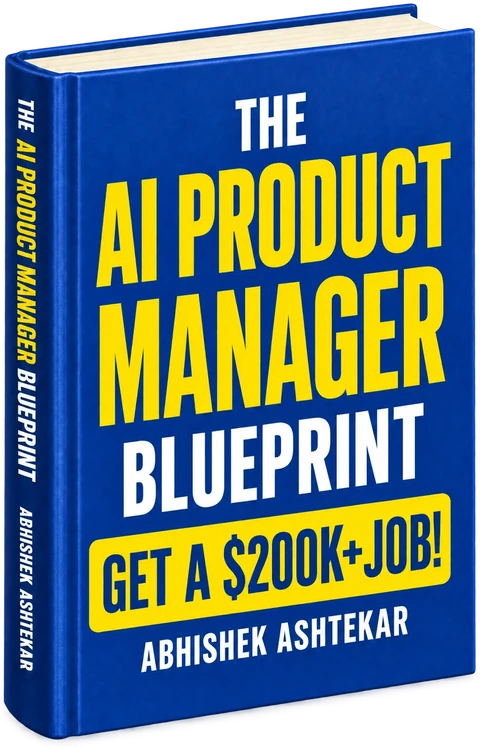
This guide is condensed from chapters 46 to 51 of The AI Product Manager Blueprint by Abhishek Ashtekar (first edition, 2026). The book goes several levels deeper, with the full walkthroughs, templates, and examples.
External sources cited
- Retrieval-Augmented Generation for Knowledge-Intensive NLP Tasks, Lewis et al. (arXiv)The paper that introduced RAG, the pattern behind Project 5.
- Embeddings, Machine Learning Crash Course, Google for DevelopersHow semantic similarity works in Projects 2 and 5.
- Why You Only Need to Test with 5 Users, Nielsen Norman GroupThe rule of thumb behind the five-user testing minimum.
- People + AI Guidebook, Google PAIRPatterns for explaining AI output and handling errors.
Last reviewed September 16, 2026. Tools, platforms, and salary data change; the book’s free resources page is updated as they move.
Browse all 88 chapters
This guide is the trailer.
The book is the whole system.
Everything this guide compresses, in full. The chapters, the skills, the portfolio projects, and the week by week roadmap that takes you from zero to hired.
- 88Chapters
- 22Skills
- 5Projects
- 1Roadmap