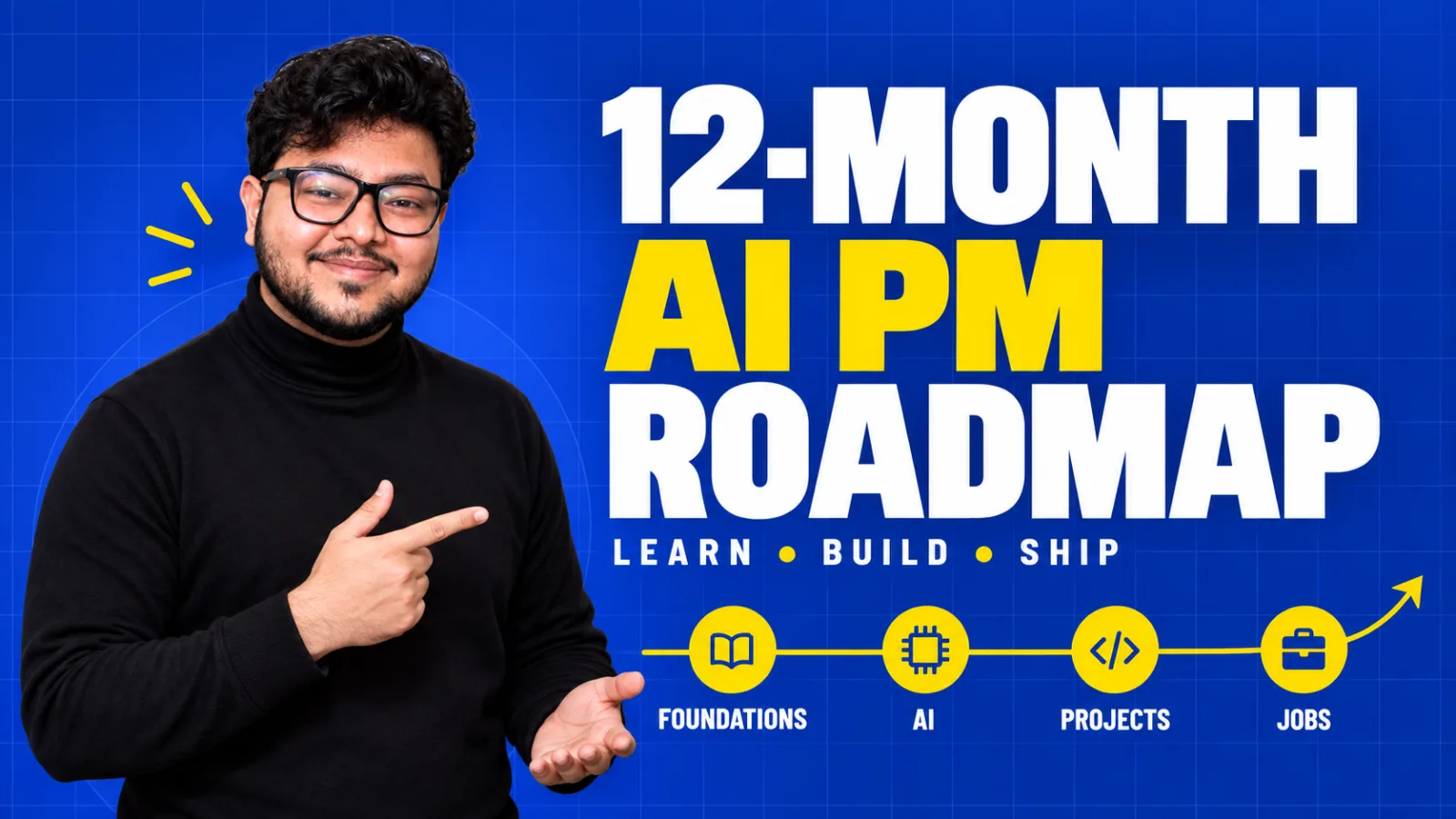
This AI product manager roadmap runs 12 months in four phases. Months 1 to 3 cover the role, product management fundamentals, and AI foundations. Months 4 to 6 deepen data literacy, LLMs, retrieval, agents, evaluation, and a responsible AI practice. Months 7 to 9 turn learning into five portfolio projects, a live portfolio, and job search materials. Months 10 to 12 run a targeted application campaign, interview practice, and offer decisions. It assumes 15 to 20 focused hours a week, and every week should end with something visible.
Key takeaways
- Twelve months is a planning model, not a deadline. The order matters more than the speed.
- The goal is not expertise in a year. It is being credible for a first opportunity that moves you closer to AI product work.
- Every week produces an artifact: notes, a teardown, SQL answers, a PRD, an eval result, an application, or a mock interview.
- If month 12 arrives without an offer, repair the weakest stage. Never restart at month one.
Five stages of your career.
Number of chapters in each stage · First edition
The month-by-month plan
- 01Month 1 · Understand the role and the market
Write your own definition of the AI PM role, map 20 relevant openings, and choose an initial direction: AI-enabled, applied AI, or core AI product work.
- 02Month 2 · Learn product management fundamentals
Tear down one product, run two or three user interviews, compare three AI products in one category, and write two one-page PRDs.
- 03Month 3 · Learn AI and machine learning foundations
Take a non-technical AI course and the core ML concepts, then write a "does this need AI?" memo for ten product problems.
- 04Month 4 · Build data literacy, SQL, and analytics
Learn enough SQL to answer product questions, learn funnels and cohorts, and build a metric tree for one AI product.
- 05Month 5 · Study LLMs and retrieval, then agents and prototyping
Build small learning prototypes and explain when to use prompting, retrieval, fine-tuning, an agent, or a no-code workflow.
- 06Month 6 · Practise evaluation, responsible AI, and product sense
Write evaluation plans, analyse risk in consequential domains, publish trade-off essays, and start recording mock interviews.
- 07Month 7 · Build the first two portfolio projects
Write product briefs, then build an AI interview coach and a voice-of-customer copilot with an evidence log.
- 08Month 8 · Add two projects and publish a portfolio
Rebuild a real product feature with AI, build a meeting-to-execution copilot, launch a simple portfolio site, and update your profile.
- 09Month 9 · Finish the fifth project and job search materials
Build a RAG knowledge assistant, polish three case studies, write a role-specific resume and cover letter base, and set up a tracker.
- 10Month 10 · Start a targeted application campaign
Run a weekly pipeline across realistic roles, stretch roles, and a few dream roles, pursue referrals, and track response rates by source and resume version.
- 11Month 11 · Prepare for interviews and portfolio walkthroughs
Practise product sense, metrics, strategy, technical AI, and behavioural rounds, and rehearse every project at three lengths.
- 12Month 12 · Improve conversion and evaluate offers
Diagnose the weakest funnel stage, repair it, and compare offers on product exposure and learning, plus growth as well as pay.
How the 12-month AI product manager roadmap works
Learning individual skills is only part of a career change. You also need an order for learning, practising, building proof, and entering the market. Without that order, it is easy to collect courses, jump between tools, build disconnected demos, apply too early, and mistake a weak process for a closed door.
The goal of this roadmap is not to make you an expert in one year. It is to make you credible for a first opportunity that moves you closer to AI product work. That might be an internship, an associate or junior product role, a product analyst or operations role, a customer-facing job at an AI company, a founder's office role, or another bridge into product decisions.
| Phase | Months | Goal | Proof you end with |
|---|---|---|---|
| 1. Understand | 1 to 3 | Role, market, PM fundamentals, AI foundations | Role definition, market map, teardown, two PRDs, "does this need AI?" memo |
| 2. Deepen | 4 to 6 | Data, LLMs, retrieval, agents, evaluation, responsible AI | SQL answers, metric tree, prototypes, eval plans, trade-off essays, first mock interviews |
| 3. Build | 7 to 9 | Five portfolio projects and job search materials | Five projects, three polished case studies, live portfolio, focused resume, tracker |
| 4. Apply | 10 to 12 | Targeted applications, interviews, offers | A measured pipeline, interview practice log, offers to compare |
Twelve months assumes 15 to 20 focused hours a week. Background, local market, and available time all change the pace, and adapting it is covered below. The month-by-month plan above is the checklist. The sections below explain what each month really involves.
Phase 1, months 1 to 3: understand the role, then learn the fundamentals
Month 1: understand the role and the market
Month one is orientation, not random building or mass applications. Learn what AI PMs do and how the role connects users, business goals, strategy, design, engineering, data, responsible AI, and delivery. The role is not ML engineering, not prompt writing, and not project coordination. It is product judgment applied to systems with model, data, evaluation, cost, latency, trust, and any safety constraints.
Open 20 current postings across company career pages, LinkedIn, startup boards, local job sites, and remote boards, including adjacent titles. Record responsibilities, experience levels, domains, tools, and the evidence employers ask for. Use a structured programme such as the IBM AI Product Manager certificate as a syllabus to compare against those postings, not as a hiring guarantee. For reading, Marty Cagan's Inspired covers how product teams think about value and feasibility, and Ethan Mollick's Co-Intelligence helps you think about AI as a collaborator.
- Your own one-paragraph definition of the role
- A 20-row market map
- An initial direction: AI-enabled PM, applied AI PM, or core AI PM
Beginners usually enter through AI-enabled or applied AI work. Your existing technical or domain background may point elsewhere. The types of AI PMs guide helps you decide.
Month 2: product management fundamentals
AI does not replace the operating system of product work. Learn to identify users, understand jobs and pain, compare alternatives, prioritise, define an experience, write requirements, sequence a roadmap, and measure outcomes.
- Tear down a product you use often: main user, job, core loop, value, friction, business model, likely metrics, one improvement.
- Run two or three short user interviews about behaviour, workarounds, frustration, and the consequences. Never ask people to invent features.
- Pick one AI category and compare three products on segment, promise, workflow, pricing, strengths, complaints, trust design, and failure modes.
- Write two one-page PRDs: problem, user, evidence, experience, user flow, minimum scope, non-goals, success measures, risks, and the open questions.
Month 3: AI and machine learning foundations
You will not train models, but you must understand enough to work with technical teams. Start with AI for Everyone, then the introductory modules of Google's Machine Learning Crash Course that match your background.
Learn the difference between deterministic rules and probabilistic systems, then training data, inference, classification, regression, thresholds, overfitting, and the evaluation. Add generative AI vocabulary: tokens, prompts, context, embeddings, retrieval, hallucination, fine-tuning, and tools.
Take ten product problems and decide whether each needs AI. Rules or filters win when logic is stable and must be transparent. AI earns a place when the product needs flexible understanding, prediction, generation, classification, recommendation, or synthesis. Write two sentences of reasoning per problem.
Phase 2, months 4 to 6: deepen data and AI judgment
Month 4: data literacy, SQL, and analytics
Learn enough SQL to filter and group rows, then join tables, so you can answer basic product questions without waiting. Focus on questions, not syntax collection. Learn activation, engagement, retention, conversion, churn, funnels, cohorts, North Star metrics, and experiment basics.
Then add AI-specific measurement. A writing assistant tracks accepted and edited suggestions, time saved, repeat use, and harmful-output reports. A support copilot tracks task time, agent approval, policy errors, escalation, satisfaction, latency, and the cost. A retrieval assistant tracks groundedness, retrieval relevance, citation support, and unanswered questions.
A metric tree for one AI product with business, user, quality, safety, and the cost branches, plus one sentence naming a metric that could improve while the product gets worse.
Month 5: LLMs and retrieval, agents and prototyping
Study what language models do well, how prompts and context shape output, when retrieval grounds answers, when fine-tuning may help, and how tool-using agents create both value and risk. Prompting defines the task, context, constraints, examples, and the output. Context engineering decides what information the system receives, from where, with which permissions. Retrieval fits when answers must use private or current sources. Agents need step limits, permissions, approval, logs, and the recovery.
Build several small learning prototypes, such as document question answering, customer-feedback themes, or meeting notes to actions. The tool matters less than what you observe: weak outputs, latency, missing context, unclear controls, and failure recovery. Deep dives: RAG for Product Managers and AI agents for Product Managers.
A one-page comparison of prompting, retrieval, fine-tuning, an agent, and a no-code workflow, with one appropriate use, one limitation, and one evaluation need for each.
Month 6: evaluation, responsible AI, and product sense
Turn knowledge into judgment. Define evaluations for several products and show that "good" changes by task: a creative tool values usefulness and variety, a policy assistant needs groundedness and honest refusal, a coding assistant needs working and secure code, and an agent needs task completion without unauthorised actions. The method is in AI evals for Product Managers.
Study bias, fairness, privacy, safety, transparency, and the human oversight, and apply them to consequential domains such as hiring, health, education, or any lending decision. Use the NIST AI Risk Management Framework as your vocabulary. Write short essays on real trade-offs: accuracy versus speed, automation versus control, personalisation versus privacy, quality versus cost.
Record answers to product design, metrics, AI explanation, trade-off, and failure questions. Check whether you clarify the goal, lead with the user, recommend, define success, and state uncertainty. Starting in month six gives you six months to improve instead of six days.
Phase 3, months 7 to 9: build public proof
Month 7: the first two portfolio projects
Build an AI interview coach and a voice-of-customer copilot, or equivalent projects in your domain. Before building, write the brief: user, job, current workflow, evidence, AI's role, minimum scope, non-goals, metrics, failure modes, trade-offs, and safeguards. A working interface without this reasoning is a demo, not an AI PM case study. Keep an evidence log of screenshots, configurations, failed examples, revisions, feedback, and the eval results.
Month 8: two more projects and a live portfolio
Rebuild a real product feature with AI and build a meeting-to-execution copilot. The rebuild tests whether you can improve an existing experience. The meeting project tests extraction, ownership, privacy, review, and the integration. Launch a simple portfolio site you can update easily, with each case study covering problem, user, research, alternatives, decision, AI capability, workflow, scope, metrics, evaluation, risk, trade-offs, and lessons. Update your LinkedIn headline and story, and pin work in Featured.
Month 9: the fifth project and job search materials
Build a RAG knowledge assistant with defined users, authorised sources, a permission model, citations, refusal behaviour, evaluation, latency, and the cost. A generic chatbot is weak proof. A product with explicit boundaries and evidence is strong proof.
Then write a role-specific resume that shows decisions ("designed a permission-aware knowledge assistant, defining retrieval flow, scope, groundedness evaluation, and failure handling"), a cover letter base, and a job tracker with company, role, source, date, fit, resume version, referral, follow-up, stage, and learning.
- Five projects, three or more polished case studies
- A live portfolio and an updated LinkedIn profile
- A focused resume and cover letter base
- A repeatable application tracker
All five project briefs are in 5 AI PM portfolio projects, the site structure is in how to build an AI PM portfolio, and the resume format is in the AI PM resume guide.
Phase 4, months 10 to 12: run the search, win the offer
Month 10: a targeted application campaign
Treat the search as a measured campaign, not one night of mass submissions. Build a weekly pipeline across realistic entry points, stretch roles, and dream roles, and give most effort to roles that match your current evidence. Use several sources, not one job board. For referrals, send short, specific messages that mention one relevant project, and ask for perspective before asking for an introduction. Track response rates by role type, seniority, source, and the resume version. The full system is in the three-bucket job search.
Month 11: interviews and portfolio walkthroughs
Keep applying while practice intensifies. Prepare product sense, metrics, strategy, technical AI, behavioural, case, and all take-home questions. Prepare product-level explanations of retrieval, fine-tuning, hallucination, evaluation, latency, cost, and the human review. Build behavioural stories about learning, conflict, feedback, failure, ambiguity, and the trade-offs. Rehearse every project in 3, 5, and 10 minute versions. Question banks and worked answers are in AI PM interview questions.
Month 12: improve conversion and evaluate offers
Do not restart the roadmap. Repair its weakest stage.
| If this happens | Revisit |
|---|---|
| Applications get no conversations | Targeting, resume clarity, visible proof, role seniority |
| First interviews do not progress | Answer structure, fundamentals, metrics, communication |
| Final rounds do not convert | Trade-off reasoning, business impact, case evidence, executive presence |
Evaluate offers beyond salary: responsibilities, manager, team, product exposure, user access, learning, stability, location, and the growth path. A role with direct AI product experience can create more long-term value than a better-paid role far from the work, but decide within your real financial situation. How to negotiate your first AI PM offer covers the conversation itself.
A sample weekly schedule (15 to 20 hours)
Protect regular sessions rather than relying on motivation. Here is one way to split a typical week in phases 1 and 2.
| Session | Time | What you do |
|---|---|---|
| Two weekday evenings | 2 hours each | Course material and notes on this month's topic |
| One weekday evening | 2 hours | Apply it: a teardown, SQL practice, a prompt experiment |
| One weekday evening | 1 to 2 hours | Write: PRD sections, an essay, a LinkedIn post |
| Saturday | 4 to 6 hours | Build: the month's main deliverable or prototype |
| Sunday | 2 to 3 hours | Feedback and review: share work, reflect, plan next week |
In phase 3, shift most hours to building. In phase 4, shift them to applications, networking, and the mock interviews. Every week should end with something visible, whatever the phase.
How to adapt the AI product manager roadmap to your starting point
Choose one or two domains to explore, such as support, education, finance, developer tools, enterprise knowledge, or workflow automation. A domain gives your projects a coherent story. It is a direction, not a lifetime commitment. Then adjust the timeline to your background.
| Starting point | How to adapt | Typical length |
|---|---|---|
| Complete beginner, 15 to 20 hours a week | Follow the plan as written | About 12 months |
| Complete beginner, 8 to 10 hours a week | Same order, each month stretched | Around 18 months |
| Existing product manager | Compress months 1, 2, and 4. Spend the time on months 5, 6, and projects close to your current product. | Much shorter, often a few months |
| Engineer or data scientist | Compress months 3 to 5. Spend extra time on month 2 discovery and month 6 product sense. | Shorter than the full plan |
| Student or recent graduate | Run the plan alongside studies and aim month 10 at internships | Aligned with internship cycles |
More hours do not help if they produce burnout or shallow work. Pick a schedule you can sustain. The no-degree version of this plan, with positioning advice, is in how to become an AI PM without a degree.
Certificates, tools, and the exam codes change. The sequence does not.
Keep learning sources small and current: product fundamentals, AI foundations, data practice, official model documentation, the Scrum Guide, the NIST framework, analytics material, and interview practice. Certificates provide structure and vocabulary, but they do not prove product judgment. Always verify a provider's page before enrolling. Microsoft, for example, retired its AI-900 exam in June 2026 and moved Azure AI Fundamentals to AI-901, which is exactly why this roadmap is organised around capabilities rather than course names. Our AI PM courses guide keeps the options sorted by need.
What to do if month 12 arrives without an offer
Treat rejection as data without pretending every hiring decision is in your control. Market conditions, location, timing, competition, and the company needs all play a part. What you do control is the next cycle.
- Look at your tracker and find the stage where most candidates like you drop out.
- Pick the single biggest fix from the conversion table above.
- Strengthen one case study or add one project that matches the roles that did respond.
- Tighten targeting toward the bucket that produced the most conversations.
- Keep a steady weekly rhythm rather than a panicked burst.
A stronger portfolio, sharper interview skill, clearer targeting, and real market feedback are all progress. Extend the roadmap rather than reading a planning date as a verdict.
Mistakes that derail an AI product manager roadmap
- Starting to build before understanding the role and the market.
- Learning AI tools before product fundamentals.
- Letting months pass without a visible artifact.
- Building demos that skip the brief, evaluation, and the failure cases.
- Delaying mock interviews until interviews are scheduled.
- Applying in month 2 instead of month 10, and burning referrals early.
- Stacking certificates instead of shipping projects.
- Restarting at month one after a setback.
By the end of the roadmap you should be able to explain the role, use product language, understand AI systems at a practical level, analyse data, design workflows and evaluate them, identify risk, communicate trade-offs, and show five coherent projects. That is what makes you credible. The overview version of this path is in how to become an AI Product Manager, and the book's Chapter 43 walks through every month in more depth.
Questions & answers
8 questions readers ask most, answered straight.
What is the roadmap to become an AI product manager?
A practical roadmap runs about 12 months in four phases: understand the role and learn fundamentals in months 1 to 3, deepen data and AI judgment in months 4 to 6, build five portfolio projects and job search materials in months 7 to 9, and run a targeted job search with interview practice in months 10 to 12.
How many hours a week do I need for the 12-month AI PM roadmap?
About 15 to 20 focused hours a week supports the 12-month plan for many learners. At 8 to 10 hours a week, expect the same sequence to take around 18 months. Consistency matters more than intensity, so choose a schedule you can maintain.
What should I study first to become an AI product manager?
Spend month one understanding the role and reading 20 real job postings, then learn product management fundamentals in month two before AI foundations in month three. Product thinking first makes every AI concept easier to apply to real decisions.
When should I start applying for AI PM jobs?
Start a targeted campaign around month 10, once you have projects, case studies, a portfolio, and a focused resume. Applying much earlier usually produces rejections that teach little and uses up referrals before your proof is ready.
Can I follow this roadmap if I already work as a product manager?
Yes, and much faster. Compress the product fundamentals and analytics months, then focus on LLMs, retrieval, agents, evaluation, responsible AI, and one or two projects close to your current product. An internal AI initiative is often the quickest route.
What if I do not get a job after 12 months?
Use your tracker to find where your funnel breaks, fix that stage, and continue. Common fixes include clearer targeting, a stronger case study, better answer structure, or deeper trade-off reasoning. Extend the plan rather than restarting it from month one.
Do I need to build all five portfolio projects?
Five projects give you coverage of the main AI product patterns, but you can start applying with three strong case studies. Quality and honest evaluation matter more than the count.
Is a certificate part of the AI PM roadmap?
A structured certificate can serve as a syllabus in the first months if you need discipline, but it is optional. The roadmap relies on projects, case studies, and interview practice to prove readiness, because certificates only show that you studied.
Where this comes from
This guide is condensed from chapters 43 and 44 of The AI Product Manager Blueprint by Abhishek Ashtekar (first edition, 2026). The book goes several levels deeper, with the full walkthroughs, templates, and examples.
External sources cited
- Machine Learning Crash Course, Google for DevelopersMonth 3 ML foundations.
- AI for Everyone, DeepLearning.AIMonth 3 non-technical AI introduction.
- Co-Intelligence, Ethan Mollick (Penguin Random House)Month 1 reading on working with AI.
- AI Risk Management Framework, NISTMonth 6 responsible AI vocabulary.
- The Scrum GuideDelivery fundamentals referenced throughout.
Last reviewed September 16, 2026. Tools, platforms, and salary data change; the book’s free resources page is updated as they move.
Browse all 88 chapters
This guide is the trailer.
The book is the whole system.
Everything this guide compresses, in full. The chapters, the skills, the portfolio projects, and the week by week roadmap that takes you from zero to hired.
- 88Chapters
- 22Skills
- 5Projects
- 1Roadmap