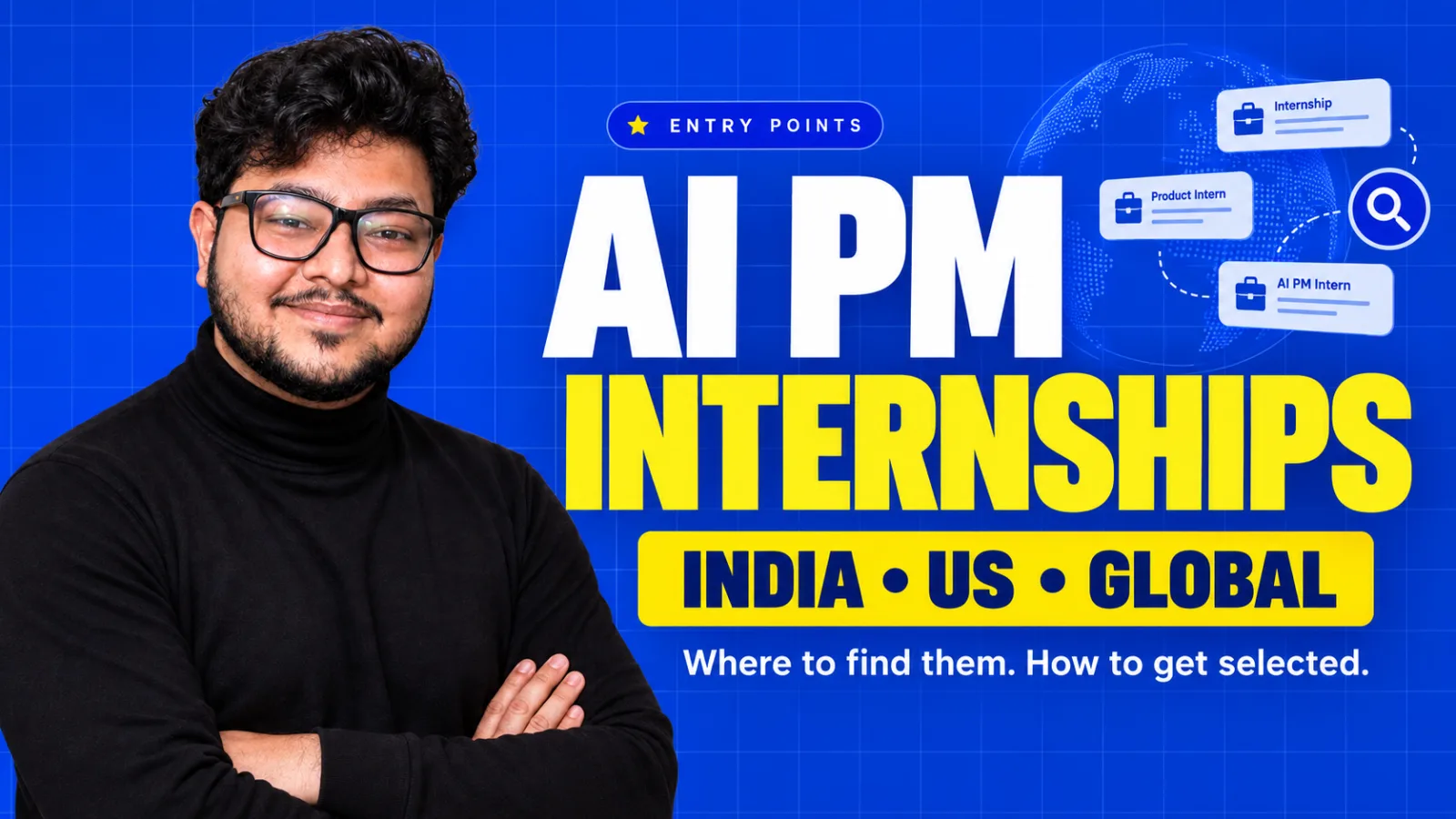
To find an AI product manager internship, search adjacent titles as well as the exact one: Product Management Intern, Product Analyst Intern, Product Operations Intern, Founder's Office Intern, and AI Implementation Intern. In India, combine Internshala, Unstop, LinkedIn, Wellfound, Cutshort, college placement portals, and company career pages. In the US, start with Handshake, university portals, LinkedIn, and the company early-career pages, because many formal summer programmes recruit months ahead. Check eligibility and real product exposure before applying, lead with one relevant portfolio project, and prioritise paid internships with clear mentorship.
Key takeaways
- The title is only a clue. Real product exposure means users, decisions, evidence, and the collaboration, whatever the role is called.
- Run two tracks at once: formal programmes with fixed deadlines, and rolling startup roles you check every week.
- Read the location and work-authorisation rules before writing a long application. "Remote" rarely means "anywhere."
- Unpaid "learning" roles that are really sales, data entry, or unlimited labour are not product internships.
What counts as an AI product manager internship?
Very few listings say "AI Product Manager Intern." Most real opportunities hide under adjacent titles, and some listings that do say "AI" contain no product work at all. So judge every role by its responsibilities, not its label.
Titles to search
- Product Management Intern and Product Intern
- AI Product Intern
- Product Analyst Intern
- Product Operations Intern
- Product Strategy or Product Research Intern
- Founder's Office Intern
- Business Analyst Intern
- Implementation or Customer Success Intern at an AI software company
- Technical Product Intern or Data Product Intern
- AI Strategy or AI Operations Intern
Add keywords such as GenAI, LLM, AI automation, SaaS, analytics, and the customer insights to surface more roles.
The product exposure test
| Signs of a real product internship | Signs it is not |
|---|---|
| Customer research or interviews | Cold calling and lead generation |
| Writing requirements or product documentation | Social media posting quotas |
| Competitor and market analysis | Data entry with no analysis |
| Feature testing and feedback analysis | Vague "exposure" with no defined work |
| Evaluating AI outputs | Selling a course or product to your network |
| Working with founders, designers, or engineers | No named supervisor |
Product exposure can exist in product operations, analysis, implementation, customer success, or a founder's office role. It does not exist in a role with no users, decisions, evidence, collaboration, or learning, however impressive the title.
Where to find AI product manager internships in India
Your first opportunity in India is unlikely to come from one perfect portal. It comes from searching several sources consistently.
| Source | Best for |
|---|---|
| Internshala | Product management internships with filters for location, remote, duration, stipend, and job offer potential |
| Unstop | Internships plus case competitions and campus challenges that double as portfolio evidence |
| Vacancies, posts from founders and recruiters, and the people to contact after applying | |
| Wellfound | Startup roles by location and remote status, including India |
| Cutshort | Tech and tech-adjacent roles in Indian startups: product, analytics, customer success |
| Y Combinator jobs | YC startups with India and remote views |
| Naukri, foundit, hirist, Instahyre | Fresher and analyst roles, plus market research on what employers ask for |
| Prosple and college portals such as Superset | Internships and fresher roles through your institution |
| AICTE Internship Portal | Technical and virtual internships for students |
| Company career pages | Roles that appear before or instead of job board listings |
Unstop competitions deserve special mention. A thoughtful product case, AI business challenge, or teardown can become a portfolio case study even if you do not win. Keep the problem, assumptions, research, decisions, and the proposed measurement, not just the final slides.
Build a company watchlist
Track Indian AI-first startups and enterprise software firms. Add analytics businesses and automation companies, plus fintech, edtech, and any consumer app using AI at scale. Follow the problems they solve, not just fashionable labels. Useful locations include Bengaluru, Delhi NCR (Gurugram and Noida), Mumbai, Pune, Hyderabad, Chennai, or a remote setup. Search where you can realistically work or relocate. What these roles pay once you convert is covered in AI PM salary in India.
Where to find AI product manager internships in the US
| Source | Best for |
|---|---|
| Handshake | Students and recent graduates, especially with university access |
| University career portals (often run on Symplicity) | Roles restricted to your institution, with less competition |
| RippleMatch and WayUp | Early-career matching for internships and entry roles |
| Filters for internship and recency, remote options, plus recruiter and founder posts | |
| Company early-career pages | Formal summer programmes, which often open a term or more before they start |
| Wellfound and Y Combinator jobs | Startups outside formal campus recruiting |
| Community-maintained internship lists on GitHub | Aggregated product management internship postings to verify at the source |
Large employers often recruit interns well before the start date, and some close applications once they have enough candidates. Career fairs, university events, and early-career pages can matter as much as public boards. Start early, log deadlines, and have your resume and portfolio ready before the cycle opens.
What about APM programmes?
Several large technology companies run Associate Product Manager or rotational product programmes for graduates and interns. They are prestigious, highly competitive, often tied to campus recruiting and specific graduation dates, and they change year to year, so check each company's careers page directly. Treat them as dream-bucket targets, not your whole strategy. Smaller companies and startups hire product interns year-round with far less competition.
Remote and global AI PM internships
A global search brings more opportunities, more competition, and more eligibility rules. Remote often means remote within one country, limited to certain universities, tied to a local payroll entity, or dependent on existing work authorisation.
Five checks before any international application
- Location: where must you live?
- Work rights: do you need existing authorisation or sponsorship?
- Enrolment: must you be a current student or graduate by a certain date?
- Time zone: which hours does the team expect you online?
- Hiring route: can they employ or contract someone in your country?
If the gap on any check is unrealistic, move on. Never answer eligibility questions dishonestly.
Global sources worth using
- Startup boards: Wellfound and Y Combinator jobs support remote filters. Startups use titles like Product Associate, Founder's Office, Product Operations, or AI Operations.
- Remote boards: We Work Remotely, Remote.co, and Remotive surface product-adjacent roles. Beginner AI PM internships are rare and competitive there, so confirm hiring countries on the original listing.
- Venture and accelerator portfolio job boards: great for discovering AI startups. Even with no open role, the portfolio becomes a watchlist.
- Mission-driven organisations: Idealist lists roles in education, health, climate, accessibility, and the civic tech, often centred on digital products or responsible AI.
If you are targeting Europe, search country by country and language by language rather than treating Europe as one market. And do not let a global search replace local progress. A local internship or startup project can create the proof that makes international work realistic later.
Run two search tracks at the same time
| Formal track | Rolling track | |
|---|---|---|
| What it covers | Summer programmes, graduate schemes, APM cycles | Startups, founder posts, portfolio boards, contract projects |
| Timing | Fixed windows, often months ahead | Year-round, check weekly |
| What wins | Early preparation and a polished application | Relevance and speed, with specific outreach |
| Your job | Calendar every deadline | Keep a weekly discovery habit |
Track each role with company, role, country, hiring location, remote rule, work authorisation, employment type, source, deadline, date applied, resume version, project highlighted, contact, follow-up date, and result. Add one column called "reason for fit." If you cannot fill it with one clear reason, the role probably does not deserve a tailored application.
The weekly internship search loop
- Discover new roles and company posts across your chosen sources.
- Filter for real product exposure, reasonable terms, and eligibility.
- Tailor the resume summary, top bullets, and the project you lead with.
- Apply carefully and review every auto-filled field.
- Follow up once, when you have a relevant person and something specific to say.
- Learn from repeated requirements and responses, then improve one thing.
Balance quality and volume. A handful of strong applications beats a careless batch, but applying so rarely that you never reach the market stalls you too. Use the search as feedback: if roles keep asking for SQL, build it; if they keep asking for user research, run interviews for a project; if retrieval and evaluation keep appearing, strengthen your RAG case study. The same system for full-time roles is in the three-bucket job search.
Match your proof to the company
Internship reviewers do not expect years of experience. They look for evidence that you understand their kind of product. Lead with the project closest to their problem.
| Company type | Lead with |
|---|---|
| Customer support AI | Voice-of-customer copilot or grounded-answer work |
| Enterprise knowledge or search | RAG knowledge assistant, with sources and permissions |
| Productivity and collaboration tools | Meeting-to-execution copilot |
| Career tech or edtech | AI interview coach |
| Roles heavy on analytics | Metrics, experiments, SQL work, and evidence-based decisions |
| Startups at an early stage | Anything you shipped, plus research and documentation |
All five project briefs are in 5 AI PM portfolio projects. Your proof must also travel: a recruiter abroad may not know your college, but they understand a clear user problem, a tested prototype, and an honest result.
How to apply for an AI PM internship and get selected
A weak application says you want to learn. A strong one shows you understand the company's product, have practised relevant work, and can contribute while learning. A reviewer should see four layers without reconstructing your story:
- Company context. You know what they build, for whom, and why this role exists.
- Role fit. Your resume summary and first bullets match the responsibilities.
- Relevant proof. One project that resembles their problem, explained by user and decision, not just its title.
- A clear message. A short note that connects the three.
Tailoring changes emphasis, never facts. Do not add a skill because the vacancy mentions it, hide eligibility limits, or inflate project results. Every claim can become an interview question. Resume structure for this is in the AI PM resume guide.
Hi [Name], I've applied for the [Role] internship. [Company]'s work on [specific product or workflow] stood out because [genuine observation]. I recently built [project], where I [one decision and result]. That experience with [relevant skill, such as evaluating AI answers or synthesising customer feedback] feels close to what the team is working on. My portfolio has the case study: [link]. Thank you for considering my application.
Reaching out to early-stage startups directly
Many small AI startups have no formal internship programme. A short, specific note can still start a conversation.
Hi [Founder], I've been using [product] and noticed [one specific user problem or friction]. I built [related project] and learned [one relevant insight]. Would your team be open to intern-level or project-based help with [user research / product documentation / feedback analysis / testing AI outputs]? Happy to share a one-page teardown if useful.
Keep the first request small. Do not ask a founder to design a role around your need for experience, and do not send a speculative redesign that ignores constraints you cannot see.
How to prepare for an AI product management internship interview
Internship interviews test potential, not years of ownership. Here are the five signals interviewers look for and how to show each.
| Signal | How to show it |
|---|---|
| Curiosity | Ask about users, workflows, metrics, feedback, and the constraints the team faces |
| Learning ability | Describe what you studied, built, tested, got wrong, and improved |
| Product thinking | Start from the user problem, not a favourite AI tool |
| Communication | Explain your project at one-minute and five-minute depths |
| Preparation | Give specific reasons for choosing this company |
- Your introduction: background, direction, strongest AI product evidence, and why this role, in under a minute.
- Your key project: problem, user, workflow, the AI's role, trade-offs, evaluation, result, limits, and the next step. Reread the case study first.
- Product questions: clarify user and outcome, name constraints, pick a focused first version, define success and guardrails.
- AI basics in plain language: LLMs, retrieval, prompting, evaluation, hallucination, human review, cost, and the latency.
- Behavioural stories: learning, collaboration, feedback, a mistake, and ownership, from college, work, volunteering, or projects.
End with good questions: which user problem the team is prioritising, how it evaluates AI features, what the intern will own, and who provides guidance. Send a short thank-you note that mentions one specific point. More question practice is in AI PM interview questions.
Stipends, unpaid roles, and internship scams
Prioritise paid internships. A modest stipend can still work when the role is short, well defined and mentored, and it gives real product exposure. But "learning" is not payment for unlimited labour.
- You are asked to pay for training, equipment, software, or a background check
- The duties are never defined, or the "product" role is really sales
- Only a certificate is offered for full-time work
- The email domain cannot be verified, or everything happens over chat
- Identity or banking details are requested too early
- Nobody can explain the product, team, or compensation
Questions to ask before you accept
- What will I work on in the first month?
- Who will supervise me, and which teams will I work with?
- Will I see real users or feedback?
- What will I produce, and how is success judged?
- Is conversion to a full-time role possible?
- May I describe non-confidential work in my portfolio?
Confirm the stipend, hours, location, equipment, duration, and the ownership of work in writing.
Turn the internship into your next role
Getting selected starts the next proof cycle. During the internship, look for user exposure, product decisions, feedback, analytics, documentation, evaluation work, and cross-functional collaboration. Ask for feedback regularly, record your outcomes as you go, and get permission before using non-confidential work in a case study. A strong internship turns portfolio practice into real experience, which is exactly what the next application needs.
From there, the path continues through bridge roles and your first PM title, as described in the AI PM career path. If you are still building the basics, start with how to become an AI Product Manager. The book's Chapters 59 to 62 cover internship search and selection in depth, and the free resources pack includes the tracker template.
Questions & answers
8 questions readers ask most, answered straight.
How do I get an AI product manager internship with no experience?
Build one or two scoped AI projects with case studies, then apply to adjacent titles such as product analyst, product operations, founder's office, and product management intern. Lead each application with the project closest to the company's problem, and reach out to early-stage startups directly with a specific offer of help.
Where can I find product management internships in India?
Use Internshala, Unstop, LinkedIn, Wellfound, Cutshort, Y Combinator's job board, Naukri, your college placement portal, the AICTE Internship Portal, and company career pages. Search adjacent titles too, and check that the listed work includes real product tasks.
Are AI product manager internships paid?
Many are, and you should prioritise paid roles. Stipends vary widely by company, city, and the country. Be cautious with unpaid full-time work, roles that only offer a certificate, and anything that asks you to pay for training or equipment.
When should I apply for product management internships in the US?
Formal summer programmes at larger companies often open during the previous academic term and can close early, so start preparing months ahead. Startups hire on a rolling basis, so check startup boards and founder posts every week alongside the formal cycle.
Can I get a remote AI product manager internship?
Yes, but remote internships are competitive and often limited to certain countries, time zones, or students at specific universities. Always check location and work authorisation rules on the original listing before applying.
Do I need to be a student to get a product management internship?
Not always. Many formal programmes require current enrolment, but startups, founder's office roles, and project-based opportunities often accept recent graduates and career switchers. Read the eligibility section of each listing.
Can a non-CS student get an AI product manager internship?
Yes. Product internships value curiosity, communication, product thinking, and evidence of learning. Pair your background with AI literacy and a relevant portfolio project, and target companies where your domain knowledge is useful.
What do product management interns actually do?
Typical work includes customer research, competitor analysis, writing product documentation, testing features and AI outputs, analysing feedback and data, supporting launches, and working with designers, engineers, and the founders on scoped tasks.
Where this comes from
This guide is condensed from chapters 59 to 62 of The AI Product Manager Blueprint by Abhishek Ashtekar (first edition, 2026). The book goes several levels deeper, with the full walkthroughs, templates, and examples.
External sources cited
- Product management internships, InternshalaIndian listings with stipend and remote filters.
- HandshakeEarly-career platform used by many US universities.
- AICTE Internship PortalGovernment-backed internship listings for students in India.
- 2026 Product Management Internship list (GitHub, community maintained)Aggregated postings to verify on the employer site.
- Y Combinator startup jobsStartup roles filterable by role, location, and a remote filter.
Last reviewed September 16, 2026. Tools, platforms, and salary data change; the book’s free resources page is updated as they move.
Browse all 88 chapters
This guide is the trailer.
The book is the whole system.
Everything this guide compresses, in full. The chapters, the skills, the portfolio projects, and the week by week roadmap that takes you from zero to hired.
- 88Chapters
- 22Skills
- 5Projects
- 1Roadmap