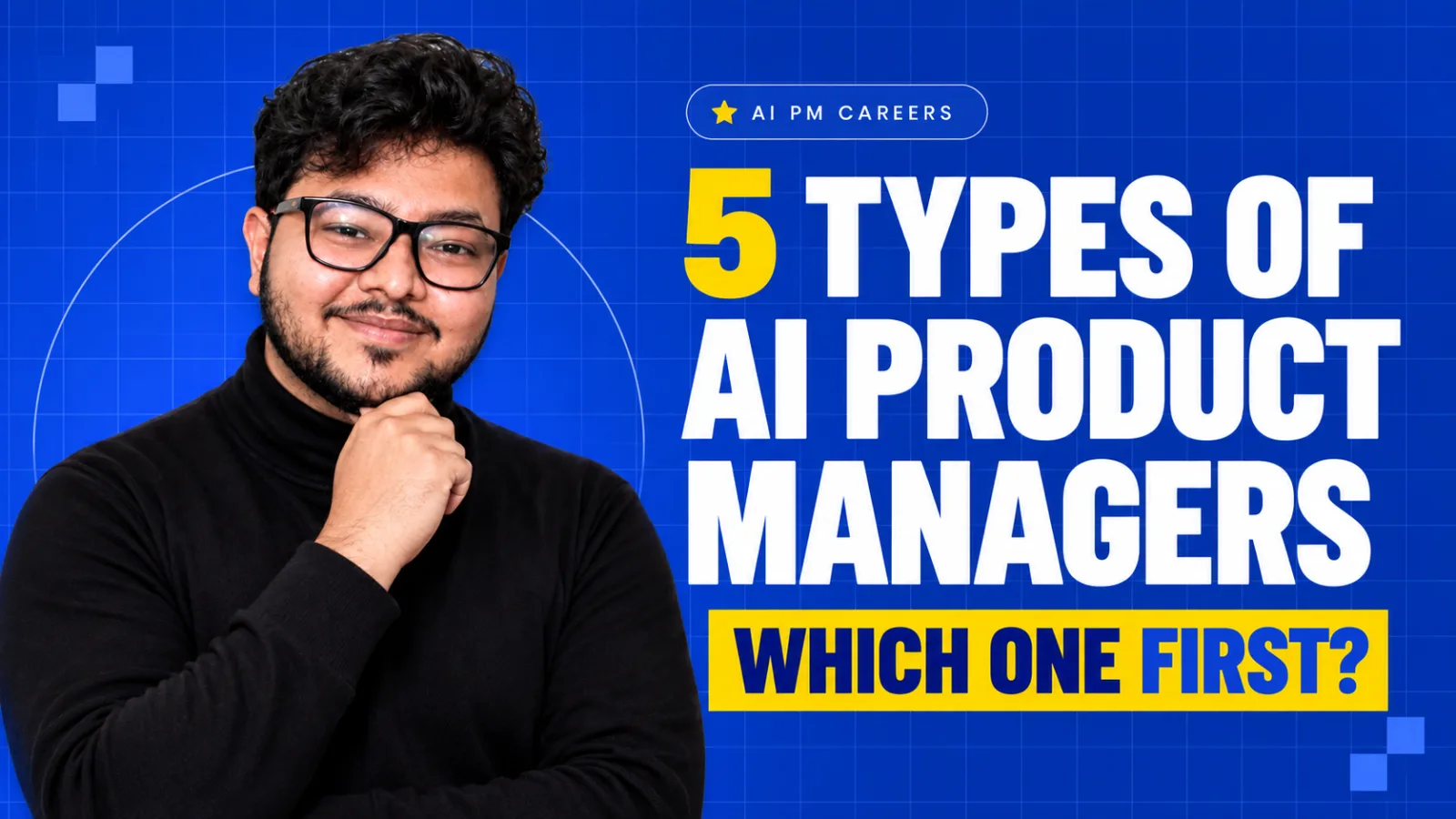
There are five main types of AI product managers. Machine learning PMs own products that predict, rank, classify, or recommend. Data PMs own the pipelines, platforms, and the analytics that AI depends on. NLP PMs own search, translation, support automation, and other language products. Computer vision PMs own products that interpret images, video, and any camera feed. Generative AI PMs turn foundation models into copilots, assistants, and AI agents inside real workflows. Roles often overlap, so read the product and systems in a job post, not the title. For most beginners, applied generative AI is the most practical first target.
Key takeaways
- "AI Product Manager" is a family of jobs. Two people with the same title can work on completely different systems.
- Identify the type from what the posting describes: rankings and fraud mean ML. Pipelines mean data. Chat and search mean NLP, cameras mean vision, copilots and RAG mean generative AI.
- Applied generative AI is the most accessible starting point because you can prototype real workflows without training models.
- Your first type is a direction, not a life sentence. Product judgment, evaluation, and a gift for communication all transfer across all five.
Why "AI product manager" is not one job
AI Product Manager is a broad title covering several kinds of product work. One person improves recommendations on a streaming platform. Another manages an internal data platform. A third builds a customer support assistant. A fourth works on medical images or factory inspection cameras. All four turn AI capability into a useful product, but their users, systems, risks, and the daily decisions are very different.
Knowing the types does two things for you. Job descriptions stop looking contradictory, because you can see which kind of work sits behind the title. And your learning and portfolio get a direction, which makes you far easier to hire than someone with a scattered collection of AI demos.
The 5 types of AI product managers at a glance
| Type | Typical products | What you must understand | Beginner access |
|---|---|---|---|
| Machine learning PM | Recommendations, fraud detection, search ranking, forecasting, pricing, moderation | Prediction targets, training data, precision and recall, experiments | Harder: often expects data and experimentation depth |
| Data PM | Pipelines, warehouses, analytics platforms, metric layers, data catalogues, data APIs | Data quality, freshness, lineage, permissions, metric definitions | Moderate: good fit for analysts |
| NLP PM | Search, translation, support automation, transcription, document processing | User intent, messy language, output quality, trust | Moderate: overlaps heavily with generative AI |
| Computer vision PM | Visual search, medical imaging, inspection, retail shelf monitoring, robotics | Image quality, sensors, real-world conditions, latency, human review | Harder: domain or technical background helps |
| Generative AI PM | Copilots, AI search, assistants, meeting tools, coding tools, agents | Prompt and context design, retrieval, evaluation, cost, trust | Most accessible: prototype with existing models |
Every type still rests on the same product foundation described in the 22 AI PM skills. What changes is which technical skills get the most weight.
A second lens: how close you sit to the model
Job postings also differ by how close the role sits to the underlying AI. This lens cuts across all five types, and it is often the more useful one when you plan your first move.
| Level | What the work looks like | Good first target if you are |
|---|---|---|
| AI-enabled PM | Adds AI capabilities to a broader product, such as smart search inside a banking app | Coming from business, operations, or a non-technical field |
| Applied AI PM | Builds products where AI is the core experience: copilots, recommendations, automation | Comfortable prototyping and evaluating model output |
| Core or platform AI PM | Works on models, APIs, infrastructure, data platforms, and developer tools that other teams build on | An engineer, data scientist, or experienced technical PM |
So a "generative AI PM" might be AI-enabled (adding a drafting feature to a CRM), applied (owning an AI meeting assistant), or platform (owning the model API other teams use). Beginners usually enter at the first two levels.
Type 1: Machine learning product manager
An ML PM works on products that use models to predict, rank, classify, recommend, forecast, or personalise. There may be no chat interface at all, yet machine learning sits at the centre of the experience. When a streaming service suggests what to watch, a marketplace decides which products appear first, or a bank flags an unusual transaction, an ML product is making that call.
ML PMs rarely train models themselves. They decide what the model is being asked to predict, which data it may use, how performance is measured, and what happens when a prediction is wrong. You need the basics: classification predicts a category (fraudulent or not), regression predicts a number (next month's demand).
The trade-offs ML PMs own
- A fraud model that catches more fraud may also block more genuine customers.
- A recommender that lifts clicks may lower satisfaction by showing the same kind of content repeatedly.
- A ranking change that boosts short-term engagement may weaken the long-term experience.
This path suits people who enjoy data, experiments, and the metrics, and it often touches revenue and safety directly. The challenge is depth: ML PM roles tend to expect stronger knowledge of data quality, experimentation, evaluation, and the system constraints. Google's Rules of Machine Learning is a classic read for anyone heading this way, and the recommendation systems course covers the most common ML product.
Type 2: Data product manager
A data PM owns products whose value comes from collecting, organising, transforming, accessing, or analysing data: analytics platforms, pipelines, warehouses and lakehouses, reporting tools, data catalogues, business intelligence, metric layers, and data APIs. Some serve external customers. Many serve teams inside the company.
Data products matter enormously to AI, because AI depends on trustworthy information. A recommender cannot personalise with incomplete user data. An enterprise assistant cannot answer correctly from outdated documents. A forecast is useless when two teams define "active customer" differently.
Data PMs work with data engineers, analysts, data scientists, governance, and the security team, and they need to understand quality, freshness, ownership, permissions, lineage, and the metric definitions. A polished dashboard is worthless if nobody trusts the numbers behind it. The work is less visible than a public chatbot, and often more important. It is also a strong route into broader AI product work, since so many AI failures start as data failures. The classic paper Hidden Technical Debt in Machine Learning Systems explains why.
Type 3: NLP product manager
Natural language processing covers systems that understand, search, classify, translate, summarise, transcribe, or generate language. NLP PMs work on search, support automation, translation, voice assistants, sentiment analysis, document processing, ticket classification, and conversational products. Since so much work runs on emails, contracts, policies, calls, and the chats, language products touch almost every workflow.
The central question is user intent. When someone asks a question, should the product answer, ask for clarification, show several results, cite sources, or hand off to a person? When translating, how should it handle tone, regional language, and specialist terms? When summarising, which details are too important to drop?
Language outputs can sound polished while being incomplete or wrong, which makes evaluation and trust central. Real language is messy, full of slang, typos, abbreviations, mixed languages, and internal jargon, so a system tested only on clean examples will disappoint real users. NLP and generative AI now overlap heavily. The distinction still helps: NLP is the broad field, and generative AI adds foundation models that produce longer, more flexible output. Search and grounding skills from RAG for Product Managers are core here.
Type 4: Computer vision product manager
Computer vision PMs build products that interpret images, video, cameras, and the physical environments: object detection, visual search, video analysis, medical scans, security, industrial inspection, autonomous systems, retail monitoring, image editing, and creative tools.
Retail shelf monitoring: the system flags empty shelves. It must cope with changing packaging, lighting, camera angles, reflections, and the store layouts. Too many false alerts and staff start ignoring it.
Medical imaging support: the system highlights possible areas of concern for a qualified professional. It must never create false confidence or remove necessary human judgment, because the consequences of error are far higher.
Vision PMs think about image quality, sensors, latency, lighting and weather, privacy, hardware limits, edge cases, and human review. A model that works in a controlled test can fail in darkness, rain, glare, crowds, or a badly placed camera. Direct entry is harder for complete beginners, while backgrounds in healthcare, engineering, manufacturing, automotive, robotics, or design make it far more accessible.
Type 5: Generative AI product manager
This is the role most people picture when they hear "AI Product Manager." Generative AI PMs work on products that create text, code, images, audio, video, answers, summaries, and the work of entire workflows: copilots, research assistants, AI search, support assistants, meeting tools, coding tools, learning assistants, and agents. The role is not limited to companies building foundation models. Almost every category of business software is adding generative features.
The job is turning broad model capability into a focused workflow.
Weak version: a project management tool adds a blank text box and a "Generate update" button. The user still has to decide what to include and check whether the draft is correct.
Strong version: the tool pulls project status, recent changes, completed tasks, and delays, considers who the update is for, drafts it, and lets the user review and edit it, then approve before sharing.
Generative AI PMs need prompt and context design, retrieval, model behaviour, evaluation, latency, cost, privacy, safety, and the user control. Cost is a product decision: a feature that looks cheap in testing can become expensive when thousands use it, so teams route tasks to different models, add limits, cache results, or change pricing. Trust is designed through behaviour: an email assistant drafts without sending, a contract tool links each highlighted clause to its page, a support assistant hands uncertain cases to an agent. How agents raise the stakes is covered in AI agents for Product Managers.
A weak generative AI PM knows a few tools and prompts. A strong one understands users, workflows, context, evaluation, cost, privacy, risk, and the measurable business value.
How to identify the type from a job description
Companies use titles inconsistently. A role called "AI Product Manager" may be mostly analytics platforms. "Product Manager, AI Search" may need ranking, retrieval, and the generation. So read the product description, the users, the systems, and the outcomes you would own.
| If the posting mentions | It is probably |
|---|---|
| Recommendations, fraud, ranking, predictions, personalisation, experiments | Machine learning PM |
| Pipelines, warehouse, data quality, catalogue, metrics layer, data APIs | Data PM |
| Search, translation, classification, speech, chat, customer conversations | NLP PM |
| Cameras, images, video, sensors, detection, visual analysis | Computer vision PM |
| Foundation models, copilots, RAG, assistants, agents, summarisation | Generative AI PM |
| Model APIs, inference, fine-tuning infrastructure, developer platform | Core or platform AI PM (any type) |
Pair this table with the skills decoder in AI PM resume keywords when you tailor applications.
Real roles overlap
The five types are useful categories, and real products combine them. An enterprise knowledge assistant needs data systems to organise documents, NLP to understand questions, retrieval to find evidence, and generative AI to write the answer. A personalised shopping assistant combines ranking models, customer data, language understanding, and generation. A visual design tool combines computer vision with generative models. One PM will not own every layer, but they must understand how each layer shapes the user experience.
Which type of AI product manager should you become?
Match your first direction to your interests and your existing strengths.
| If you enjoy | Consider |
|---|---|
| Experiments, metrics, predictions, recommendations | Machine learning PM |
| Analytics, platforms, structured systems, reliable business data | Data PM |
| Language, search, documents, support, conversation | NLP PM |
| Healthcare imaging, robotics, manufacturing, security, visual creativity | Computer vision PM |
| Building practical prototypes quickly around everyday workflows | Generative AI PM |
Let your background point the way
- Finance: fraud, risk scoring, financial document workflows.
- Education: tutoring, assessment, learning assistants.
- Design or content: generative creative tools.
- Data analysis: data PM or ML PM.
- Sales or customer support: sales copilots and service assistants.
- Healthcare or engineering: vision and high-stakes domain products.
You do not have to start from nothing. Domain knowledge is an advantage, as the no-degree path guide explains in detail.
Build a portfolio that matches your type
A scattered collection of AI demos hides your direction. A focused portfolio tells hiring managers exactly where you fit.
| Target type | Portfolio focus |
|---|---|
| Generative AI PM | Real business workflows: support, sales prep, document search, meeting follow-up. Show context, evaluation, risks, cost, and the outcome, not just a chatbot. |
| Data PM | Metric definitions, data quality problems, dashboard trust, access rules, decision support |
| NLP PM | Search, support automation, translation, document processing, with messy and mixed-language inputs |
| ML PM | A teardown of a ranking, recommendation, or fraud system: objective, metrics, false positives and negatives, trade-offs |
| Computer vision PM | One focused visual workflow: environment, detection task, edge cases, error consequences, human review |
Your projects do not need big-tech scale. They need to show you understand the decisions. The five briefs in 5 AI PM portfolio projects lean toward generative AI and NLP, and each can be adapted to a data or ML angle.
Why applied generative AI is the best first target for most beginners
For most complete beginners, especially those without a technical degree, applied generative AI is the clearest starting point. You can use existing models and tools to prototype useful workflows without building a model. You can interview users, design an experience, test outputs, define metrics, find failure modes, and document decisions, all of which show product judgment early.
That does not make it easy or shallow. It makes it accessible. And it does not trap you. You might start in applied generative AI and later move into agents, enterprise AI, evaluation, platforms, or responsible AI. You might begin in data products and move toward ML infrastructure. The skills that transfer most are product thinking, user research, metrics, communication, prioritisation, evaluation, and a responsible AI practice.
If you are still unsure, pick one real workflow, build a focused case study, and learn to evaluate whether the system creates useful, trustworthy results. The differences between types become much clearer after one real product problem. The full path is in how to become an AI Product Manager, and a day in the life of an AI PM shows what the generative AI version of the job looks like hour by hour.
Questions & answers
8 questions readers ask most, answered straight.
What are the different types of AI product managers?
The five main types are machine learning product managers (predictions, rankings, recommendations), data product managers (pipelines, platforms, analytics), NLP product managers (search, translation, language products), computer vision product managers (images, video, cameras), and generative AI product managers (copilots, assistants, agents).
What does a generative AI product manager do?
A generative AI product manager turns foundation model capabilities into useful features inside real workflows, such as copilots, AI search, meeting assistants, and agents. They design context and retrieval, define quality and evaluation, manage cost and latency, and build trust through controls like sources, approvals, and the human handoff.
Which type of AI product manager is best for beginners?
Applied generative AI is usually the most accessible starting point, because you can prototype real workflows with existing models and tools, test outputs, and document product decisions without training models. It still requires strong product thinking, evaluation, and the attention to cost and risk.
Is a data product manager an AI product manager?
Not always. A data product manager owns data platforms, pipelines, analytics, and the data APIs. Their work is essential to AI because AI depends on trustworthy data, and many data PMs move into AI roles, but the job itself may not involve owning AI behaviour.
What is the difference between an ML product manager and a generative AI product manager?
An ML product manager usually owns predictive systems such as recommendations, fraud detection, or ranking, measured with metrics like precision and recall. A generative AI product manager owns products that create content or complete workflows using foundation models, with more focus on context, grounding, output quality, and trust.
What is an AI platform product manager?
An AI platform product manager builds the models, APIs, infrastructure, or tools that other teams or developers use to create AI features. The role usually requires more technical depth and suits engineers, data scientists, or experienced technical PMs.
Do different types of AI product managers earn different salaries?
Pay varies more by level, company, industry, and the location than by type alone, although highly technical platform and ML roles at large technology companies often sit at the top of ranges. See our AI product manager salary guide for level-by-level figures by country.
Can I switch between types of AI product manager later?
Yes. Product thinking, evaluation, metrics, communication, and a responsible AI practice all transfer across every type. Many people start in applied generative AI or data products and later move into agents, platforms, ML systems, or specialised domains.
Where this comes from
This guide is condensed from chapters 18 and 43 of The AI Product Manager Blueprint by Abhishek Ashtekar (first edition, 2026). The book goes several levels deeper, with the full walkthroughs, templates, and examples.
External sources cited
- Rules of Machine Learning, Google for DevelopersPractical guidance for machine learning product work.
- Recommendation Systems course, Google for DevelopersHow the most common ML product type works.
- Hidden Technical Debt in Machine Learning Systems, Sculley et al. (NeurIPS 2015)Why data and infrastructure dominate real ML products.
- People + AI Guidebook, Google PAIRDesign patterns that apply across all five types.
Last reviewed September 16, 2026. Tools, platforms, and salary data change; the book’s free resources page is updated as they move.
Browse all 88 chapters
This guide is the trailer.
The book is the whole system.
Everything this guide compresses, in full. The chapters, the skills, the portfolio projects, and the week by week roadmap that takes you from zero to hired.
- 88Chapters
- 22Skills
- 5Projects
- 1Roadmap