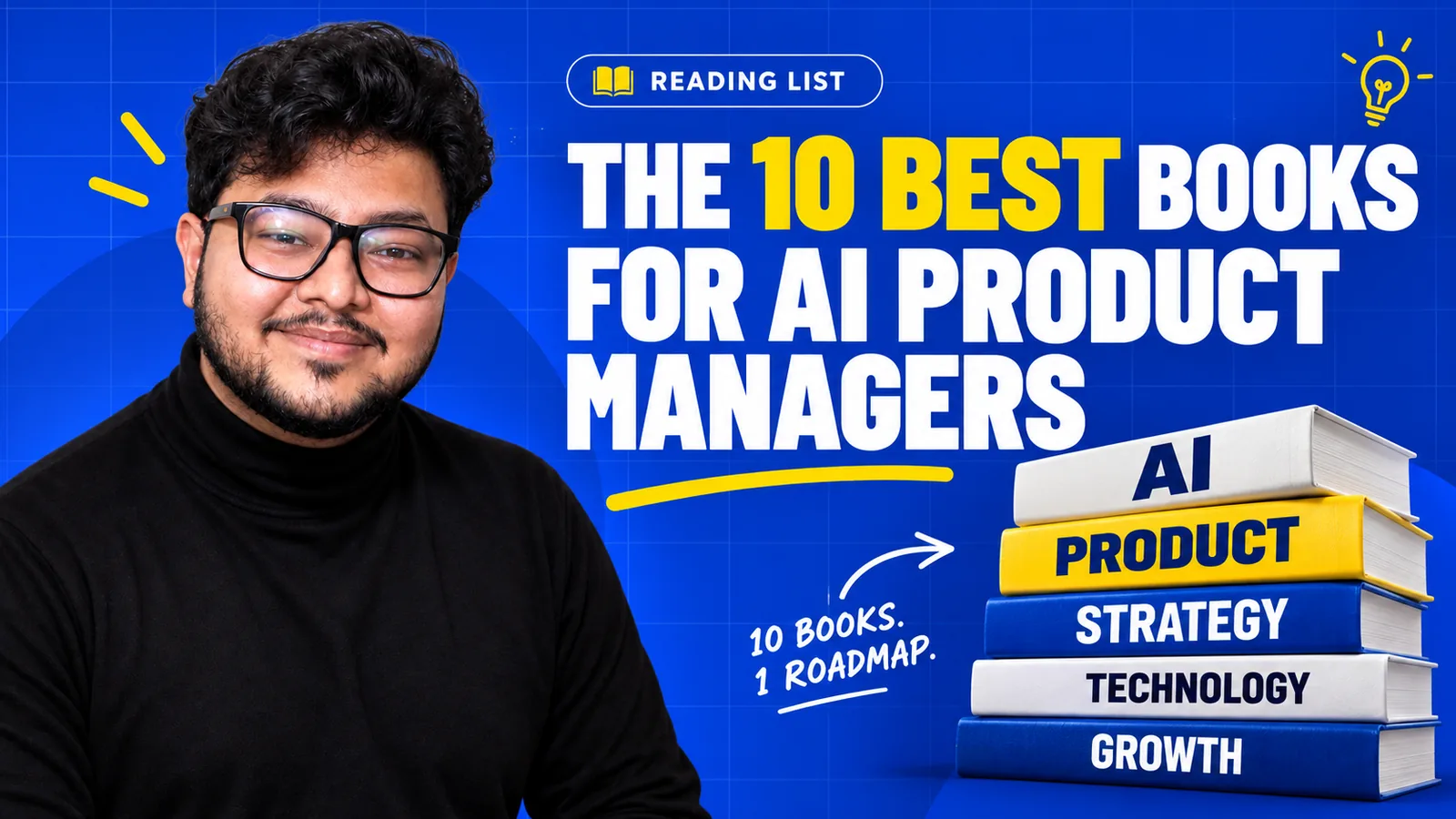
The best books for AI product managers work in stages, not as one pile. Start with The AI Product Manager Blueprint for the full career map. Build product judgment with INSPIRED and Continuous Discovery Habits. Add the AI layer with Building AI-Powered Products or The AI Product Playbook. Save AI Engineering for when you're working on LLM products. Read one book at a time, and apply each one to a project before you open the next.
Key takeaways
- Reading order matters more than the book count. Technical books read too early turn into vocabulary without judgment.
- Product books still earn their place. INSPIRED and Continuous Discovery Habits teach what to build, and AI doesn't change that.
- Experienced PMs can skip ahead to the AI layer. Engineers should do the opposite and start with discovery.
- A book is finished when it changes a decision in your project, not when you reach the last page.
Why the best books for AI product managers need a reading order
AI product management is awkward to learn from books because the job sits between two fields. You still need classic PM skills: finding the user problem, deciding what to build, setting priorities, and measuring results. On top of that sits machine learning and data quality. Then come LLMs and retrieval, agents and evaluation, plus the uncomfortable fact that an AI system won't behave the same way twice.
That's why most book lists fail their readers. A great product book can teach sharp thinking while barely mentioning models. A great technical book can explain inference cost in detail while assuming you already know how products get discovered. Stack ten of them on your desk in random order and you'll either stall or finish them all without being able to use any of it.
So this list of the best books for AI product managers is built as a sequence. Stage one gives you the map. Stage two builds product judgment. Stage three adds the AI product layer. Stage four gives you the technical depth to hold your own with engineers. You don't have to read all ten. You have to read the right next one.
If you're still deciding whether this career fits you, the complete AI PM roadmap is a faster starting point than any book.
The best AI product management books of 2026 at a glance
| Book | Author | Stage | Read it when |
|---|---|---|---|
| The AI Product Manager Blueprint | Abhishek Ashtekar | 1. The map | You're starting from zero |
| INSPIRED | Marty Cagan | 2. Product foundations | You need core PM thinking |
| Continuous Discovery Habits | Teresa Torres | 2. Product foundations | You build before you validate |
| Building AI-Powered Products | Marily Nika | 3. The AI PM layer | You're a PM moving onto AI |
| The AI Product Playbook | Marily Nika and Diego Granados | 3. The AI PM layer | You want a framework for AI PM roles |
| The Art of AI Product Development | Janna Lipenkova | 3. The AI PM layer | You need to judge where AI belongs |
| AI Product Manager's Handbook | Irene Bratsis | 3. The AI PM layer | You want a broad reference to dip into |
| Product Management for AI | Justin Norman, Peter Skomoroch, and Mike Loukides | 3. The AI PM layer | You want a short primer on ML products |
| AI Engineering | Chip Huyen | 4. Technical depth | You work on LLM, RAG, or agent products |
| Designing Machine Learning Systems | Chip Huyen | 4. Technical depth | You work on recommendation, ranking, or other classic ML |
Stage 1: get the map first
1. The AI Product Manager Blueprint by Abhishek Ashtekar
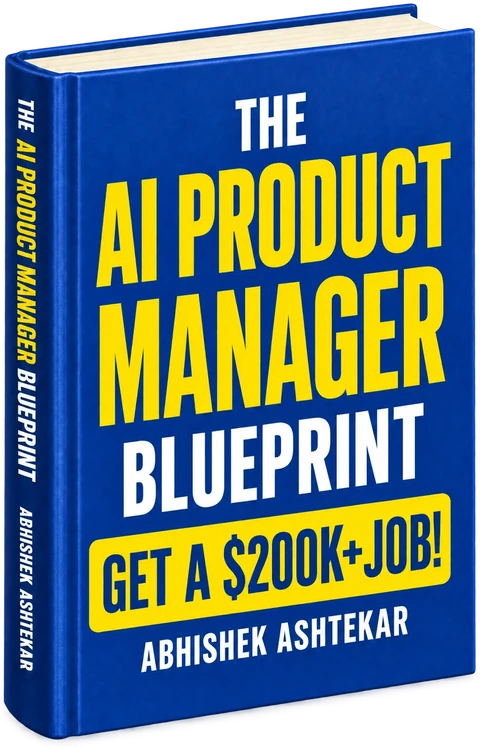
I wrote The AI Product Manager Blueprint for the reader who is starting from scratch, so I'll be direct about why it sits first. A beginner has several problems at once. What does an AI PM do? Which product skills matter? How much AI do you need, and how technical do you have to get? What should you build, and how do you turn that into a job? Learn those pieces from ten separate sources and the field feels far harder than it is.
The book puts them in one sequence across 88 chapters. It starts with the role, moves through the 22 core skills (product thinking, discovery, PRDs, metrics, AI and ML fundamentals, LLMs, RAG, agents, and evaluation), then turns to the work that gets you hired: portfolio projects, case studies, resumes, LinkedIn, job search, internships, and the interviews themselves.
The five portfolio projects are where it earns its place on a reading list. Knowing what RAG means is different from deciding whether a product needs it. Projects such as the AI interview coach and the voice-of-customer copilot force those decisions: the user problem, where AI belongs, how the output gets evaluated, and how the work becomes a case study.
Read it first if you're new to both product management and AI. Once the map makes sense, every book below becomes easier to place, because you know which gap it fills.
Stage 2: product management foundations
Neither book in this stage mentions RAG or agents. Both still rank among the top AI product management books anyway. AI makes prototypes cheap, which makes it easier than ever to build something nobody needs. These two books stop that from happening.
2. INSPIRED by Marty Cagan
INSPIRED explains how strong technology product teams discover and deliver products that work for customers and the business. The idea I'd take straight into AI work is the four product risks: value (will people want it?), usability (can they use it?), feasibility (can the team build it?), and viability (does it make sense for the company?).
Those risks get concrete fast with AI. Picture an agent that handles expense approvals. Proving the model can do the task only covers part of feasibility. Users still need to trust it, some actions need a human sign-off, and the company has to weigh compliance plus the cost of every wrong approval. INSPIRED gives you the frame to ask all four questions before a demo convinces everyone.
It's especially useful for engineers and data scientists moving into PM. Their gap is rarely another architecture. It's customers, value, and the risks a product carries.
3. Continuous Discovery Habits by Teresa Torres
Continuous Discovery Habits teaches you to make customer learning a weekly habit instead of a two-week research phase before months of building. Torres connects desired outcomes to customer interviews and the opportunities they reveal, then to solutions and the assumption tests, and her Opportunity Solution Tree shows how the problem you found links to the solution you're considering.
This matters more in AI, because users are still working out what they want and what they'll trust. Imagine building for recruiters. It's easy to assume they want an AI job description writer. A handful of interviews might show that job descriptions barely hurt, while pulling evidence out of scattered interview notes hurts every day. The first idea was buildable. It was still the wrong product.
Stage 3: AI product management books for the PM layer
This stage is where product thinking meets model behaviour. If you already work as a PM, start here and skip back to stage two only when discovery feels weak.
4. Building AI-Powered Products by Marily Nika
Building AI-Powered Products is the clearest explanation I know of why managing an AI product differs from managing normal software. The core difference is uncertainty. Traditional software does what engineers specify. AI systems can give different outputs for similar inputs, produce a confident wrong answer, or get better at one task while getting worse at another after a model change.
Take a customer support assistant. Getting the model to answer is the easy part. The product team still has to decide which sources it can trust, what a good answer looks like, which mistakes are serious, when to hand off to a human, and how to know it's improving after launch. The book builds that way of thinking, covering probabilistic behaviour, data dependence, model drift, explainability, trust, AI metrics, and agentic products.
For a working PM moving into AI, this is the best first book on the list. It aims straight at the gap you're most likely to have.
5. The AI Product Playbook by Marily Nika and Diego Granados
The AI Product Playbook is strongest on a point most people miss: "AI product manager" isn't one job. The authors split it into the AI Experiences PM, who owns how users interact with and trust AI features; the AI Builder PM, who works close to models, APIs, and the platform layer; and the AI-Enhanced PM, who uses AI inside broader product work. Job descriptions make far more sense once you can tell which one a company is hiring for. Our breakdown of the types of AI product managers takes the same question further.
The book also covers why AI products need attention long after launch. Models, data, and the way users behave all drift, so monitoring and iteration become part of the lifecycle rather than an afterthought.
6. The Art of AI Product Development by Janna Lipenkova
The Art of AI Product Development refuses to assume every problem needs AI, and that's rarer than it should be. Teams see an impressive agent demo and go hunting for somewhere to put an agent. Lipenkova works in the right direction: start with the problem and the workflow, check the data you have, and only then decide whether AI belongs and how much automation makes sense.
- How painful and how frequent is the problem?
- How do people solve it today?
- Could ordinary software solve it?
- What happens when the AI gets it wrong?
- Does a human need to review the output?
- Do the economics hold up at real usage?
That last question gets skipped most. An AI feature can work technically and still fail as a product because it's too slow, too expensive, or too hard to trust. Read this once you understand the basic role and want sharper judgment about where AI earns its place.
7. AI Product Manager's Handbook by Irene Bratsis
AI Product Manager's Handbook gives you a wider view than books focused mainly on LLMs. That matters because plenty of AI work is still classic machine learning: recommendations, ranking, fraud detection, forecasting, personalisation, and the odd computer vision system. An AI PM can spend years on those systems without touching a chatbot.
It covers ML product development, AI strategy, discovery, model lifecycle concepts, generative AI, commercialisation, and responsible AI. Don't read it cover to cover. Treat it as a reference and open the chapters that match the product problem in front of you.
8. Product Management for AI by Justin Norman, Peter Skomoroch, and Mike Loukides
Product Management for AI comes from the machine learning era rather than today's LLM wave. You won't learn agent frameworks or context engineering from it. You will learn the foundations that still hold: picking problems suited to ML, living with uncertainty, working with data, running experiments, and what happens after a model ships.
Its best lesson is that a strong model doesn't guarantee a strong product. A team can raise a model metric while making the experience slower, or improve average accuracy while hiding poor results for an important user group. Read it as a short primer, then move to a newer book for LLMs. If basic AI vocabulary still trips you up, Andrew Ng's AI for Everyone course is a quick fix before you start.
Stage 4: technical books for AI product managers
Neither book here is a product management book, and that's exactly why they come last. Once you understand the role, high-level explanations stop being enough. You need to follow engineers when they talk about model selection, retrieval quality, context, latency, and the cost of inference.
9. AI Engineering by Chip Huyen
AI Engineering is the best technical book for AI product managers working on modern LLM applications. For a PM, the evaluation chapters are the most valuable part. Say two models are on the table. One gives slightly better answers and costs far more. The other is faster and cheaper but fails more often on one type of request. "Which model is better?" has no answer until you know what those failures are and how much they matter to users. That's a product decision as much as a model decision.
The retrieval and agent material pays off quickly too. When a product answers from company documents, the final answer depends on the retrieval system as much as the model, so bad sources or missing permissions show up as a bad user experience. Agents raise the stakes again. A system that drafts an email carries far less risk than one that sends it. Pair the book with our guides to RAG for product managers and AI evals for product managers to turn the concepts into PM artifacts.
10. Designing Machine Learning Systems by Chip Huyen
Designing Machine Learning Systems is the book for understanding the whole system around a classic ML model. Recommendations, search ranking, fraud detection, pricing, and the moderation queue often have nothing to do with a chat interface, and companies still depend on them heavily.
The idea to take away is the gap between improving a model and improving a product. A recommendation model can post a better offline score while users find nothing more relevant, conversion stays flat, and serving costs climb. The model metric is evidence. It isn't the outcome. The book also covers data quality, deployment, monitoring, and the retraining needed when real-world data shifts.
If your work is mostly LLM applications, read AI Engineering first. If you work on production ML more broadly, start here. A technically strong AI PM eventually reads both.
Which AI product manager books to read first, by background
The best books for AI product managers depend on the gap you already have. Here are the three most common starting points.
| Your background | Read first | Then | Later |
|---|---|---|---|
| New to PM and AI | The AI Product Manager Blueprint | INSPIRED, then Continuous Discovery Habits | Building AI-Powered Products, then AI Engineering |
| Working product manager | Building AI-Powered Products or The AI Product Playbook | The Art of AI Product Development | AI Engineering |
| Engineer, data scientist, or ML practitioner | INSPIRED | Continuous Discovery Habits | The AI Product Playbook |
The engineer path surprises people. It looks backwards to hand a technical reader two non-technical books. But their weak spot is rarely models. It's knowing which problem deserves building, and discovery books fix that faster than another architecture book. The gap between the two roles is covered in AI product manager vs product manager.
One optional extra for any path: Co-Intelligence by Ethan Mollick is a practical, readable look at people working alongside generative AI, and it pairs well with stage three.
How to read AI product management books so they change your decisions
Highlighting a book feels productive. It isn't. The readers who get value from this list read actively and turn ideas into decisions they can reuse.
- Keep a product notebook. When a book explains tokens, write what that means for cost and context. When it covers hallucination, write which product controls reduce harm. When it describes tool use, write the permissions and approvals you'd need.
- Apply every chapter to one product. Pick a product you use daily and test each idea against it.
- Challenge the author. Compare each framework with current products instead of accepting it whole.
- Build between books. Take the idea into a portfolio project before you open the next title. Our five portfolio project briefs give you a starting point.
Read one book, apply it, and let the project show you the next gap. That gap picks your next book far better than any ranking.
Books or courses: use both
Books give you frameworks and depth you can return to. Courses give you a sequence and exercises, plus deadlines. They solve different problems, so the strongest learners use one of each.
If you learn better with structure, pick one programme from our ranking of the best AI product management certification for your background and read alongside it. Duke's AI Product Management Specialization pairs well with stage three books, because it builds the machine learning judgment those books assume. For the skills each book and course feeds, see the 22 AI PM skills.
Start with one book and one project
The point of this list isn't to finish ten books. It's to make better calls when you choose a product problem, design an AI workflow, pick an evaluation method, or explain why the simple solution beats the impressive one.
Pick the book that matches where you are today. Apply it to a real project while you read. When the project exposes a gap, choose the next book around that gap. A year of that loop will teach you more than any stack of unread books, and it leaves you with a portfolio as proof.
Questions & answers
8 questions readers ask most, answered straight.
What is the best book to become an AI product manager from scratch?
The AI Product Manager Blueprint. It covers the full path in one sequence: the role, product management, AI fundamentals, LLMs, RAG, agents, evaluation, five portfolio projects, resumes, job search, and interviews. It's built for the reader who needs the whole map rather than one specialist topic.
What are the best AI product management books for beginners?
Start with The AI Product Manager Blueprint, then read INSPIRED for product fundamentals. After that, Building AI-Powered Products or The AI Product Playbook takes you deeper into AI-specific product work. Leave the technical books until you've built something.
What should an experienced product manager read to move into AI?
Building AI-Powered Products first. It targets the shift from ordinary software to products that depend on models and data, including probabilistic behaviour, drift, evaluation, and the rise of agentic systems. The AI Product Playbook is the next pick if you want a framework for the different AI PM roles.
What is the best technical book for AI product managers?
AI Engineering by Chip Huyen, for anyone working on LLM applications. Its chapters on evaluation, model selection, RAG, agents, latency, and the cost of each call match the trade-offs AI PMs face. Choose Designing Machine Learning Systems instead if your work is classic ML like recommendations or ranking.
Are traditional books for product managers still worth reading in 2026?
Yes. The technology changed faster than the core problems. Teams still have to understand customers, decide what creates value, test assumptions, and make trade-offs. That's why INSPIRED and Continuous Discovery Habits sit on this list next to much newer AI books.
Do AI product managers need to read technical books?
Eventually, yes, at a product level. You don't need to train models, but you do need to follow discussions about retrieval, evaluation, latency, and the cost of inference without translation. Read technical books after the product and AI PM stages, when you have a project to connect the material to.
How many books should I read before applying for AI PM jobs?
There's no magic number. Two or three well-applied books, such as the Blueprint, INSPIRED, and one AI PM book, plus portfolio projects built from them, put you in a stronger spot than ten books with nothing to show.
Should I read books or take a course to learn AI product management?
Use both. A course gives structure and deadlines, and a book is easier to return to when you need one framework or concept again. Pair one certification with one book at a time, and turn both into project work.
Where this comes from
This guide is condensed from chapters 21, 22, 42, and 43 of The AI Product Manager Blueprint by Abhishek Ashtekar (first edition, 2026). The book goes several levels deeper, with the full walkthroughs, templates, and examples.
External sources cited
- The AI Product Manager Blueprint, Abhishek AshtekarThe complete zero-to-hired roadmap: 88 chapters and five portfolio projects.
- INSPIRED, Marty CaganHow technology product teams handle value, usability, feasibility, and viability.
- Continuous Discovery Habits, Teresa TorresWeekly customer discovery and the Opportunity Solution Tree.
- Building AI-Powered Products, Marily NikaHow AI changes product strategy and execution.
- AI Engineering, Chip HuyenEvaluation, RAG, agents, and cost trade-offs for LLM applications.
Last reviewed September 17, 2026. Tools, platforms, and salary data change; the book’s free resources page is updated as they move.
Browse all 88 chapters
This guide is the trailer.
The book is the whole system.
Everything this guide compresses, in full. The chapters, the skills, the portfolio projects, and the week by week roadmap that takes you from zero to hired.
- 88Chapters
- 22Skills
- 5Projects
- 1Roadmap