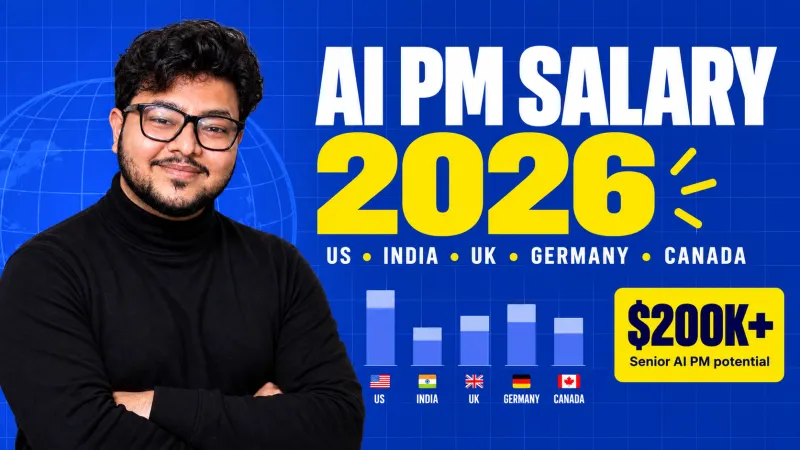

The average AI product manager salary in the US is about $197,500 in 2026, based on public market data, with a typical range of $164,000 to $243,000 and top earners approaching $290,000. By level, early and associate AI PMs in strong markets earn roughly $130,000 to $170,000 base, mid-level AI PMs $150,000 to $200,000, and senior AI PMs $180,000 to $230,000 or more. Senior total compensation, including bonus and equity, runs from about $250,000 to $550,000. The Bay Area and Seattle lead, followed by New York, Boston, plus Austin.
Key takeaways
- $197,500 is an average dominated by experienced people, and often total pay. It is not a typical starting salary.
- $200K+ is realistic in the US as a mid-to-senior target.
- Equity drives the gap between senior base salaries and $250K to $550K total packages.
- Higher pay comes with the highest hiring bar in the world: proven ownership, technical fluency, and strong writing.
The salary ladder, level by level
| Level | Range | What it covers |
|---|---|---|
| Entry & associate | $130K to $170K | APM, junior PM, product analyst, product ops · years 0 to 2 |
| Mid-level | $150K to $200K | Own a product area end to end · 3 to 5 years |
| Senior | $180K to $230K | Lead ambiguous, high-stakes AI product work · 6 to 10 years |
| Senior total comp | $250K to $550K (total compensation) | Base + bonus + equity at AI-first and major tech companies |
- Senior base salaries at major technology companies can exceed $250K to $300K.
- Reported averages are usually total pay, not guaranteed base.
- $200K+ is realistic in the US, and it is a mid-to-senior target, not a starting salary.
| Level | Annual range | Typical roles and scope |
|---|---|---|
| Entry & associate | $130K to $170K | APM, junior PM, product analyst, product ops · years 0 to 2 |
| Mid-level | $150K to $200K | Own a product area end to end · 3 to 5 years |
| Senior | $180K to $230K | Lead ambiguous, high-stakes AI product work · 6 to 10 years |
| Senior total comp | $250K to $550Ktotal comp | Base + bonus + equity at AI-first and major tech companies |
How much do AI product managers make in the US?
The United States has the highest compensation ceiling for AI product managers anywhere. It has the deepest concentration of AI labs, cloud platforms, enterprise software companies, developer tool businesses, big tech employers, and heavily funded AI startups, all competing for the same scarce people.
Public 2026 data puts average AI PM pay near $197,500, with a commonly reported range of about $164,000 to $243,000. Employee-reported data on Glassdoor places the top ten percent of US AI PMs around $288,000 and above. Some experienced roles at frontier AI companies advertise more than $290,000.
Two cautions before you plan around those numbers. First, they are usually total pay, not guaranteed base salary. Second, most of the people behind them are experienced professionals. The rest of this guide breaks the average into what each level actually earns. For the global comparison, see AI PM salary in 2026.
AI product manager salary in the US by level
| Level | Typical titles | Base salary | What employers expect |
|---|---|---|---|
| Entry and associate (0 to 2 years) | Associate AI PM, APM, product analyst, product ops | About $130K to $170K | Learning speed, clear writing, scoped support work |
| Mid-level (3 to 5 years) | AI Product Manager | About $150K to $200K | Ownership of a feature or product area end to end |
| Senior (6 to 10 years) | Senior AI PM, Lead PM | About $180K to $230K+ | Judgment on ambiguous, high-stakes AI product work |
| Senior total compensation | Senior and staff roles at AI-first and major tech companies | About $250K to $550K total | Strategic platforms, revenue-linked products, large decisions |
These bands are not hard ceilings. Employer-posted ranges for senior AI and data product roles at major tech companies can exceed $250,000, and even $300,000, in base salary alone. Those roles hire experienced leaders who manage high-value platforms, technical teams, commercial risk, and big product decisions.
The pattern behind the ladder: at entry you are paid for potential, at mid-level for execution and ownership, at senior for judgment and measurable impact, and at leadership for teams, strategy, and the business results. What each level involves day to day is covered in the AI PM career path.
How US AI PM compensation packages are built
US tech offers usually separate into several parts. Understanding them is the difference between reading an offer and misreading it.
| Component | How it works | What to ask |
|---|---|---|
| Base salary | Fixed annual cash | Where it sits in the band for this level |
| Annual bonus | A target percentage tied to company or individual performance | Recent actual payout, not just the target |
| Restricted stock units (RSUs) | Common at public companies, vesting over several years | Vesting schedule and refresh grants |
| Stock options | Common at startups, with uncertain value | Exercise price, share count, exit timeline |
| Sign-on bonus | One-time cash, sometimes with clawback terms | Repayment conditions if you leave early |
| Benefits | Health insurance, retirement match, leave | Retirement match percentage and health costs |
At senior levels, equity is often what separates a $220,000 base from a $400,000 total package. Public company RSUs have visible market value, though the price moves. Startup options may become valuable, stay illiquid for years, or end up worthless. Compare cash with cash first, then treat equity as upside. The detailed negotiation playbook is in how to negotiate your first AI PM offer, and crowdsourced company-level packages are on Levels.fyi.
AI product manager salary by US city
Location is one of the strongest influences on US pay, although company pay policies vary. Some pay the same band nationally. Others adjust by location zone.
| Market | Where the AI product work is |
|---|---|
| San Francisco Bay Area | AI research, frontier labs, startups, venture capital, specialised product work. The top of most pay bands. |
| Seattle | Cloud infrastructure, enterprise software, developer platforms, big tech |
| New York | Fintech, financial services, media, enterprise AI, business software |
| Boston | Healthcare, biotech, research, education, enterprise technology |
| Austin | A growing software and startup market with lower living costs than the coasts |
A higher Bay Area salary does not automatically mean a better outcome. Housing and taxes, plus general living costs, eat into the difference, so compare savings potential and career value, not just the gross figure. Hybrid and remote roles add another layer: some companies pay the band of the office you are tied to, while others pay by where you live.
US AI PM pay by company type
| Company type | Typical package shape | Trade-off |
|---|---|---|
| Frontier AI labs and AI-first companies | High base plus substantial equity | Very high hiring bar and intense pace |
| Large public tech companies | Strong base, annual bonus, and RSUs | Harder interviews and narrower scope per role |
| Enterprise SaaS, cloud, cybersecurity, developer tools | Strong pay because AI ties to revenue, cost, or risk | B2B complexity and longer sales cycles |
| Growth-stage startups | Solid base plus meaningful options | Equity value is uncertain |
| Early-stage startups | Lower cash, more options | Highest risk, broadest ownership |
| Traditional companies adding AI | Stable pay, less upside | AI may be a small experiment rather than a core product |
Industry matters as much as company size. Enterprise software, financial services, cybersecurity, cloud infrastructure, developer tools, and AI platforms tend to pay more because an AI feature there saves millions, reduces fraud, or lifts conversion in ways the business can measure. Healthcare AI can pay well and usually needs domain and regulatory knowledge. Startup-specific pay data is published by Wellfound.
Why US AI PM salaries are so high, and what that demands
US companies pay these numbers because a strong AI PM turns expensive, uncertain technology into products that customers use and businesses can justify. That takes a rare mix: users, strategy, data, AI behaviour, evaluation, design, communication, and the risk judgment in one person.
The hiring bar rises with the pay. US employers expect clear evidence of product ownership, technical fluency, strong written communication, customer understanding, metrics, and the experience working with engineering or ML teams. Competition includes experienced PMs, former software engineers, data scientists, consultants, domain experts, and MBA graduates. Knowing AI vocabulary is not enough. The skills interviewers probe are mapped in the 22 AI PM skills, and the interview itself in AI PM interview questions.
Entry-level AI product manager salary in the US
Genuine entry-level AI PM titles are uncommon. Even postings labelled "entry" often expect prior experience in product, engineering, data, or consulting. So for most people, the realistic first step is a bridge role: associate product manager, product analyst, product operations, AI implementation, or customer success at an AI company.
Base pay for early and associate AI product roles in strong US markets sits around $130,000 to $170,000, with bridge roles often below that band depending on city and company. The bigger decision is environment. An associate PM role inside an AI company can be worth more to your career than a generic PM title where you never touch AI systems. Where to find those roles is covered in AI PM internships and the three-bucket job search.
Getting into the US AI PM market from outside the US
For people living elsewhere, including India, there are four main routes, and each has limits.
| Route | Reality check |
|---|---|
| Relocation with sponsorship | Depends on work authorisation and immigration rules, and employers sponsor selectively |
| Higher education in the US | Expensive, and a degree does not guarantee a job |
| Internal transfer | Needs time and strong performance at a multinational |
| Remote work for a US company | Highly competitive, and often paid by location rather than US bands |
Some US companies hire international employees or contractors with location-based pay, some use global bands, and some use employer-of-record platforms. A remote AI PM in India may earn far more than a local package without receiving a US-based salary. Treat a high-paying US remote role as a later goal. The more reliable path is gaining product experience locally, working with global teams, shipping AI features, and then competing with stronger proof. India-specific ranges are in AI PM salary in India.
Skills and specialisations that raise US AI PM pay
Experience is the largest factor, but the kind of experience matters more than the years. Two people can each claim five years. One shipped AI features, improved adoption, reduced support workload, lowered model costs, and built evaluation systems. The other attended meetings and followed instructions. The US market does not pay them the same.
| Evidence or specialisation | Why US employers pay more for it |
|---|---|
| Shipped AI features with measured outcomes | Proves you can turn models into adoption, revenue, or savings |
| AI evaluation systems | Reduces the risk of silent failures reaching customers |
| Lower model costs at scale | Directly improves margins on usage-heavy products |
| AI platforms and infrastructure | Decisions affect many teams for years |
| Agents and workflow automation | High value paired with high risk if autonomy goes wrong |
| Regulated domains such as healthcare, fintech, and the security space | Domain judgment plus compliance knowledge is scarce |
Specialisation pays when it solves an expensive or difficult business problem. A specialised title on its own does not. Build the foundation first, get exposure to real problems, then choose a specialty that matches your strengths and market demand. The evaluation skill in particular is explained in AI evals for Product Managers.
How to reach a $200K+ AI PM salary in the US
- Get the foundations right: product management, metrics, user research, and practical AI literacy.
- Build visible proof: scoped AI projects with evaluations, described in honest case studies. See 5 AI PM portfolio projects.
- Enter close to AI products, even through a bridge role.
- Own an AI feature and measure what changed: adoption, cost, quality, revenue.
- Move toward high-value domains such as enterprise software, fintech, security, cloud, or AI platforms.
- Negotiate with evidence and understand every part of the package.
$200K+ is realistic in the US. It usually arrives after you have shown you can handle larger outcomes, not before.
Questions & answers
8 questions readers ask most, answered straight.
What is the average AI product manager salary in the US?
Public 2026 data puts average US AI product manager pay at about $197,500, with a typical range of $164,000 to $243,000 and higher earners approaching $290,000. These figures often include bonuses and equity and mostly reflect experienced professionals.
What is the entry-level AI product manager salary in the US?
Early and associate AI PM roles in strong US tech markets offer base salaries of roughly $130,000 to $170,000. True entry-level AI PM titles are uncommon, so many people start in bridge roles such as associate PM, product analyst, or product operations, which can pay less depending on city and company.
How much does a senior AI product manager make in the US?
Senior AI PMs commonly earn around $180,000 to $230,000 or more in base salary. With bonus and equity at AI-first and major tech companies, total compensation typically ranges from about $250,000 to $550,000, and some senior base salaries exceed $250,000.
How much do AI product managers make in San Francisco?
The San Francisco Bay Area usually sits at the top of US AI PM pay bands because it concentrates AI labs, startups, and the venture capital. Higher living costs offset part of that premium, so compare savings potential and career value as well as gross pay.
How much do AI product managers make in New York?
New York is one of the strongest US markets, driven by fintech, financial services, media, and the enterprise AI. Pay is generally near the top of national ranges, with company type and level mattering more than the city alone.
Is $200K a realistic salary for an AI product manager?
Yes, in the US, as a mid-to-senior target. Reaching it usually requires product ownership, technical fluency, shipped AI features with measurable results, and the ability to operate with limited supervision.
Do US AI product manager salaries include stock?
Often. Public tech companies commonly offer RSUs and startups offer stock options on top of base salary and bonus. Equity is a large part of senior total compensation, so always check the vesting schedule and treat startup options as uncertain.
Can I work remotely for a US company and earn a US AI PM salary?
Sometimes, but many US companies pay remote international hires by location or regional band, or as contractors. You can still earn far above a local package, but usually not the same total compensation as a US-based employee in a top market.
Where this comes from
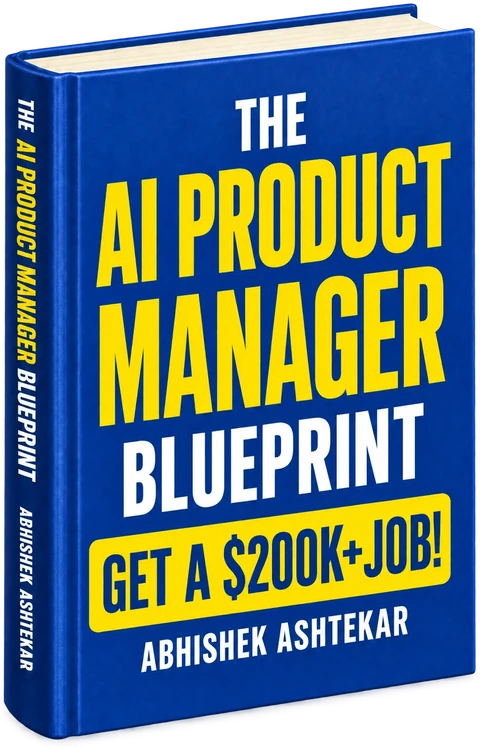
This guide is condensed from chapters 15 to 17 of The AI Product Manager Blueprint by Abhishek Ashtekar (first edition, 2026). Salary figures are public 2026 market data compiled from employee submissions, job listings, recruiter estimates, and employer-provided ranges, as cited in Part IV of the book. The book goes several levels deeper, with the full walkthroughs, templates, and examples.
External sources cited
- AI Product Manager salaries, Glassdoor (US)Employee-reported US AI PM pay, including top-decile figures.
- Product Manager pay in the United States, Levels.fyiCompany and level compensation data.
- Product Manager salaries in AI startups, WellfoundStartup salary and equity ranges.
- AI Product Manager salary data, ZipRecruiterListing-based US salary estimates.
Last reviewed September 16, 2026. Tools, platforms, and salary data change; the book’s free resources page is updated as they move.
Browse all 88 chapters
This guide is the trailer.
The book is the whole system.
Everything this guide compresses, in full. The chapters, the skills, the portfolio projects, and the week by week roadmap that takes you from zero to hired.
- 88Chapters
- 22Skills
- 5Projects
- 1Roadmap