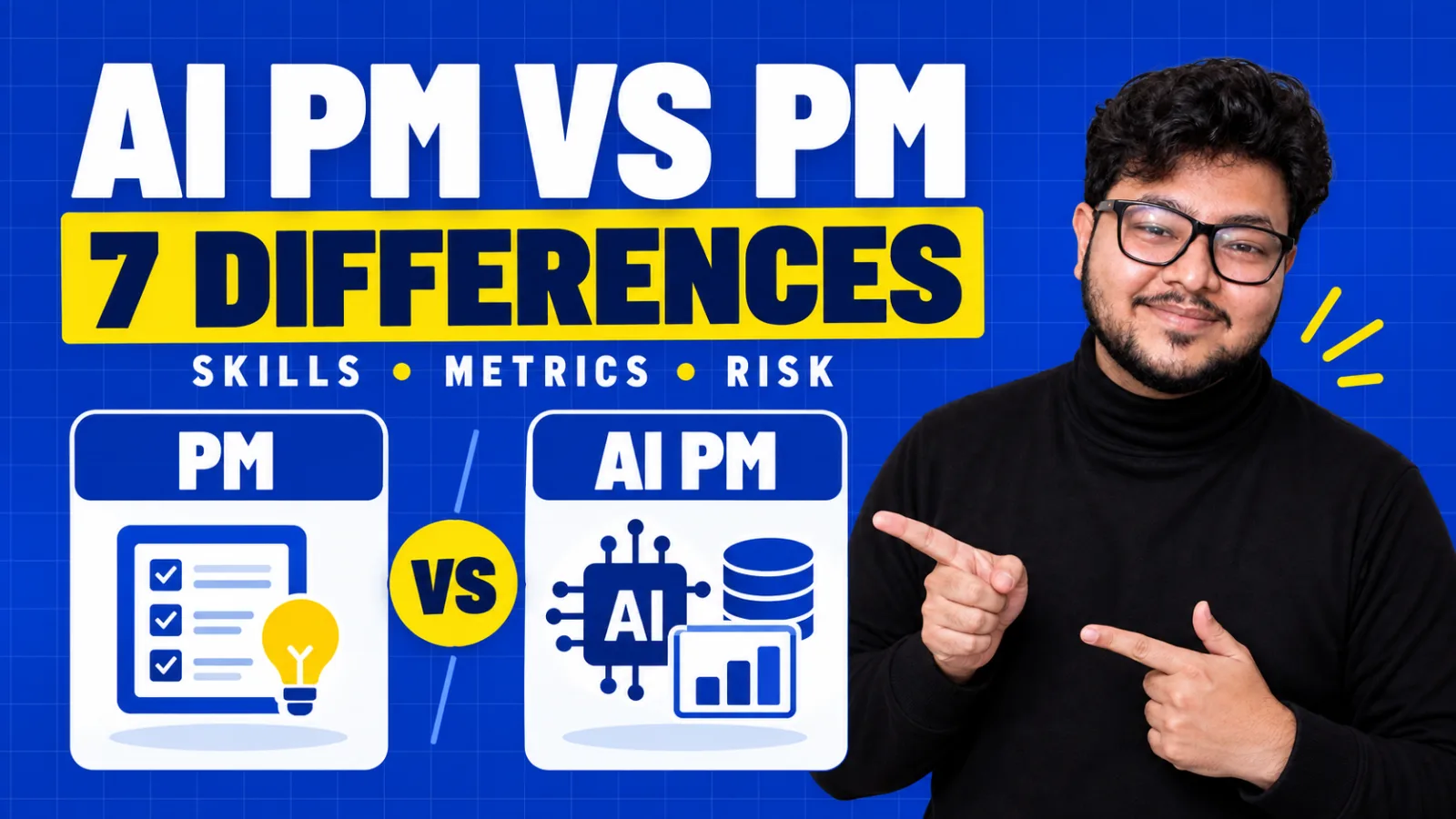
AI product manager vs product manager comes down to one idea: an AI PM does the same core job as a PM, applied to products whose behaviour is not fixed in advance. Both own users, problems, priorities, launches, and the outcomes. The AI PM adds seven things: deeper technical awareness of models and data, a development process built around testing variable output, two scoreboards (product results plus system quality), heavier responsibility for risk and fairness, planning for silent failure, a wider team including ML and data specialists, and faster-moving technology. It is product management first and AI second.
Key takeaways
- An AI PM is still a PM. AI knowledge without product judgment does not get you hired or promoted.
- The biggest shift is uncertainty. Features must be defined by how well they perform across situations, not only by what they do.
- AI PMs manage two scoreboards: is the output dependable, and does it create a meaningful product result?
- AI features often fail silently. Defining failure before launch is part of the job.
AI product manager vs product manager at a glance
Neither "a completely new profession" nor "a normal PM with AI in the title" is accurate. The foundation is identical. What changes is the layer of uncertainty on top of it.
| Dimension | Product Manager | AI Product Manager |
|---|---|---|
| Core job | Decide what to build, for whom, and why | The same, for products that interpret, predict, generate, or recommend |
| System behaviour | Mostly deterministic: same input, same output | Probabilistic: similar inputs can produce different outputs |
| Technical depth | Enough software understanding to work with engineers | That, plus models, data, retrieval, evaluation, cost, and the latency |
| Requirements | What the feature does | What it does and how well it must perform across situations |
| Testing | Does the interface work? | Does it hold up on unclear, unusual, and out-of-scope inputs? |
| Success metrics | Adoption, retention, conversion, revenue | Those, plus groundedness, precision, recall, relevance, and the error severity |
| Failure | Usually visible and reproducible | Often silent: fluent and confident, yet wrong |
| Risk | Privacy, accessibility, consent | Those, plus bias, unsupported claims, and automated decisions about people |
| Cost | Mostly fixed infrastructure | Usage-based inference cost that scales with every request |
| Team | Design, engineering, analytics, marketing, sales | Add ML engineers, data scientists, data engineers, security, privacy, responsible AI |
| After launch | Iterate on feedback and metrics | Continuous evaluation and monitoring, because real users expose the key weaknesses |
| Pace of change | Markets and competitors shift | Model capability, pricing, and the regulation also shift fast |
What stays exactly the same
Both roles start from the same foundation: understanding users, defining problems, supporting business goals, choosing priorities, working with design and engineering, launching, measuring results, and learning from feedback. AI knowledge cannot replace any of it.
Someone who understands models deeply but cannot say who needs the product, or whether it creates value, will struggle in either role. That is why the best path into AI product management builds product judgment first and adds AI second. The complete skill list, with product judgment as the first eight skills, is in the 22 AI PM skills.
Difference 1: technical awareness
A product manager needs enough software understanding to see how constraints affect time, scope, reliability, and the experience. An AI PM needs that plus a practical grasp of AI systems: how quality depends on the data, the model, the instructions, retrieval, evaluation, response time, operating cost, and feedback after launch. Not to become an engineer, but to ask better product questions.
A PM on an analytics dashboard asks: is the data accurate, are the charts understandable, can users find what they need?
An AI PM on an analytics assistant also asks: where did this answer come from, is the data current, what happens when the question is unclear, can the user verify it, should it answer with a chart or an explanation, and how will we test whether its conclusions are dependable?
Technical awareness is what stops an AI PM from confusing a good demo with a ready product. A model can shine in a demonstration and fall apart on incomplete data or messy real workflows.
Difference 2: the development process
Many traditional features can be specified as rules. A checkout has defined steps. An export button produces a file. Hard to build, perhaps, but the expected behaviour is knowable before launch.
AI features are less predictable. The same question phrased two ways can get different answers. Performance is often strong on common cases and weak on rare ones. A small change to the source data or instruction can shift the output. So the team defines both what the feature does and how well it must perform, across many situations.
Traditional search shows articles containing the user's words. The team improves ranking, filters, and the article quality.
An AI answer interprets the question, finds relevant material, combines it, and replies directly. That is more convenient and creates new decisions: which questions the AI handles, which sources it may use, how unsupported claims are prevented, when sources are shown, and when it hands off to a person. Testing expands to incomplete, emotional, unusual, and out-of-scope questions, often through a limited release first.
If the answer pattern above is new, RAG for Product Managers explains how it works.
Difference 3: how success is measured
Both roles care about activation, adoption, retention, conversion, revenue, satisfaction, and the time saved. A feature is not successful just because its model scores well.
An AI PM also measures the system producing the experience, which means running two scoreboards at once.
| Product type | System quality measures |
|---|---|
| Classifier (fraud, spam, routing) | Precision, recall, and the cost of each type of error |
| Recommendation | Relevance, diversity, acceptance |
| Answer or knowledge assistant | Groundedness, completeness, clarity, unsupported information rate |
| Generative tool | Human-reviewed usefulness for the intended task |
Error severity matters as much as error rate. In fraud detection, missing fraud costs money while blocking a genuine customer costs trust. In medical triage, a missed danger signal is far worse than extra review work. Cost and latency belong on the scoreboard too: a smaller model that is good enough, and faster and cheaper at scale, can be the better product. A technically excellent feature nobody adopts has failed. So has a popular feature that misleads people. The measurement method is covered in AI evals for Product Managers.
Difference 4: responsibility for risk, fairness, and the trust
Every PM makes decisions about privacy, accessibility, consent, and the user welfare. AI adds new ways a product can influence what people believe or how they are treated. Outputs sound convincing when incomplete. Recommendations can quietly favour one group. Summaries can drop critical context. A system can work in formal English and fail for users who mix languages.
A normal filter sorts candidates by location or experience. An AI system that recommends which candidates to review first carries far more responsibility. The team must check whether it disadvantages certain backgrounds, whether its reasoning can be understood, and whether recruiters stay accountable for the final decision.
The AI PM does not replace legal, privacy, or security experts. The job is to recognise when they belong in the process and make sure their concerns shape the design before launch. And trust is never a banner saying "this AI is trustworthy." It comes from behaviour: users can verify important information, correct weak results, understand limits, and reach a person when needed. The NIST AI Risk Management Framework is the standard reference for this work.
Difference 5: how failure looks
| Traditional software failure | AI feature failure |
|---|---|
| A button does not respond | An answer is fluent and wrong |
| A payment fails with an error | A summary reads well but omits the most important point |
| A report shows the wrong number | A recommendation looks reasonable and is irrelevant |
| The bug can be reproduced and fixed | A classifier looks accurate overall and fails for one user group |
Because AI can fail while looking healthy, the AI PM defines failure before launch. What is the worst output this system could produce? How likely is it, and how serious? Can users detect it and recover? Should the product show sources, ask for confirmation, or involve a human first? The goal is not zero errors, which is usually unrealistic. It is understanding the errors that matter, reducing their likelihood, limiting their consequences, and monitoring after launch. Google's People + AI Guidebook has practical patterns for designing around errors.
Difference 6: a wider team and a bigger system
A product manager usually works with design, engineering, analytics, marketing, sales, and the business stakeholders. An AI PM often adds machine learning engineers, data scientists, data engineers, evaluation specialists, model platform teams and researchers, plus specialists in security, privacy, and AI risk. Each sees a different slice. The data engineer cares whether information is reliable. The ML engineer cares about model performance. Security cares about access. Design cares whether users understand and control the experience. The AI PM connects them without letting any single view define success.
The product is also bigger than its interface. A knowledge assistant looks like a chat window, but it depends on documents, permissions, retrieval, model choice, instructions, formatting, citations, feedback, monitoring, and the human escalation. A strong model cannot rescue an unclear workflow, and a beautiful interface cannot rescue unreliable answers. How this plays out hour by hour is in a day in the life of an AI Product Manager.
Difference 7: the speed of change
Every PM tracks changing customers, markets, and the competitors. AI PMs also track model capabilities, pricing, infrastructure, product patterns, evaluation methods, and regulation, all moving quickly. A new model can cut operating costs. A new technique can improve retrieval. A competitor's launch can reset what users expect.
The skill is not chasing every announcement, which makes products unfocused. It is recognising when a development changes what is possible, affordable, safe, or useful for your product, and ignoring the rest.
AI product manager vs product manager vs technical PM, data PM, and project manager
Job titles overlap, so here is how the adjacent roles usually differ. Companies use these titles inconsistently, so always read the responsibilities.
| Role | Main focus | How it differs from an AI PM |
|---|---|---|
| Technical Product Manager | Platforms, APIs, infrastructure, developer-facing products | Deep technical scope, but not necessarily probabilistic systems or model quality |
| Data Product Manager | Data platforms, pipelines, analytics products, data quality | Owns the data foundation that AI products depend on, often without owning AI behaviour |
| AI Product Owner | Backlog, user stories, and sprint delivery for an AI team, often in Scrum | More delivery-focused, with strategy and outcomes often set by a PM |
| Project or Program Manager | Timelines, coordination, resources, delivery risk | Manages how work gets done, not which problem deserves investment |
| ML Engineer | Building and training models, then deploying them | Builds the system, while the AI PM decides what it should do and why |
Within AI product management itself there are several distinct types, from AI-enabled PMs to platform and core model PMs. The breakdown is in the 5 types of AI Product Managers.
A product manager who uses AI is not an AI product manager
This distinction trips up many resumes. Using AI tools to write PRDs, summarise feedback, or analyse data makes you a more productive product manager. It does not make you an AI PM. An AI product manager owns a product or feature whose behaviour depends on AI, and answers for its quality, risk, cost, and the outcomes. If you are applying for AI PM roles, show ownership of AI behaviour, not only use of AI tools.
Do AI product managers earn more than product managers?
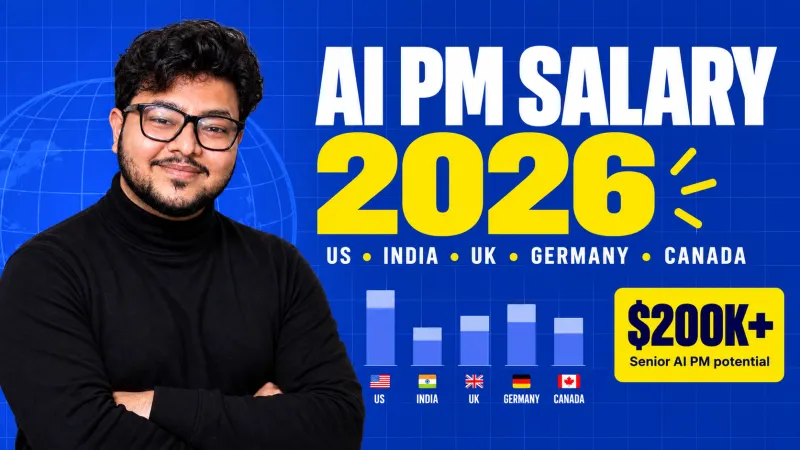
Often, but the premium is not fixed. It varies by country, company, level, industry, and how technical the responsibility is. Public 2026 data puts average US AI PM pay near $197,500, with senior total compensation reaching $250,000 to $550,000. As basic AI knowledge becomes standard for all PMs, shallow AI familiarity loses its premium, while real AI product judgment keeps it. The full breakdown by level and country is in AI PM salary in 2026.
How to move from product manager to AI product manager
Existing PMs have the hardest part already: product judgment. The gap is AI literacy and evidence of working with probabilistic systems.
- Weeks 1 to 4: Learn LLM basics, RAG, agents, and evaluation at product level. Tear down three AI products in your domain.
- Weeks 5 to 8: Find an AI opportunity inside your current product. Write a PRD with model, data, evaluation, failure, and the cost sections.
- Weeks 9 to 12: Build a small prototype or evaluation set for it and present the findings internally. An internal AI project is the fastest route, because it produces real stories with real users.
If an internal move is not possible, build one portfolio project close to your domain and describe your existing PM work honestly alongside it. The AI PM resume guide shows how to frame both.
How to move from engineering or data science to AI product management
Technical professionals have the opposite gap. Knowing how models work does not teach which problem deserves attention, how users behave, what the business needs, or how to trade off competing priorities. Focus on user research, problem framing, prioritisation, metrics that reflect value, and stakeholder communication. Volunteer for discovery work, write PRDs for features you already build, and practise explaining technical trade-offs to non-technical people. Your technical depth becomes a strong advantage once product judgment sits on top of it.
AI product manager vs product manager: which should you pursue?
- Choose product management first if you are new to product work and AI products in your market are still rare. You can add AI later.
- Choose AI product management if you enjoy working through uncertainty, want to sit close to models and data, and your target companies are building AI into their core products.
- Either way, build the product foundation first. The order matters more than the title.
The full path from zero is in how to become an AI Product Manager. The book's first eight chapters describe the role, responsibilities, and the career path in depth.
Questions & answers
8 questions readers ask most, answered straight.
What is the difference between an AI product manager and a product manager?
Both decide what to build, for whom, and why. An AI product manager does this for products whose behaviour depends on AI, so they also manage probabilistic output and the quality of models and data. They run evaluations, plan for silent failures, handle bias and trust risks, watch inference costs, and work with a wider team of ML and data specialists.
Is an AI product manager more technical than a product manager?
Yes, in a practical sense. AI PMs need to understand models, data, retrieval, evaluation, cost, and the latency well enough to make product decisions and challenge assumptions. They do not need to code or train models, which remains the job of engineers and data scientists.
Can a product manager become an AI product manager?
Yes, and existing PMs have a strong head start because product judgment is the hardest part to learn. The gap is AI literacy and evidence of working with AI systems, which you can close through an internal AI initiative or a focused portfolio project with an evaluation.
What is the difference between an AI product manager and a technical product manager?
A technical product manager focuses on technically complex products such as platforms, APIs, and the developer tools. An AI product manager focuses on products whose behaviour comes from AI models. The roles overlap when a technical PM owns an AI platform, but model quality and evaluation are specific to AI PM work.
Do AI product managers get paid more than product managers?
Often, though the premium varies by country, company, level, and the industry. Average US AI PM pay is reported near $197,500 in 2026. The premium follows genuine AI product judgment rather than the job title, and it narrows for shallow AI experience as AI skills become common.
Is AI going to replace product managers?
AI is automating parts of product work such as drafting documents and synthesising feedback. It is not replacing the judgment about which problem matters, what good looks like, and which trade-off to accept. Product managers who understand AI systems are becoming more valuable.
What is the difference between an AI product manager and an AI product owner?
An AI product owner usually manages the backlog, user stories, and sprint delivery for an AI team, often within Scrum. An AI product manager typically owns strategy, discovery, outcomes, and the cross-functional decisions. At some companies one person does both.
Should I become a product manager or an AI product manager?
Build the product management foundation either way. If your target companies are putting AI at the core of their products and you enjoy working with uncertainty, aim for AI PM roles. If AI products are still rare in your market, start as a PM and add AI skills over time.
Where this comes from
This guide is condensed from chapters 1 to 8 and 18 of The AI Product Manager Blueprint by Abhishek Ashtekar (first edition, 2026). The book goes several levels deeper, with the full walkthroughs, templates, and examples.
External sources cited
- AI Risk Management Framework, NISTThe reference framework for AI risk, fairness, and the trust decisions.
- People + AI Guidebook, Google PAIRDesign patterns for errors, trust, and the user control in AI products.
- Classification: accuracy, recall, precision (Google for Developers)The system quality metrics AI PMs add to product metrics.
- Inspired, Marty CaganThe product management foundation both roles share.
Last reviewed September 16, 2026. Tools, platforms, and salary data change; the book’s free resources page is updated as they move.
Browse all 88 chapters
This guide is the trailer.
The book is the whole system.
Everything this guide compresses, in full. The chapters, the skills, the portfolio projects, and the week by week roadmap that takes you from zero to hired.
- 88Chapters
- 22Skills
- 5Projects
- 1Roadmap