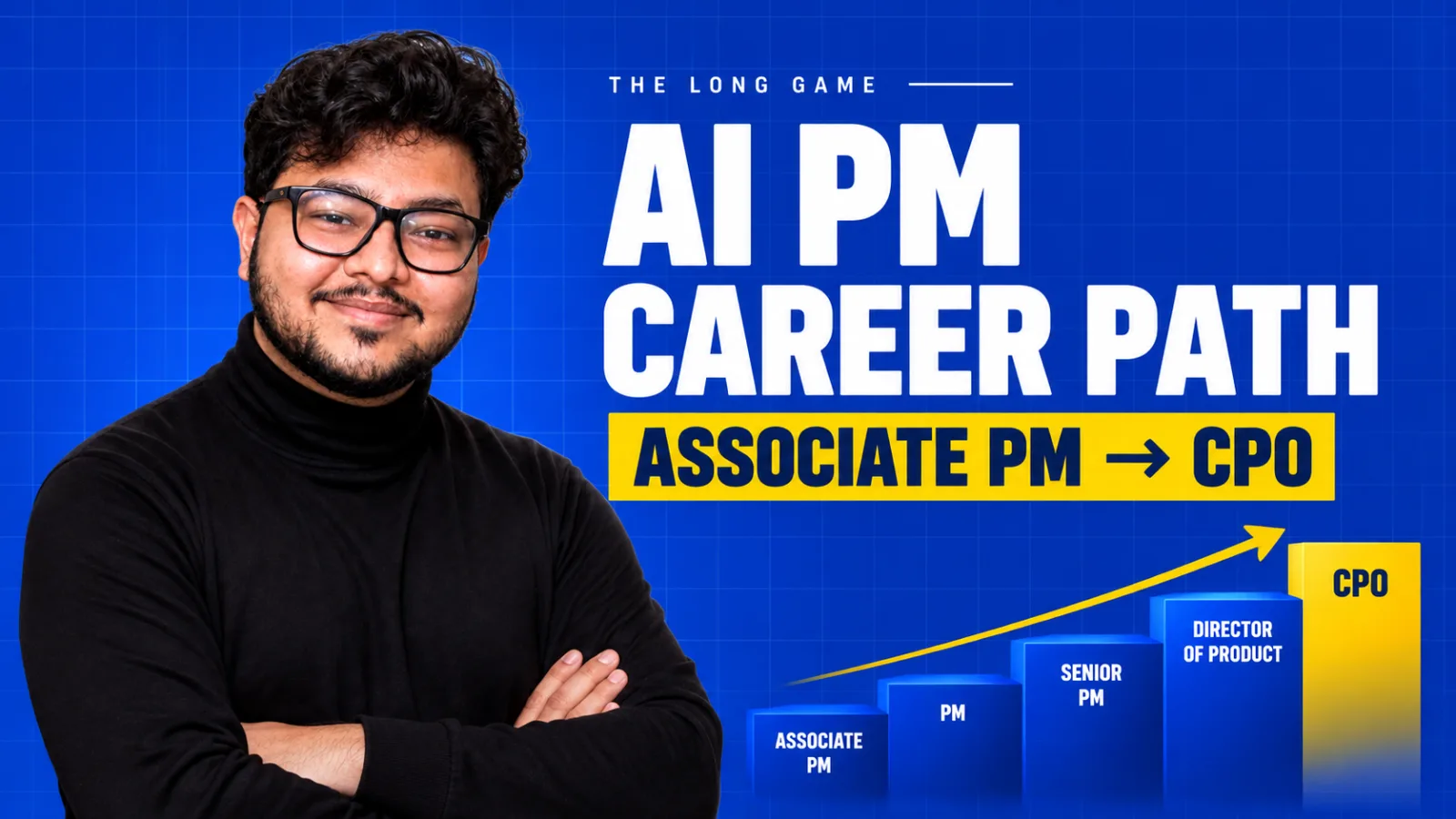
The AI product manager career path moves through four stages. Entry roles (associate PM, product analyst, AI product intern) build exposure in roughly the first two years. Mid-level AI PMs own a complete feature or product area, often after three to five years. Senior AI PMs, group PMs, and directors lead larger areas and other PMs, typically after six to ten years. Executives (VP of Product, Head of Product, CPO) set company-wide product and AI strategy, usually after ten or more years. Each step is earned with a new kind of proof: learning, then ownership, then leadership, then organisational impact.
Key takeaways
- AI product management is a career path, not a single jump. Your first goal is a realistic entry point, not a director title.
- Each level changes the proof you need: potential at entry, ownership at mid-level, leadership at senior, organisational impact at executive.
- Seniority is trusted judgment at a larger scope, not a reward for time served.
- After senior level you can grow as an individual contributor (staff, principal) or as a people leader (director, VP, CPO). Neither is more legitimate.
The AI product manager career path at a glance
From outside, "AI Product Manager" looks like one big destination. In practice it is a ladder. You start by supporting product work, then own features, then product areas and teams, and eventually company-level strategy. Each step brings more independence, more influence, and more accountability for outcomes.
| Stage | Typical titles | Rough experience | What you own | Proof expected |
|---|---|---|---|---|
| 1. Entry | Associate PM, Junior PM, Product Analyst, Product Ops, AI Product Intern | 0 to 2 years | Tasks inside a feature: research, testing outputs, analysis, documentation | Learns fast, communicates clearly, supports the team reliably |
| 2. Mid-level | AI Product Manager, Product Manager | 3 to 5 years | A complete feature, workflow, or product area | Features you led, decisions you made, trade-offs, results |
| 3. Senior and leadership | Senior AI PM, Lead PM, Group PM, Director of AI Products | 6 to 10 years | Several connected features or a major area, often other PMs | Strategy, mentoring, cross-team direction, business impact |
| 4. Executive | VP of Product, Head of Product, Chief Product Officer | 10+ years | The product organisation or a major division | Product vision, strong teams, major investments, long-term growth |
A common beginner mistake is fixating on director or CPO titles. Those show where a long career can lead. They should not define your first goal, which is to become capable enough for a realistic entry point and earn trust with product responsibility.
Stage 1: entry-level AI product work (exposure)
True beginner AI PM roles are uncommon, because AI products involve evaluation, cost, privacy, reliability, and the trust of users all at once. Starting through an adjacent role is normal. Titles include Associate Product Manager, Junior Product Manager, Product Analyst, Product Operations Associate, Business Analyst, and AI Product Intern.
A company is building an AI assistant for customer support teams. As an entry-level team member, you organise common customer questions, test the assistant's answers, log recurring failures, compare response formats, and summarise feedback from support agents. You are not setting AI strategy. You are learning how quality is judged and how evidence changes decisions.
The objective at this stage is exposure: understanding how users, designers, engineers, data teams, and business stakeholders work together. And reliability. When you research carefully, write clearly, ask useful questions, and finish small responsibilities well, people start trusting you with bigger ones. Where to find these roles is covered in AI PM internships and the three-bucket job search.
Stage 2: mid-level AI product manager (ownership)
The defining change is ownership. You no longer only assist. You lead a complete feature, workflow, or product area: study the user problem, propose a direction, write requirements, work with design and engineering, define success, coordinate evaluation, manage trade-offs, and guide it from discovery to launch. Leaders still review big decisions, but they expect you to arrive with recommendations.
In the support example, you now own the assistant. You decide which questions it answers, which go to a human, how answers use approved sources, how quality is evaluated, and how the team proves it saves time without eroding customer trust.
Judgment gets harder because teams want different things. Business leaders want a faster launch. Engineers want more testing. Users want more control. Finance wants lower operating cost. There is rarely a perfect option, and your job is a practical decision that protects users and supports the business. The daily reality of this stage is described in a day in the life of an AI Product Manager.
Stage 3: senior AI product manager and product leadership
Seniority is not a reward for time served. It is trusted judgment at a larger scope: owning meaningful outcomes when model behaviour is uncertain, data is imperfect, stakeholders disagree, and the business still needs a decision.
Senior AI PMs, lead PMs, group PMs, and directors oversee several connected features, a major area, or other PMs. The work shifts from individual launches to long-term direction: how AI capabilities fit together, which investments deserve priority, what standards teams share, and which risks could damage trust.
A senior AI product leader might oversee support automation, internal knowledge search, agent recommendations, and conversation analytics. Instead of evaluating each feature separately, they set shared rules for source quality, human handoffs, permissions, monitoring, and the feedback loop, and decide whether teams share one platform or build separately.
Stage 4: VP of Product and Chief Product Officer
Executive leaders decide where the company competes, which markets and customers matter, how product teams are structured, and which major investments shape future growth. In an AI-first company they also decide what role AI plays in the whole strategy.
- Should AI be central to the product or support selected workflows?
- Build our own capabilities or rely on external model providers?
- How do we differentiate when competitors can access similar models?
- What cost and risk are acceptable?
- How should privacy, safety, and the trust of users shape the roadmap?
These choices affect the whole company. A weak strategy wastes money and damages confidence. A strong one creates new products and strengthens the market position. Marty Cagan's second book is a widely read guide to how product leaders build strong teams at this level.
There is no single route in
Careers rarely move in a straight line. Some AI PMs start in software engineering or data science and move toward users and business decisions. Others come from design, research, analytics, consulting, marketing, operations, customer success, or business analysis. Domain experience is a real advantage: healthcare judgment on a healthcare AI product, finance knowledge on a fintech one.
| Starting role | What it teaches for AI product work |
|---|---|
| Product Analyst at an AI company | How data drives product decisions |
| Customer success at an AI startup | Recurring user problems with real AI products |
| Business Analyst in automation | Turning inefficient workflows into requirements |
| Product Operations | How launches are coordinated and feedback collected |
| Engineer or data scientist | Technical trade-offs, which become powerful with product judgment on top |
Rejecting a useful role because the title is imperfect slows you down. Ask whether it brings you closer to product decisions, AI systems, users, data, technical teams, or measurable outcomes. The full entry roadmap is in how to become an AI Product Manager.
How long each step on the AI product manager career path takes
The ranges in the ladder above are a guide, not a rule. People sometimes move faster because they bring exceptional technical skill, deep domain knowledge, prior leadership, or unusually convincing product evidence. Company size changes titles too: a Product Manager at a startup may carry responsibilities that belong to a Senior PM at a large company.
Experience matters because it is more than time on a resume. It is watching a launch behave differently than expected, users misunderstanding a feature, a technical constraint reshaping the roadmap, and making decisions when no option is perfect. Reading about evaluation is different from reviewing hundreds of inconsistent outputs. For most people, the dependable approach is earning trust one level at a time.
Your first 90 days as an AI product manager
Before the offer, you proved potential. After joining, your job is to build trust. The first 90 days are not a race to change the roadmap. Agree on expectations with your manager in week one: what success looks like at 30, 60, and 90 days, which decisions you own, and how the team communicates. Write it down.
| Weeks | Focus | What you produce |
|---|---|---|
| 1 and 2 | Relationships: your manager, the engineering and design leads, the data and ML partners, customer-facing teams, adjacent product owners | A stakeholder map and a decision map of how work actually moves |
| 3 and 4 | Learn the product deeply: use it as a beginner, a power user, an admin, and someone hitting failure. Read research, tickets, eval reports, incident reviews. | A short learning memo on users, workflows, metrics, the AI system, priorities, and the open questions |
| 5 to 8 | Ship one small improvement where user pain, team need, and low risk meet | A completed win with a baseline and a measure, and the learning written down |
| 9 to 12 | Propose a larger initiative grounded in the evidence you gathered | A staged proposal tied to user and business value |
For an AI product, your map should include data sources, prompts, retrieval, models, tools, evaluation sets, failure modes, human review, latency, cost, permissions, monitoring, and the rollback. Ask the basic questions early: what does good output mean here, which failures matter most, and how are cost and latency managed? A new PM is allowed not to know. Staying vague because you avoided asking does far more damage.
Talking before listening. Sitting in meetings without using the product. Reading documents without building relationships. Chasing a big launch. Hiding basic questions. Ignoring metrics. Disappearing into technical detail. And arriving with the proposal you wanted to make before you joined.
How to grow from AI PM to senior AI PM
Your first year or two should build credibility for shipping and learning, communicating well, and following through. Three to five meaningful releases build a stronger record than one oversized initiative that never reaches users.
The proof that makes a senior case
- Shipped impact. Keep a log of each problem, decision, collaborators, trade-offs, launch, metric movement, user response, failures, and the lessons.
- Customer depth. Join calls, study support patterns, and explain why adoption or retention changed.
- Technical judgment. When quality is weak, separate likely causes in the model, prompt, retrieval, data, tools, eval set, interface, or user expectations. When someone proposes an agent, ask which task it owns, which permissions it gets, and how failure is recovered.
- Business impact. Understand how your product affects revenue, retention, support cost, serving cost, pricing, and the differentiation.
- Cross-functional influence. Bring engineering clear problems and context, not just status requests. Involve legal and security early when risk is material.
- Systems, not just solutions. Create an evaluation process, launch checklist, metric definition, or decision template that helps several people decide better.
- Mentorship. Review documents, explain trade-offs, help newer teammates handle ambiguity. You do not need a management title to multiply knowledge.
Communicate upward with concise updates on learning, impact, risk, and the decisions leadership needs to make, and do not assume your work is visible. Ask your manager what "senior" means at your company, which behaviours and scope are missing, and what opportunity could demonstrate them, then revisit that gap during the year rather than at review time.
Avoid becoming a ticket manager, staying technically vague, ignoring business outcomes, trying to please everyone, hoarding knowledge, or burning out under constant urgency. Senior PMs still execute, and they also choose where not to spend attention.
Individual contributor or people leader? Staff, principal, director, VP
After senior level, many companies offer two paths. Both can carry high influence and high pay.
| IC track: Staff or Principal PM | Management track: Director, VP, CPO | |
|---|---|---|
| Unit of ownership | A complex product area or cross-team problem | A portfolio, an organisation, then company strategy |
| Core work | Connecting shared customer needs, data problems, evaluation standards, and platform bets that no single feature owner can solve | Setting strategy, allocating resources, hiring, coaching, performance management, organisational design |
| Influence comes from | Reusable clarity and better decision systems | The judgment of the people you hire and support |
| Suits people who | Want deep product and technical influence without managing a large team | Want to build teams and shape the organisation |
Choose the work you want, not the title that sounds impressive. A prestigious title with unclear authority is often worth less than a smaller title with real ownership.
What changes at director, VP, and CPO
Directors add portfolio and people responsibility: several PMs, strategy, resource allocation, hiring, and the accountability for business results. VPs connect product strategy with company strategy: markets, investment, pricing, organisation design, partnerships, and the communication with the executive team and sometimes the board. A CPO owns overall product direction, the leadership team, operating culture, and the link between customer value and company strategy. In an AI-first company, the CPO also decides where AI creates durable advantage, what to build or buy, how data and evaluation become company assets, and which risks the company will not accept.
Leadership never means leaving AI knowledge behind. Executives need enough depth to question assumptions about data, models, evaluation, cost, security, and the regulation, and to translate those constraints into investment, sequencing, pricing, and the trust of customers. Business understanding deepens too: margins, budgets, forecasting, sales, partnerships, and the capital allocation.
AI product manager salary along the career path
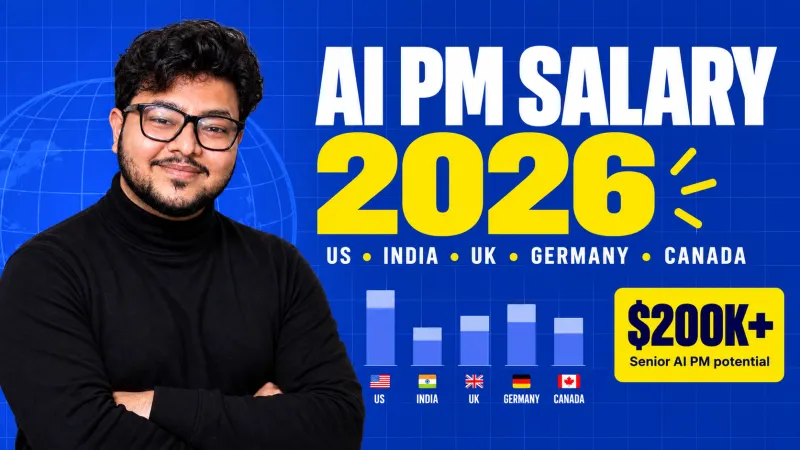
Pay rises with responsibility, and the structure changes as you climb. The figures below come from public 2026 data cited in Part IV of the book.
| Level | United States | India |
|---|---|---|
| Entry and bridge roles | About $130K to $170K base in strong markets | About ₹9L to ₹25L |
| Mid-level AI PM | About $150K to $200K base | About ₹30L to ₹45L |
| Senior AI PM | About $180K to $230K+ base, total comp $250K to $550K | About ₹50L to ₹65L+ |
| Leadership | Highly variable, driven by equity and company stage | Packages crossing ₹1 crore |
Compensation becomes more variable as scope rises. Base, bonus, equity, company stage, geography, and the risk combine differently: a smaller company may offer a bigger title and more equity with more uncertainty, while a large company may pay more in total with narrower formal scope. Compare the whole role and package, not a single number. Crowdsourced level data on Levels.fyi helps you sanity-check offers. Country-by-country detail is in AI PM salary in 2026, and offer strategy is in how to negotiate your first AI PM offer.
Specialise to accelerate your AI product manager career path
Depth makes you known. You might build a reputation in enterprise AI, developer tools, healthcare, search, data products, agents, evaluation, or responsible AI. A specialty creates depth, while leadership needs enough breadth to connect that depth to the whole business. Public writing or speaking helps when it reflects real work and clear thinking, because it makes your judgment easier for others to discover. It never replaces substance. The types of AI PMs guide is a good map of where specialties live.
When to change roles
Consider moving when your scope has stopped growing, strong work cannot reach users, mentorship is missing, or the product area cannot build relevant proof. Do not switch so fast that you never finish meaningful work. Before moving, ask five questions: what scope will I own, what decisions will I make, who will I learn from, what evidence can I build, and do the company's incentives support responsible product work?
Is AI product management a good career?
For people who enjoy judgment under uncertainty, yes. The role sits where users, AI capability, data, trust, and the value to the business all meet, which is exactly why strong AI PMs are well paid and why the work stays interesting. It is also demanding: ambiguity, writing, disagreement, failed experiments, and accountability for outcomes you do not fully control.
The people who progress are not always those who started with the ideal degree or title. They keep learning, communicate clearly, understand users, and accept responsibility for increasingly important outcomes. If you are weighing it against general product management, read AI Product Manager vs Product Manager.
Habits that compound from your first role
- Connect every piece of work to an outcome.
- Make trade-offs explicit instead of hiding them.
- Listen to users directly and often.
- Build trust across engineering, design, data, and the business.
- Communicate uncertainty honestly.
- Develop other people.
- Take responsibility for results, including the ones that disappoint.
Your first job gets you into the room. The next years teach you to create impact. Later roles ask you to make impact repeatable through teams and strategy. The book's Chapters 4 and 86 to 88 cover each stage in depth.
Questions & answers
8 questions readers ask most, answered straight.
What is the career path for an AI product manager?
A typical path runs from entry roles such as associate PM, product analyst, or AI product intern, to mid-level AI product manager owning a feature or area, to senior AI PM, group PM, or director leading larger areas and people, and finally to VP of Product or Chief Product Officer setting company-wide strategy.
How long does it take to become a senior AI product manager?
Senior roles are commonly reached after roughly six to ten years of relevant experience, though strong performance, prior technical or domain expertise, and company size can shorten or lengthen that. Promotion depends on demonstrated judgment at a larger scope, not years alone.
What comes after senior product manager?
Two paths usually open. The individual contributor path leads to staff or principal product manager roles with influence across complex areas. The management path leads to director, VP of Product, and Chief Product Officer, adding people leadership, portfolio ownership, and company strategy.
What should I do in my first 90 days as an AI product manager?
Spend weeks one and two building relationships and a stakeholder map, weeks three and four learning the product and its AI system deeply, weeks five to eight shipping one small improvement, and weeks nine to twelve proposing a larger initiative grounded in the evidence you gathered.
Can I become a Chief Product Officer from an AI PM role?
Yes, over a long career. Reaching CPO usually takes well over a decade of increasing scope, with a record of product outcomes, team building, strategic decisions, and business understanding. AI product experience is increasingly valuable at that level as companies make AI central to strategy.
Is AI product management a good long-term career?
It is a strong long-term career for people who enjoy working through uncertainty and connecting users, technology, and the outcomes a business needs. Pay rises substantially with responsibility, and the skills transfer across industries, specialties, and the different leadership paths.
Do I need to become a manager to advance as a product manager?
No. Many companies offer staff and principal product manager roles that carry high influence and pay without managing a large team. Choose the path based on the work you want to do every day.
How much do senior AI product managers earn?
In the United States, senior AI PM base salaries are commonly reported around $180,000 to $230,000 or more, with total compensation from about $250,000 to $550,000 depending on company and equity. In India, senior roles reach roughly ₹50 lakh to ₹65 lakh or more, with leadership packages crossing ₹1 crore.
Where this comes from
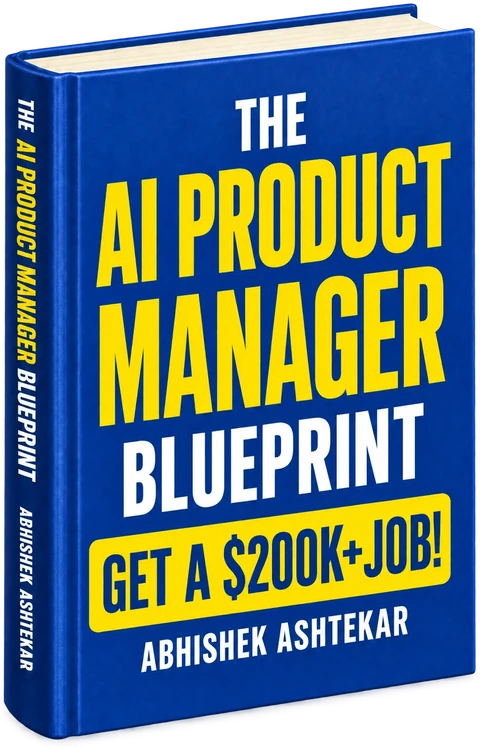
This guide is condensed from chapters 4 and 86 to 88 of The AI Product Manager Blueprint by Abhishek Ashtekar (first edition, 2026). The book goes several levels deeper, with the full walkthroughs, templates, and examples.
External sources cited
- Empowered, Marty Cagan (SVPG)How product leaders build and coach strong teams.
- Product Manager levels and compensation, Levels.fyiCrowdsourced data on PM levels across companies.
- Inspired, Marty CaganProduct fundamentals that carry through every level.
- AI Risk Management Framework, NISTThe risk vocabulary senior AI product leaders use for governance.
Last reviewed September 16, 2026. Tools, platforms, and salary data change; the book’s free resources page is updated as they move.
Browse all 88 chapters
This guide is the trailer.
The book is the whole system.
Everything this guide compresses, in full. The chapters, the skills, the portfolio projects, and the week by week roadmap that takes you from zero to hired.
- 88Chapters
- 22Skills
- 5Projects
- 1Roadmap