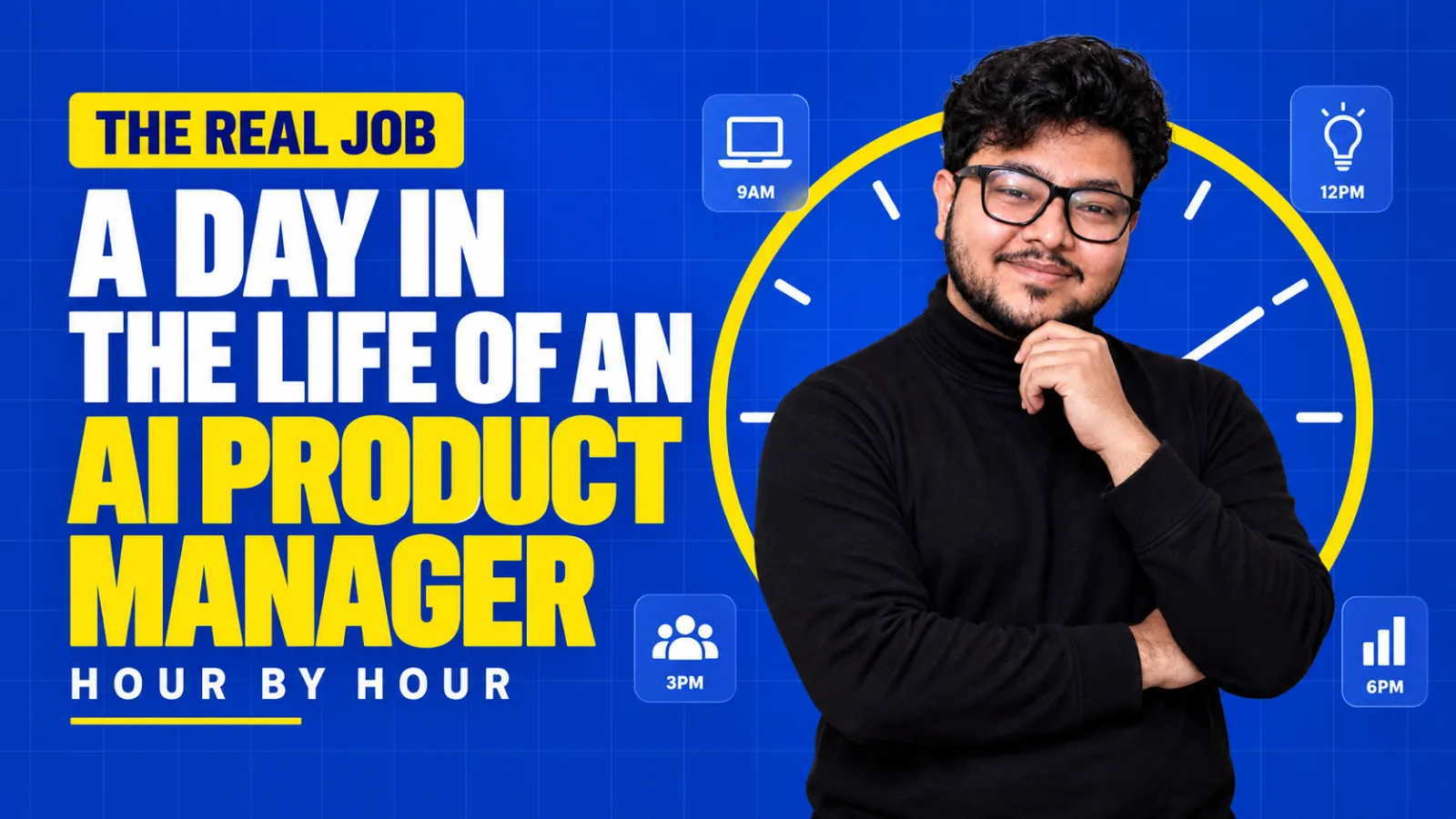
A day in the life of an AI product manager moves from understanding to deciding. Mornings go to product dashboards and AI quality signals, then working sessions with data scientists and engineers to diagnose problems. Midday covers design and engineering alignment and a quick check on market changes. Afternoons are for deep work: user feedback, PRDs, experiment plans, and decision notes. Late afternoon is stakeholder communication and trade-off negotiation. The day ends with a written record of what changed and what happens next. Most of it is reading and asking, then writing and deciding, not coding.
Key takeaways
- The main output of an AI PM is clearer product direction, not code.
- AI incidents are often silent. The app stays up while answers quietly get worse, so AI PMs read quality signals every day.
- Writing carries the job: PRDs, experiment plans, decision memos, and stakeholder updates that say what is ready and what is not.
- A productive day is measured by whether the product became clearer, not by the number of meetings attended.
What does an AI product manager do all day?
A day in the life of an AI product manager is less dramatic than the title suggests. An AI PM does not spend the day training models, testing every new AI tool, or making grand strategy calls from a glass office. The work is a practical mix of data, conversations, writing, user feedback, technical discussion, business context, and judgment.
Schedules differ between companies, but the rhythm is similar. The day starts with understanding what is happening, moves into discussions about what should change, and ends with clearer decisions. Throughout, the AI PM combines four kinds of information: product data, technical knowledge of the AI system, user evidence, and business context.
| Block | Focus | Output |
|---|---|---|
| Early morning | Dashboards, AI quality signals, incidents | Questions worth investigating |
| Mid morning | Data science and ML working session | A diagnosis and a chosen experiment |
| Late morning | Engineering and design alignment | Scope, rollout, and UX decisions |
| Midday | Market and model changes | A short "does this matter for us?" call |
| Afternoon | Deep work: feedback, PRDs, analysis | Documents that make decisions explicit |
| Late afternoon | Stakeholders and negotiation | Agreed trade-offs and honest commitments |
| End of day | Decision log and tomorrow's plan | A written record everyone shares |
AI product manager roles and responsibilities
Before walking through the hours, here is what those hours add up to. These ten responsibilities appear in most AI PM job descriptions, in one form or another.
- Choose the problem. Decide which user problem deserves investment and whether AI is the right tool for it.
- Define the experience. Specify how the AI should behave, where it stops, and what users see when it is unsure.
- Set the quality bar. Define what good output means and which failures are unacceptable.
- Own evaluation. Make sure the team tests on realistic and adversarial cases before and after launch.
- Watch production. Read product metrics and AI quality signals together, and catch silent failures.
- Prioritise. Choose which fix, experiment, or feature comes next, and what waits.
- Manage trade-offs. Balance quality, speed, cost, risk, and the scope of work with engineering and data teams.
- Write it down. PRDs, experiment plans, launch briefs, decision memos, post-launch reviews.
- Align stakeholders. Give leadership, sales, support, legal, and the security team the same truth at the right level of detail.
- Answer for outcomes. Connect the feature to adoption, retention, revenue, cost savings, or risk reduction.
The skills behind these responsibilities are mapped in the 22 AI PM skills. Now, here is how they fill an actual day.
A day in the life of an AI product manager, hour by hour
The schedule below is a composite example, not a real person's calendar. It follows an AI PM who owns an AI support assistant at a mid-size software company: the assistant answers customer questions from approved help content and hands off to human agents when needed. Times will differ everywhere. The kinds of work will not.
8:30 · Dashboards and AI quality signals
Before the first meeting, the AI PM reviews yesterday's numbers: questions asked, answers accepted, response time, conversations handed to humans, and customer satisfaction. Then the AI-specific layer. Were answers grounded in approved content? Did anyone report an unsupported answer? Did one type of request struggle? Did cost per conversation rise? Did the latest update slow anything down?
Usage went up. That alone proves nothing. Users may be asking follow-up questions because the first answer was unclear, or retrying because it failed. Today, the dashboard shows satisfaction dropping for billing questions specifically. That could be outdated documents, weak retrieval, confusing formatting, or a model poorly suited to account-specific cases. The AI PM writes it down as a question for the team, not a conclusion.
AI failures rarely look like outages. The app stays online while the assistant answers with old information, pulls the wrong source, shows data to the wrong user, sounds confident when it should ask a question, or routes simple requests to an expensive model. Catching these patterns early is a core part of the morning.
9:30 · Working session with data science and ML engineering
The conversation is technical, but its purpose is a product decision. The team finds the assistant handles short policy questions well and struggles with longer billing questions that depend on a customer's account. Possible causes: the evaluation set has too few billing cases, retrieval pulls general policy instead of billing rules, or the question needs live account data the system does not have.
The AI PM does not pretend to out-diagnose specialists. The job is to translate each possibility into user and business impact, then choose. If the real problem is poor source content, a new model achieves little. Options on the table: add billing cases to the eval set, test a retrieval fix, ask a clarifying question for account-specific requests, or narrow scope so billing questions go straight to humans until quality improves. Each option costs time and money, and affects experience quality differently. The team picks one experiment and one short-term safeguard. The eval approach behind this is in AI evals for Product Managers, and retrieval fixes are covered in RAG for Product Managers.
11:00 · Engineering and design alignment
"Improve billing answers" sounds simple. In practice it means a new prompt version, different source documents, new evaluation tests, a feature flag, and a rollback plan. The AI PM does not write the code but needs to understand how the change touches the whole product. Feature flags let the team release the change to a slice of traffic and switch it off instantly, a pattern Martin Fowler describes well in his article on feature toggles.
Design questions matter just as much, because trust depends on the experience as much as the model. Should every answer show its source? Should customers be able to say "this did not help" in one tap? Should the assistant ask a follow-up question before answering account questions? Should it confirm before taking any action? A strong system inside a confusing experience is still a weak product. Google's People + AI Guidebook is a common reference for these decisions.
Permissions can reshape the plan too. If the assistant could expose internal notes to customers, the right call might be launching with public help content only and adding private sources once access controls are proven.
12:30 · A quick scan of market and model changes
There is always a new model, benchmark, tool, or prediction. A disciplined AI PM asks one narrow question: does this change our product's quality, cost, risk, user expectations, or roadmap? Most announcements do not. A few do: a cheaper model that is good enough for simple questions, a competitor showing sources on every answer so customers now expect it, or new guidance on automated decisions. Notice those. Ignore the rest.
14:00 · Deep work: feedback, analysis, and the writing
The afternoon holds the most focused individual work. Dashboards show what users did. Feedback explains why. The AI PM reads support tickets, survey comments, and interview notes about the assistant and looks for patterns. One complaint may be unusual. The same complaint ten times is a product issue. Several customers cannot tell whether an answer came from company policy or general knowledge, which points to clearer citations. Agents keep rewriting the assistant's handoff summaries, which points to better structure or editing controls.
Then the writing. Today it is a PRD update for the billing experiment. For an AI feature, that document covers far more than screens: the user problem, workflow, data sources, expected AI behaviour, success measures, failure cases, evaluation method, fallback experience, launch limits, cost, and the risk profile. It answers practical questions before engineering hits them. What happens when the assistant does not know? Should it ask or decline? Can the customer verify what it says? Which cases always go to a person? How will the team know it is improving?
16:00 · Stakeholders and negotiation
Late afternoon is conversations with leadership, sales, customer success, legal, security, and the other product teams. Each needs a different depth of detail and the same underlying truth. Leadership needs to know what can launch and what risk remains. Sales needs to know what it can promise honestly. Support needs to know how to explain the assistant and when customers will need help. Security needs to understand the data and access involved.
Weak: "The model needs more work on billing."
Strong: "The assistant performs well on general policy questions but is not reliable yet for account-specific billing. This week, billing questions go straight to human agents. We are testing a retrieval fix behind a flag on a small share of traffic, and we will decide on wider rollout once billing answers clear the quality bar on our eval set."
Then negotiation. Sales wants billing answers for a big customer next week. Engineering is already stretched. Security wants another review before private data is connected. The AI PM cannot say yes to everyone. The job is to lay out the trade-off clearly enough that the organisation makes a responsible choice, not to win an argument.
17:30 · Decision log and tomorrow's plan
The day ends with a short written record: billing quality is weaker than general policy, a retrieval fix is being tested behind a flag, billing questions are routed to humans meanwhile, and feedback suggests answers are too long. That note stops people leaving the same meeting with different conclusions and builds a decision history the team will need later. Then a short list for tomorrow: interview questions for two customers, time blocked to finish the PRD, and one decision that still needs evidence. The day rarely ends with everything done. It ends with more clarity than it started with.
The documents an AI product manager writes
Product management is often described as meeting-heavy, but much of its value comes from written clarity.
| Document | What it does |
|---|---|
| PRD | Defines the problem, AI behaviour, quality bar, failure handling, metrics, and the launch scope |
| Experiment plan | States the hypothesis, control, treatment, metrics, guardrails, and the decision rule |
| Evaluation report | Shows test design, results by case type, failure categories, and a recommendation |
| Decision memo | Recommends one side of a trade-off with evidence and next steps |
| Launch brief | Explains what ships, to whom, with which limits and rollback conditions |
| Stakeholder update | Says what is ready, what is not, and how remaining risk is handled |
| Post-launch review | Compares results to expectations and records what the team learned |
If you want to practise the job before you have it, these documents are the best place to start. They also make excellent portfolio pieces, as explained in how to build an AI PM portfolio.
Startup vs large company: how the day changes
| Startup AI PM | Large company AI PM | |
|---|---|---|
| Scope | Broad: research, testing outputs, roadmap, launch messaging, customer issues | Narrower: one product area within a larger system |
| Specialists | Few, so you cover more roles yourself | Many, so you coordinate across more teams |
| Pace | Fast feedback loops, quick decisions | More reviews and approvals, and more documentation |
| Scale | Smaller user base, higher tolerance for experiments | Millions of users or big enterprise customers, higher stakes per change |
| Typical morning | A user interview before standup | A dashboard review before a cross-team sync |
How the day changes by product type
| Product type | Where the day's attention goes |
|---|---|
| Consumer writing or creative tools | Engagement, onboarding, output quality, how often users edit results |
| Healthcare AI | Accuracy, safety, compliance, human review, clinician trust |
| Developer tools | APIs, latency, documentation, correctness, technical users |
| Enterprise AI | Permissions, data access, workflow integration, adoption, training |
| Agentic products | Autonomy limits, approval points, tool failures, traces, cost per task |
These differences line up with the different types of AI PM roles, described in the 5 types of AI Product Managers. Agent-heavy days are covered in AI agents for Product Managers.
Do AI product managers code?
Most do not code as a core part of the job. Some build quick prototypes, write SQL, or analyse data directly, and those abilities help. But the main output of an AI PM is clearer product direction, not software. The day is spent reading, listening, asking questions, writing and prioritising, explaining, and at the end deciding.
That makes the role a poor fit for someone who wants to program all day, and an uncomfortable one for someone who wants to discuss strategy without understanding technical detail. AI product management sits between those worlds. You need to be comfortable with dashboards and people, AI systems and user needs, business outcomes and responsible behaviour.
The hard parts and the rewarding parts
What makes the job intense
The AI PM often stands in the middle of uncertainty. The model is useful but inconsistent. Users do not fully trust it yet. Leadership wants a faster release while engineers need more time. Legal flags a concern. A competitor ships something. The data shows good and bad signals at once. The job is to create direction without pretending certainty exists, and the acceptable level of uncertainty depends on the product: a weak brainstorming idea is easy to ignore, a wrong financial recommendation can hurt someone.
What makes it worth it
You see uncertain ideas become useful workflows. You stop teams from building shallow AI features. You improve products through evidence and testing rather than opinion. And the work can help people save time, understand information, finish difficult tasks, or make better decisions. It is also well paid, with average US AI PM pay reported near $197,500 in 2026. Level-by-level figures are in AI PM salary in 2026.
What a productive day in the life of an AI product manager looks like
Measure the day by clarity, not by meetings attended. At the end of a good day, you can answer yes to several of these.
- Does the team understand the user problem more deeply than this morning?
- Did the data reveal an issue worth solving?
- Did evaluation show where the system fails?
- Did user feedback change the direction?
- Did the requirements become more precise?
- Do stakeholders understand the remaining trade-offs?
- Does the team know exactly what to do next?
Some days produce clear progress. Others reveal new uncertainty: a model performs worse than expected, a release slips because a risk appears, users reject an idea that looked strong internally. That is normal. The job is not eliminating uncertainty. It is managing it carefully enough to keep making responsible progress.
Is the AI product manager job right for you?
| You will probably enjoy it if you | You may struggle if you |
|---|---|
| Like turning messy information into a clear decision | Want to write code most of the day |
| Enjoy writing and explaining complicated ideas simply | Dislike documents and long written reasoning |
| Are curious about how AI systems fail, not only how they impress | Want strategy work without technical detail |
| Can hold several perspectives and still recommend one path | Need certainty before acting |
| Care about users and business results equally | Care about only one of the two |
Try the job this week
You do not need the title to practise the day. Pick an AI product you use and run a mini version of each block.
- Morning: Use the product for ten real tasks and log where answers were weak, slow, or unclear.
- Diagnosis: For each weak answer, guess the likely cause: missing context, retrieval, instructions, or model fit.
- Design: Sketch one change that would make users trust it more.
- Deep work: Read 30 public reviews of the product and group the complaints.
- Writing: Write a one-page PRD for a fix, including failure cases and a quality bar.
- Stakeholders: Write the "strong update" version: what is ready, what is not, and how the risk is handled.
If you enjoyed that, the full path is in how to become an AI Product Manager. If you want to understand how the role differs from general product work, read AI Product Manager vs Product Manager. The book's Chapter 12 walks through the full day in more depth.
Questions & answers
8 questions readers ask most, answered straight.
What does an AI product manager do on a daily basis?
An AI product manager reviews product metrics and AI quality signals, works with data scientists and engineers to diagnose issues and choose experiments, aligns design and engineering on scope and rollout, writes PRDs and decision notes, reviews user feedback, and communicates trade-offs to stakeholders. The day ends with a written record of decisions and next steps.
What are the main responsibilities of an AI product manager?
The core responsibilities are choosing which problems deserve AI, defining how the AI should behave, setting the quality bar, owning evaluation, monitoring production, prioritising work, managing quality and cost trade-offs, writing clear documents, aligning stakeholders, and answering for business outcomes.
Do AI product managers code?
Most do not code as a core responsibility. Some write SQL, build quick prototypes, or analyse data themselves, which helps. Their main output is clear product direction: decisions about the problem, the AI behaviour, quality, risk, and the priorities, communicated in writing and conversation.
How many meetings does an AI product manager have?
It varies widely by company. Larger companies usually involve more meetings, reviews, and the approvals that go with them, while startups have fewer meetings and broader hands-on work. Strong AI PMs protect focused time for writing, feedback analysis, and evaluation review because much of their value comes from written clarity.
What is the hardest part of being an AI product manager?
Working through uncertainty. Models can be useful yet inconsistent, users may not trust them yet, and leadership, engineering, legal, and the sales team often want different things. The AI PM has to create clear direction and honest commitments without pretending the uncertainty does not exist.
How is an AI product manager's day different from a regular product manager's?
The structure is similar, but an AI PM also reviews AI quality signals, investigates silent failures such as unsupported answers, works closely with data science and ML teams, designs for uncertainty and user trust, and manages inference cost alongside product metrics.
Is being an AI product manager stressful?
It can be intense because the role sits between users, technology, business pressure, and risk, often with incomplete information. People who enjoy structured decision-making, writing, and a lot of learning usually find it rewarding, especially when careful evaluation and clear communication keep the uncertainty manageable.
Do AI product managers work remotely?
Many AI PM roles are hybrid or remote, depending on the company. Remote roles place extra weight on written communication, because updates, PRDs, and the decision logs carry more of the collaboration.
Where this comes from
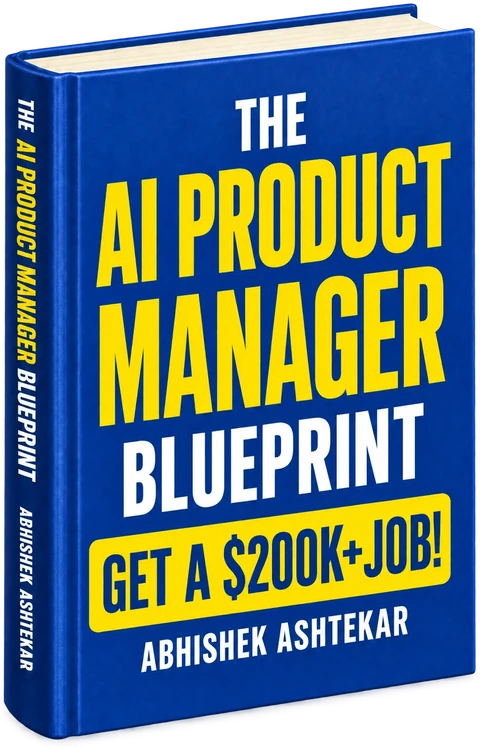
This guide is condensed from chapters 3 and 12 of The AI Product Manager Blueprint by Abhishek Ashtekar (first edition, 2026). The book goes several levels deeper, with the full walkthroughs, templates, and examples.
External sources cited
- People + AI Guidebook, Google PAIRDesign patterns for trust, feedback, and the handling of errors in AI products.
- Feature Toggles (aka Feature Flags), Martin FowlerHow teams release changes safely to part of their traffic.
- Your AI Product Needs Evals, Hamel HusainWhy AI teams review quality continuously, not only at launch.
- AI Risk Management Framework, NISTReference for the risk conversations in the stakeholder block.
Last reviewed September 16, 2026. Tools, platforms, and salary data change; the book’s free resources page is updated as they move.
Browse all 88 chapters
This guide is the trailer.
The book is the whole system.
Everything this guide compresses, in full. The chapters, the skills, the portfolio projects, and the week by week roadmap that takes you from zero to hired.
- 88Chapters
- 22Skills
- 5Projects
- 1Roadmap