The best AI product management certification depends on where you start. Complete beginners should take the IBM AI Product Manager Professional Certificate on Coursera, because it teaches product management and AI together. PMs who get lost in machine learning conversations should take Duke's AI Product Management Specialization. Working PMs who want RAG, agents, and evals should look at Product School or Product Faculty. Pick one, build a project from it, and skip the second certificate.
Key takeaways
- IBM is the strongest first certificate for career switchers. It covers both halves of the job in one sequence.
- Duke builds machine learning judgment. Product School and Product Faculty cover the LLM, RAG, and agent work that 2026 roles ask about.
- Your background decides the pick. A certificate that repeats what you already know is wasted money.
- The badge gets one line on a resume. The project you build during the course gets you through the interview.
How I ranked the best AI product management certifications
Search for the best AI product management certification and you get two kinds of results. Some are classic product management courses with a generative AI module bolted onto the end. Others assume you already run a product team and jump straight into retrieval pipelines and agent design. Both can be good. Neither is good for everyone.
So I didn't rank these programmes by brand or price. I opened each current curriculum and asked five questions. Does it teach product decisions, or only AI vocabulary? Does it cover the parts of AI work that change a PM's day, such as evaluation, data quality, and failure handling? Does it give you something to build? Is it honest about the background it expects? And does the format fit how people learn, whether that's self-paced video or a live cohort with deadlines?
The ranking below reflects those answers for a typical reader of this site: someone moving into AI product management from another role. If you already hold a PM title, jump to the background table, because your first pick is different. And if you're still deciding whether this career is right for you at all, read the complete AI PM roadmap before you spend anything.
Top AI product management certifications at a glance
| Certification | Provider | Format | Best for |
|---|---|---|---|
| AI Product Manager Professional Certificate | IBM on Coursera | Self-paced | Career switchers new to PM and AI |
| AI Product Management Specialization | Duke University on Coursera | Self-paced | PMs who need machine learning judgment |
| AI Product Management Certification | Product School | Live online | Working PMs moving onto AI features |
| AI Product Management Certification | Product Faculty on Maven | Live cohort | PMs who want to build with agents and RAG |
| AI Product Manager Nanodegree | Udacity | Self-paced with projects | Learners who want graded project work |
| AI Product Management 101 & Certification | Dr. Marily Nika on Maven | Live workshop | Hands-on learners who like building in public |
| AI Product Management Expert Certification | Pragmatic Institute | Instructor-led | PMs who want AI inside a proven framework |
| AI Product Manager Professional Certificate | Microsoft on Coursera | Self-paced | Beginners whose biggest gap is PM itself |
| Building AI Experiences in Your Product | Mind the Product | Live class | PMs about to ship an AI feature to users |
| AI for Product Management Course | Pendo | Self-paced | A short first look before a bigger commitment |
Course pages change often. Before you pay, confirm the syllabus, who teaches it, the project work, the access period, and the refund terms on the provider's own page.
1. IBM AI Product Manager Professional Certificate (Coursera)
If you're starting from zero, the IBM AI Product Manager Professional Certificate is where I'd send you first. It doesn't assume you know either side of the job. The ten-course sequence teaches everyday product work, like client management, Agile delivery, roadmaps, and the product lifecycle, then connects it to machine learning, generative AI, prompt engineering, AI strategy, responsible AI, and AI agents.
- Product management fundamentals and the product lifecycle
- Agile and adaptive product development
- Product planning and roadmapping
- AI and machine learning fundamentals
- Generative AI, prompt engineering, and agents
- AI product strategy and responsible AI
That breadth is the reason it sits at number one. You don't have to stitch together a general PM course, an intro to AI, and a separate generative AI course before anything clicks. Coursera's subscription model also keeps the cost far below a live bootcamp, and financial aid is available on many programmes.
The trade-off is depth. A broad beginner programme can't go as far into evaluation design, retrieval systems, or agent architecture as the specialist options further down. Skip it if you already work as a PM and understand AI basics. You'll spend weeks on material you know.
2. Duke University AI Product Management Specialization
Duke's AI Product Management Specialization takes a different route. Instead of opening with generative AI tools, it teaches you to think about machine learning the way a product manager has to. You learn which problems suit ML, how the data science process runs, how models get trained and evaluated, and what changes when a model moves into production.
- How machine learning works at a PM level
- Spotting problems that suit ML, and the ones that don't
- Data quality and data management
- Managing an ML project through to deployment
- Human-centred AI design and privacy
It includes three applied projects, and Coursera states that no programming is required. That makes it one of the few serious technical programmes open to a non-engineer.
Pick Duke over IBM when you already understand product basics and keep getting lost in conversations with data scientists. A normal software feature does the same thing every time. A model makes predictions, and it can score well on a test set and then slip when user behaviour shifts. Duke gives you the mental model for that uncertainty. It spends less time on the newest LLM and agent patterns, and I don't count that against it. Once ML fundamentals click, the newer concepts get much easier to reason about.
3. Product School AI Product Management Certification
For a working PM who wants a course about how AI changes the job, the Product School AI Product Management Certification is one of the most current options available. The curriculum covers AI-specific PRDs, RAG architecture, embeddings and vector stores at a PM level, prompting, AI user experience, agentic systems and evaluation, plus guardrails.
It also tackles the trade-offs that make an AI PRD different from a normal one: cost against latency, and how you evaluate outputs that change from run to run. Those are the questions that come up in real AI roadmap meetings.
- Evaluating AI product opportunities
- Writing an AI-specific PRD
- RAG, embeddings, and retrieval for PMs
- Agentic systems and multi-step workflows
- Evaluations, guardrails, and AI quality
There's a distinction worth holding onto here. Using AI as a PM, say to summarise research faster, is a different skill from managing an AI product. The second one means deciding what counts as a good answer, what happens when the model is wrong, and when a person must step in. Product School teaches the second skill. Product School itself says the certification suits people who already know product workflows, so skip it if you've never done PM work.
4. Product Faculty AI Product Management Certification
The Product Faculty AI Product Management Certification on Maven is the programme I'd look at if my goal were to get comfortable building modern AI products, not just describing them. Its 2026 curriculum covers agentic AI, multi-agent systems, RAG, context engineering, evaluations, AI product metrics, and current AI building tools, and it ends with a capstone where you build an AI product. Maven lists no prior AI or coding experience as a requirement.
- How modern AI products are structured
- Agents, multi-agent systems, and context engineering
- AI evaluations and product metrics
- Rapid prototyping with current tools
- A capstone that turns an idea into a working product
This is a builder's programme, not an introduction to product management. You can learn what an agent is from a blog post. Deciding which tools an agent may touch, what context it receives, how you recover from a failed action, and where a human keeps control only makes sense once you build one. Our guide to AI agents for product managers covers that ground if you want a preview first.
Live cohorts cost more than self-paced certificates. Pay for this one when you already know PM basics and will attend every session with a project to push forward.
5. Udacity AI Product Manager Nanodegree
The Udacity AI Product Manager Nanodegree has been around for years, and Udacity refreshed it on January 27, 2026. The current version covers AI integration, custom datasets, generative AI strategy, requirements, roadmaps, LLM product strategy, model bias, conversational AI, NLP concepts, and model performance metrics.
- Scoping an AI product and writing its requirements
- Dataset design and data annotation
- Model performance and evaluation, plus bias
- Conversational AI and LLM product strategy
- Several hands-on projects
Projects are the reason it makes this list. A certificate proves you finished something. A project gives you a story to tell when an interviewer asks how you'd define a dataset, handle a weak model, or decide whether AI belongs in the product at all.
Udacity rates the programme intermediate and expects basic product management plus descriptive statistics before you start. Check those prerequisites honestly. If they sound unfamiliar, take IBM or Microsoft first.
6. AI Product Management 101 by Dr. Marily Nika
AI Product Management 101 & Certification by Dr. Marily Nika is the most practitioner-led option here. Maven lists Dr. Nika as a GenAI product builder at Google and a former Meta product leader, and she also wrote Building AI-Powered Products, which appears in our list of the best books for AI product managers.
The workshop moves through LLM basics for PMs, user research, ideation with tools such as Perplexity and Gemini, prototyping with Claude, AI evaluations, and a product demo at the end.
- LLM concepts and AI PM fundamentals
- AI-assisted discovery and user research
- Rapid prototyping and artifact creation
- Evaluations for AI products
- Presenting and defending an AI product
Choose it if you learn by making things and talking through your decisions with other people. It suits the person who reads plenty about AI but can't yet turn a user problem into a hypothesis, a prototype, an evaluation plan, and a demo. The course forces you to connect those pieces.
7. Pragmatic Institute AI Product Management Expert Certification
The Pragmatic Institute AI Product Management Expert Certification combines three areas: product foundations, using AI inside your own PM work, and deciding how AI should fit into the product you manage.
That split matters more than it sounds. You might use an AI agent to organise customer research while managing a product with no AI in it at all. Or your customers might talk to an AI feature directly, which raises harder questions about trust, autonomy, privacy, and how to measure it. Pragmatic keeps "AI for product managers" and "AI in your product" separate, and most courses blur them.
- AI-assisted discovery, competitor research, and hypotheses
- Prioritisation and faster prototyping with AI
- Finding sensible AI opportunities inside a product
- Organisational readiness for an AI feature
- Trust, transparency, and how much autonomy to allow
It's a strong fit if your company already uses the Pragmatic framework, or if you want AI added to a structured method rather than learned from scratch.
8. Microsoft AI Product Manager Professional Certificate (Coursera)
The Microsoft AI Product Manager Professional Certificate on Coursera is the other strong beginner pick, but I'd position it differently from IBM. Its five-course curriculum spends most of its time on the product manager role itself: market research, competitive analysis, strategy, roadmaps, UX and UI, launches, quality, and the product lifecycle. AI product strategy and responsible AI sit inside that bigger picture.
- Product management fundamentals
- Market research and competitive analysis
- Product strategy and roadmaps
- UX and UI concepts
- AI product strategy and responsible AI
Choose Microsoft when your biggest gap is product management, not AI. An AI PM still has to understand users, markets, priorities, and the requirements, and advanced AI vocabulary won't cover for missing fundamentals. If you're already a working PM chasing RAG and evals, Product School or Product Faculty is the closer match.
9. Mind the Product: Building AI Experiences in Your Product
Building AI Experiences in Your Product from Mind the Product is narrower than a full certification, and that's its strength. The class asks one question: how do you design and ship an AI experience people can use and trust?
The curriculum covers spotting AI opportunities, AI UX patterns, how LLM behaviour shapes design, guardrails, communicating uncertainty, cross-functional delivery, and measuring trust after launch.
Think about what changes when a search results page becomes a generated answer. Should you show sources? What happens when confidence is low? Can the AI take an action on its own, or should the user approve it first? What does the screen say when the model can't answer? Those are product questions, and this class spends its whole length on them. Take it when you already know PM basics and have an AI feature coming up on your roadmap.
10. Pendo AI for Product Management Course
Pendo's AI for Product Management Course is the compact option on this list. Pendo built it with Google Cloud and Mind the Product, and it covers AI use cases for product teams, using AI across the development lifecycle, and the principles behind AI features in software products.
I wouldn't use Pendo as a full career transition plan. Use it as a quick first look before committing to IBM, Duke, or a live cohort, or as a refresher for an experienced PM who hasn't touched AI yet and wants to see which gaps are worth a bigger course.
Which AI product manager certification fits your background
The best AI product management certification for you is the one that closes your real gap. Match your starting point to a first pick, then add a second programme only if the first leaves a clear hole.
| Your starting point | First pick | Add later if needed |
|---|---|---|
| New to both PM and AI | IBM AI Product Manager | Duke for ML depth |
| New to PM, comfortable with AI | Microsoft AI Product Manager | Product School once you've shipped something |
| Working PM, weak on ML | Duke AI Product Management | Product School for LLM work |
| Working PM moving onto LLM features | Product School or Product Faculty | Mind the Product for AI UX |
| Engineer or data scientist moving into PM | Product Ideation, Design & Management (University of Maryland) | Pragmatic Institute or Product School |
| Unsure the field is for you | Pendo plus AI for Everyone | IBM once you commit |
Two notes on that table. Engineers usually don't need another technical course. Their gap is discovery and product judgment, so a pure PM programme like Maryland's specialization, or the IBM Product Manager Professional Certificate, fixes more than an AI course would. And if AI vocabulary still feels foreign, Andrew Ng's AI for Everyone is a short, non-technical warm-up that makes every certification above easier to follow.
If you'd like to see the full free and paid learning stack, including SQL and product analytics, the AI PM courses guide maps it month by month.
Is an AI product management certification worth it?
Yes, when it produces evidence. No, when it replaces evidence.
Think of proof in three layers. Learning proof shows you studied. Thinking proof shows how you frame a problem and make a call. Building proof shows you turned that call into a prototype, an evaluation, or an experiment. A certificate delivers the first layer. Hiring managers test the other two, which is why a candidate with one certificate and three strong case studies beats a candidate with five certificates and none.
So judge any programme by what you'll be able to show when it ends. Duke's applied projects, Udacity's project work, Product School's AI specifications, and Product Faculty's capstone all give you raw material. Push that material past the minimum and it becomes a portfolio piece. Our list of five AI PM portfolio projects shows what "past the minimum" looks like.
Finish one programme properly before you buy another. Five beginner certificates repeat the same definitions, and none of them adds a line an interviewer will ask about.
How to get full value from any AI PM certification
Most people treat an AI product management certification online like a playlist. They finish the videos, download the badge, and stop. The ones who get hired treat every module as a prompt to make something.
- Pick a product before you start. Choose one real workflow, like support tickets or interview prep, and apply every module to it.
- Write while you learn. After the RAG module, draft a one-page retrieval plan. After the evaluation module, build a 50-case test set. Our RAG guide and AI evals guide give you templates for both.
- Push assignments past the minimum. Add metrics, failure cases, and a cost estimate the course didn't ask for.
- Publish the result. A short case study on LinkedIn or your portfolio turns private learning into public proof.
- List it correctly. Put the certificate under Certifications, and put the project under Projects with a result. The AI PM resume guide shows the format.
Do this and one self-paced certificate becomes three or four portfolio pieces. Skip it and even the most expensive cohort becomes a line on a resume that nobody asks about.
Pair your certification with a role-specific book
Courses give you an order to follow. The trouble comes months later. You need to rework an AI PRD, prepare an interview answer about retrieval, pick a portfolio project, or rewrite your resume, and the course videos aren't built for looking things up.
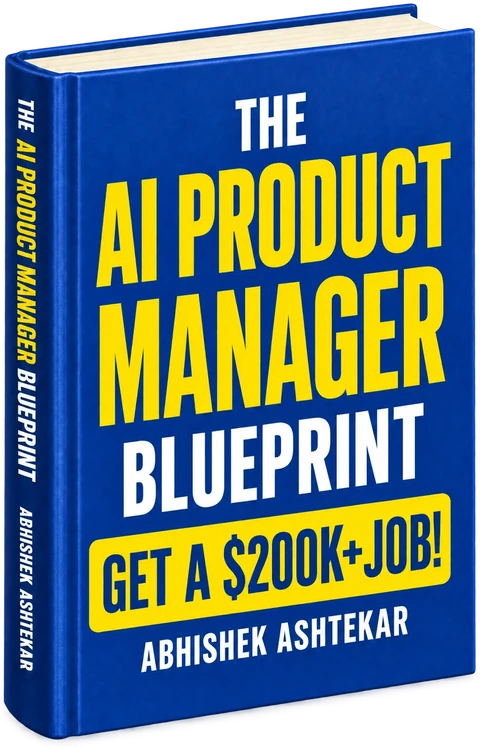
That's the gap The AI Product Manager Blueprint fills. Its 88 chapters cover the role, the 22 core skills, AI and ML fundamentals, LLMs, RAG, agents, evaluation, five portfolio projects, resumes, job search, and interviews. Chapter 20 ranks the courses worth your time and the order to take them in.
Use the two together. Take IBM if you need a structured start, Duke for ML depth, or Product School and Product Faculty for current AI product work. Keep the book beside that path as the reference that connects the lessons to projects, applications, and job offers.
Questions & answers
10 questions readers ask most, answered straight.
What is the best AI product management certification for beginners?
The IBM AI Product Manager Professional Certificate on Coursera. It teaches product management and AI together, so you don't need to know either one first. Microsoft's AI Product Manager certificate is the alternative if your bigger gap is product management itself.
Which is better, the IBM or the Duke AI product management certification?
Choose IBM if you're new to both product management and AI. Choose Duke if you already understand product work and want a stronger grip on machine learning, data quality, and model evaluation. IBM is broader. Duke goes deeper into how ML products behave.
Is an AI product management certification enough to get a job?
No. A certificate supports a career change, but interviews test product judgment, AI trade-offs, and evidence. Pair one certification with two or three portfolio projects, a tailored resume, and interview practice. That combination gets offers.
Do I need coding skills for an AI product management certification?
No. Duke states that no programming is required, and Product Faculty lists no prior coding or AI experience. You do need technical literacy: models, data, prompts, retrieval, evaluation, latency, and the cost of running it, at the level needed to make product decisions with engineers.
How much does an AI product management certification cost at Product School, on Maven, or on Coursera?
Self-paced Coursera programmes from IBM, Duke, and Microsoft run on a monthly subscription, and financial aid is available on many of them. Live cohorts from Product School, Product Faculty, and Maven instructors cost much more. Check the provider's page for current local pricing before you enrol.
Is there a free AI product management certification?
Not a full one from a major provider. The closest route is Coursera: IBM, Duke, and Microsoft all run there, and Coursera offers financial aid on many programmes, which can cover the whole fee if you're approved. Pendo's short course and Andrew Ng's AI for Everyone are lighter first steps before you commit to a full programme.
Which AI product manager certification on Coursera is best?
IBM's AI Product Manager Professional Certificate for complete beginners, Duke's AI Product Management Specialization for machine learning depth, and Microsoft's AI Product Manager Professional Certificate if your bigger gap is product management itself. Take one of the three, not all of them.
How long does an AI product management certification take?
Self-paced certificates usually take a few months part time, depending on your weekly hours. Live cohorts run on fixed schedules of several weeks. Plan your project work into that time rather than after it.
Are AI product management certifications worth it for experienced PMs?
Only the advanced ones. Skip beginner programmes that re-teach roadmaps and user stories. Product School, Product Faculty, and Mind the Product focus on RAG, agents, evaluation, and AI UX, which is where an experienced PM's gap sits.
Should I take a certification or build AI projects first?
Learn enough to make sensible decisions, then start building while you study. Don't finish course after course before creating anything. After each module, apply the concept to one project, document the decision, and move on.
Where this comes from
This guide is condensed from chapters 20 and 45 of The AI Product Manager Blueprint by Abhishek Ashtekar (first edition, 2026). The book goes several levels deeper, with the full walkthroughs, templates, and examples.
External sources cited
- IBM AI Product Manager Professional Certificate, CourseraTen-course beginner curriculum covering PM and generative AI.
- AI Product Management Specialization, Duke University on CourseraML foundations with three applied projects and no programming requirement.
- Microsoft AI Product Manager Professional Certificate, CourseraFive-course programme centred on the PM role.
- AI Product Management Certification, Product SchoolCurriculum covering AI PRDs, RAG, agents, and evaluation.
- AI Product Manager Nanodegree, UdacityIntermediate, project-based programme updated in 2026.
Last reviewed September 17, 2026. Tools, platforms, and salary data change; the book’s free resources page is updated as they move.
Browse all 88 chapters
This guide is the trailer.
The book is the whole system.
Everything this guide compresses, in full. The chapters, the skills, the portfolio projects, and the week by week roadmap that takes you from zero to hired.
- 88Chapters
- 22Skills
- 5Projects
- 1Roadmap